South Korea wants a cybersecurity czar. President Lee Jae Myung said so at a Cabinet meeting in Seoul on Tuesday, November 3, according to CoinDesk. He asked officials to consider a single, powerful body to run security across government and private business. No timetable has been announced.
What the cybersecurity czar would do
Lee told officials to “proactively consider the formation of a cybersecurity czar agency,” per JoongAng Daily. He called it a control tower for security that is now scattered across agencies. He also said the current approach is weak. In his words, per CoinDesk: “The existing security system, which centers on inspections and after-the-fact responses, is showing clear limitations.”
He added that AI is making cybercriminals more sophisticated. He wants threats spotted earlier and information shared faster. This is a review, not a law. Nothing has been created yet.
How the Binance hack fits in
CoinDesk links the proposal to the October 29 theft of about $6.3 billion from Binance. The FBI attributed that theft to North Korea’s TraderTraitor group, and Pyongyang denies it. Lee did not name North Korea, CoinDesk notes.
However, the sources do not agree on the trigger. Some outlets, such as Seoul Economic Daily, tie the order to a run of breaches at domestic firms. So the Binance link is how CoinDesk reports it, and not something the president is quoted saying. We treat it as one cause among several.
Inspections under way before the cybersecurity czar
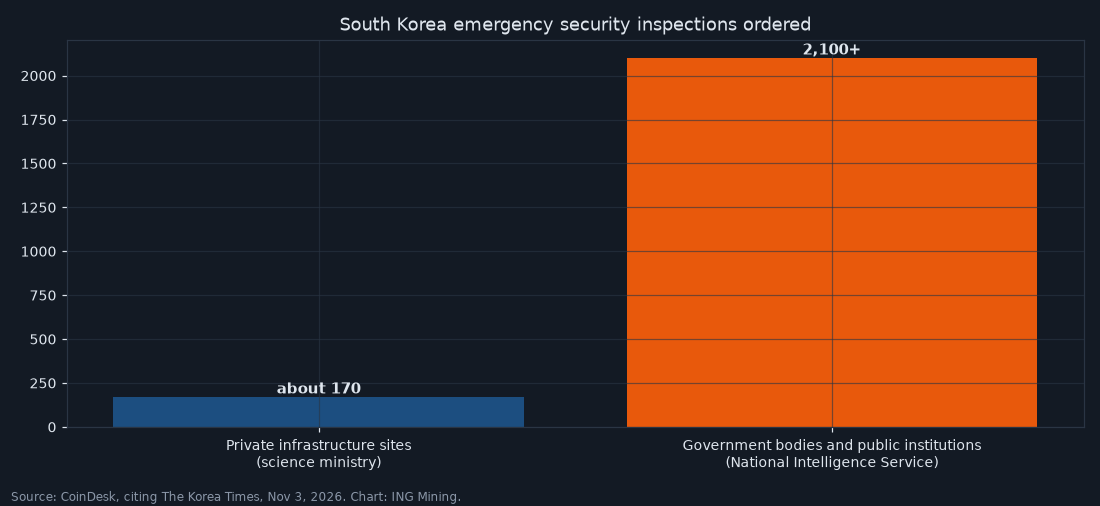
The government has not waited. The National Intelligence Service has ordered security checks at more than 2,100 government bodies and public institutions. The science ministry is inspecting about 170 major private facilities, including financial and telecom firms. Both figures come from The Korea Times, as cited by CoinDesk.
What a South Korea cybersecurity czar means for miners
Nothing changes for your hashrate today. Still, the direction matters. Governments are moving from fines after a breach to central oversight before one. Exchanges are the target. Self-custody mining payouts are not. That is why we point miners at their own wallet and not an exchange account.
Miner math: where your margin stands while regulators react
Here is the live maths on November 3. Bitcoin is $77,497 and the network is 1024 EH/s, so hashprice is about $34.26 per petahash per day. That is what one PH/s of hashing earns before power.
| Machine | 5c/kWh | 8c/kWh | 12c/kWh | Break-even |
|---|---|---|---|---|
| Antminer S19 (95 TH/s, 3250 W) | -$0.65 | -$2.99 | -$6.11 | 4.2c |
| Antminer S19k Pro (115 TH/s, 2645 W) | $0.77 | -$1.14 | -$3.68 | 6.2c |
| Antminer S19 XP (141 TH/s, 3010 W) | $1.22 | -$0.95 | -$3.84 | 6.7c |
| Antminer S21 Pro (234 TH/s, 3510 W) | $3.80 | $1.28 | -$2.09 | 9.5c |
Numbers are profit per day after electricity, at the three power prices shown. Break-even is the most you can pay per kilowatt-hour before the machine loses money. Specs are the manufacturer ratings; network data comes from mempool.space. Try your own power price in our free bitcoin mining profit calculator. See what these machines really sold for in our used ASIC miner price index. Want to run the same numbers on a machine you can buy today? See our used ASIC miners, or buy several at once through bulk lots.
If more exchange-security fear pushes bitcoin down 5%: the break-even power price on an S19k Pro falls from 6.2 to 5.9 cents per kilowatt-hour. At 8 cents, daily profit goes from -$1.14 to -$1.34.
The only channel to your margin is price, and fear moves price. If the table shows a loss at your power rate, read our mining economics guides or see our we buy used miners page. Our Bitcoin price prediction page shows the ranges we expect.
-Nick
ING Mining
This is general information, not financial advice. Crypto is volatile, and exchanges can fail. Please do your own research.
How this story was made: drafted with the help of AI tools from public sources, then edited by Nick Squires. See our editorial policy. Spot an error? Email ns@ingmining.com.