
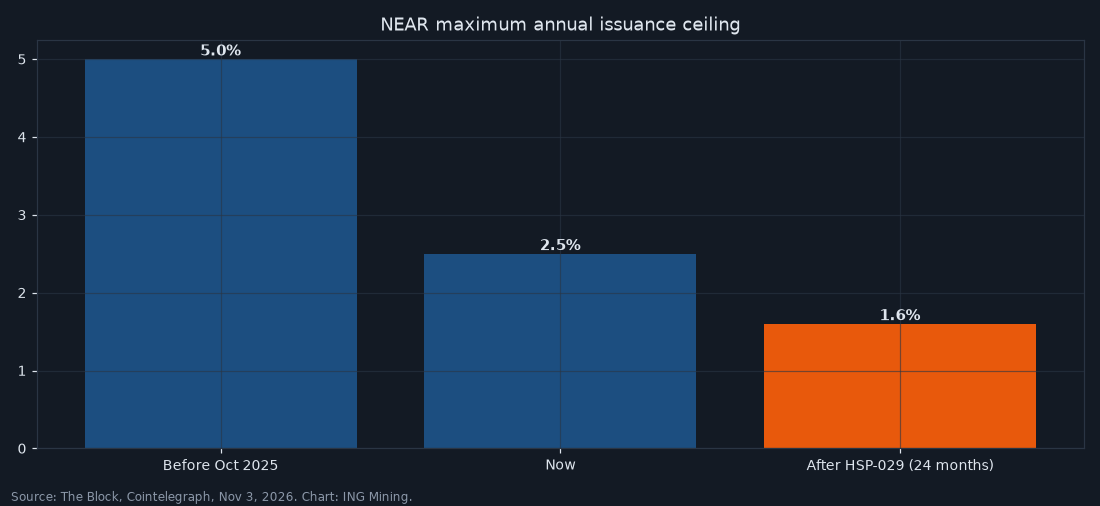
NEAR token issuance is about to shrink. NEAR holders approved proposal HSP-029 on Monday, November 2. It cuts the maximum annual issuance rate from 2.5% to 1.6%, according to The Block and Cointelegraph. The token still fell about 7% on Tuesday.
What the NEAR token issuance vote changed
The ceiling falls in a straight line over 24 months, about 3.75 basis points a month, per The Block. The 90/10 split of new tokens between stakers and the treasury does not change. Cointelegraph reports 99.9% of participating voting power backed the proposal, with about 3.28 million veNEAR cast in favour. The Block says only that it passed with “overwhelming support.”
The numbers both outlets give agree. Issuance is 11.8 million NEAR lower over two years and 66.1 million lower over six. Gross staking yield is projected to drop from about 5.2% to about 3.3%. The Block adds that daily issuance falls from roughly 89,500 NEAR to roughly 57,300 at full effect.
It is not final yet
The vote does not change the code on its own. Cointelegraph says the Security Council has a 14-day veto window. After ratification there is a 90-day grace period. Validators must then adopt a protocol upgrade. So nothing changes on-chain for months. NEAR made a similar cut from 5% to 2.5% in October 2025, The Block notes.
Why the price fell anyway
Neither outlet gives a cause. Cointelegraph reports NEAR near $3.82, down about 7% on the day and about 13% on the week. We will not guess why. A supply cut that is slow and already announced is not a surprise, and markets were weak on Tuesday. Bitcoin has had a hard week too, as our report on bitcoin below $77,000 shows.
What a lower issuance ceiling means for bitcoin miners
This is the same idea as the bitcoin halving: pay the people who secure the network less over time. Bitcoin does it on a fixed schedule, and the next halving is due in 2028. NEAR did it by vote. We take one lesson from that. A schedule you can verify is worth more than a promise.
Miner math: your margin while altcoin supply news plays out
Here is the live maths on November 3. Bitcoin is $77,524 and the network is 1024 EH/s, so hashprice is about $34.27 per petahash per day. That is what one PH/s of hashing earns before power.
| Machine | 5c/kWh | 8c/kWh | 12c/kWh | Break-even |
|---|---|---|---|---|
| Antminer S19 (95 TH/s, 3250 W) | -$0.64 | -$2.98 | -$6.10 | 4.2c |
| Antminer S19k Pro (115 TH/s, 2645 W) | $0.77 | -$1.14 | -$3.68 | 6.2c |
| Antminer S19 XP (141 TH/s, 3010 W) | $1.22 | -$0.95 | -$3.84 | 6.7c |
| Antminer S21 Pro (234 TH/s, 3510 W) | $3.81 | $1.28 | -$2.09 | 9.5c |
Numbers are profit per day after electricity, at the three power prices shown. Break-even is the most you can pay per kilowatt-hour before the machine loses money. Specs are the manufacturer ratings; network data comes from mempool.space. Try your own power price in our free bitcoin mining profit calculator. See what these machines really sold for in our used ASIC miner price index. Want to run the same numbers on a machine you can buy today? See our used ASIC miners, or buy several at once through bulk lots.
If bitcoin slips another 5%: the break-even power price on an S19k Pro falls from 6.2 to 5.9 cents per kilowatt-hour. At 8 cents, daily profit goes from -$1.14 to -$1.33.
NEAR is a proof-of-stake coin, so none of your ASICs mine it. The vote changes nothing for hashprice today. It does show how fast issuance rules are being tightened across crypto. If the table above shows a loss at your power price, see our we buy used miners page, or browse the mining economics guides.
-Nick
ING Mining
This is general information, not financial advice. Crypto is volatile, and exchanges can fail. Please do your own research.
How this story was made: drafted with the help of AI tools from public sources, then edited by Nick Squires. See our editorial policy. Spot an error? Email ns@ingmining.com.