
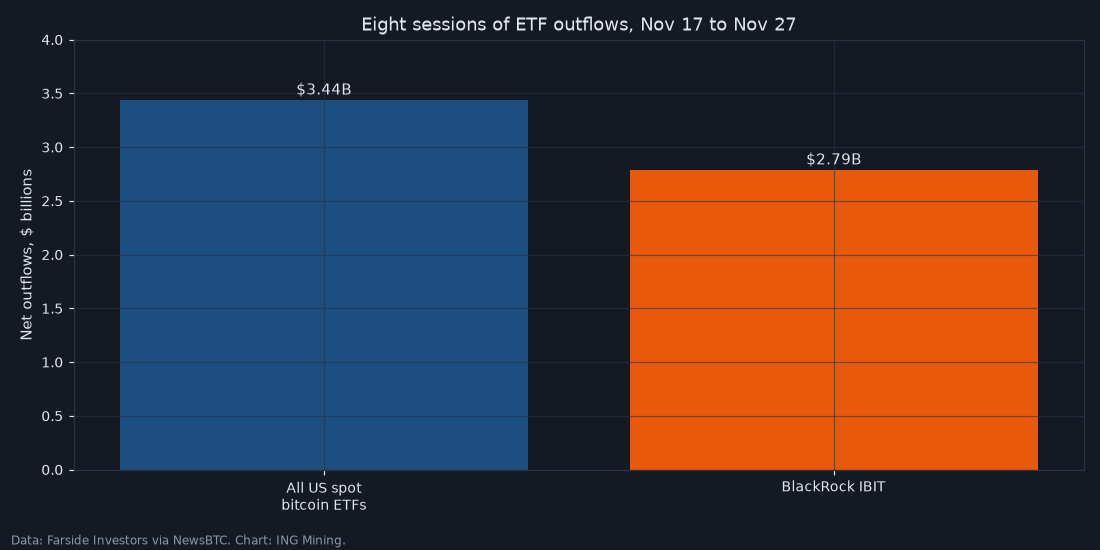
IBIT outflows reached nearly $2.8 billion over eight straight sessions, according to NewsBTC, using Farside Investors data. That is about 81% of everything that left US spot bitcoin ETFs in the period. Here is what the numbers say, and what they do not.
What the IBIT outflows data shows
The streak began on November 17. Across the eight sessions to November 27, US spot bitcoin ETFs lost $3.44 billion combined. NewsBTC puts BlackRock’s iShares Bitcoin Trust at about $2.79 billion of that. The heaviest days for IBIT were November 19 and 20, with net redemptions of $541.1 million and $544.7 million.
On Friday, November 27, the funds lost $389 million together, and IBIT lost $327.2 million. Wednesday was worse overall at $453 million. Friday was a shortened post-Thanksgiving session, and U.S. markets were closed on Thursday. Other outlets also report the $389 million figure and an eighth straight day of outflows.
What IBIT outflows do not tell us
Outflows are not BlackRock selling its own bitcoin. NewsBTC makes the same point: the fund holds coins for its shareholders, and redemptions run through the creation and redemption process. IBIT is also the biggest fund, so it naturally leads the totals. The data does not say whether the sellers are institutions, advisers or retail.
Notably, the daily outflow shrank only a little. It did not turn into inflows. Monday is the last U.S. session of November, so it is the next test.
What it means for miners
ETF selling is demand leaving the market. It can pull the bitcoin price down, and price is half of hashprice. Bitcoin trades near $59,000 now, according to CoinDesk. Our bitcoin price prediction page shows the daily range we expect.
Miner math: bitcoin hashprice today
Here is the live maths on November 28. Bitcoin is $59,461 and the network is 1008 EH/s, so hashprice is about $26.74 per petahash per day. That is what one PH/s of hashing earns before power.
| Machine | 5c/kWh | 8c/kWh | 12c/kWh | Break-even |
|---|---|---|---|---|
| Antminer S19 (95 TH/s, 3250 W) | -$1.36 | -$3.70 | -$6.82 | 3.3c |
| Antminer S19k Pro (115 TH/s, 2645 W) | -$0.10 | -$2.00 | -$4.54 | 4.8c |
| Antminer S19 XP (141 TH/s, 3010 W) | $0.16 | -$2.01 | -$4.90 | 5.2c |
| Antminer S21 Pro (234 TH/s, 3510 W) | $2.05 | -$0.48 | -$3.85 | 7.4c |
Numbers are profit per day after electricity, at the three power prices shown. Break-even is the most you can pay per kilowatt-hour before the machine loses money. Specs are the manufacturer ratings; network data comes from mempool.space. Try your own power price in our free bitcoin mining profit calculator. See what these machines really sold for in our used ASIC miner price index. Want to run the same numbers on a machine you can buy today? See our used ASIC miners, or buy several at once through bulk lots.
If the outflows push bitcoin down another 10%: the break-even power price on an S19k Pro falls from 4.8 to 4.4 cents per kilowatt-hour. At 8 cents, daily profit goes from -$2.00 to -$2.31.
We would not price a machine purchase off one week of fund flows. We would check power cost first. The mining economics guides show the arithmetic, and you can sell us your used miners if the maths no longer works. Buyers can see all miners.
-Nick
ING Mining
This is general information, not financial advice. Crypto is volatile, and exchanges can fail. Please do your own research.
How this story was made: drafted with the help of AI tools from public sources, then edited by Nick Squires. See our editorial policy. Spot an error? Email ns@ingmining.com.