
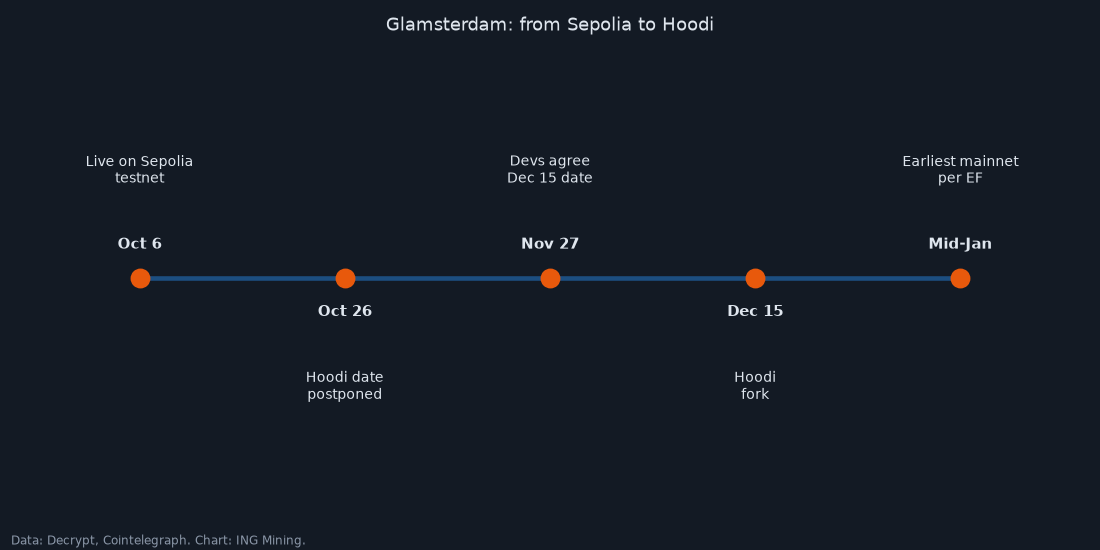
Ethereum developers set the Glamsterdam Hoodi testnet fork for December 15, nearly two months late. Decrypt and Cointelegraph both report the date, and The Block carries it too. Here is what changed, what the delay was about, and why bitcoin miners can mostly ignore it.
What was decided for the Glamsterdam Hoodi testnet
Developers agreed on Thursday that the fork activates on Hoodi at 19:12 UTC on December 15, at epoch 143,616, per Decrypt. Hoodi was due to fork on October 26. The upgrade went live on the Sepolia testnet on October 6. Client teams are expected to cut releases by early next week.
No mainnet date exists yet. Cointelegraph says an Ethereum Foundation researcher named mid-January as the earliest viable date. Treat that as the earliest case, not a promise.
Why the Glamsterdam Hoodi testnet slipped
The security firm ChainSecurity warned that new gas rules could break safeguards in existing smart contracts. It cited 13 real-world examples, per Decrypt. The rule at the centre is EIP-8037. It raises the cost of creating new data, so the network’s state grows more slowly.
Under the proposal, creating a new account would cost about seven times as much gas as today. Deploying a 24 kB contract would cost about eight times as much. After reviewing feedback, developers chose to ship EIP-8037 as written. As a result, some participants still worry about breakage. Developer Ansgar Dietrichs told Cointelegraph that leaving it open would have pushed the fork into 2027.
What else is on the table
Developers also agreed to treat post-quantum and AI security threats as higher priority. Decrypt quotes a “DEFCON 2-3” level of urgency from the meeting summary. The next call, around December 10, will settle the scope of Hegota, the upgrade after Glamsterdam.
What it means for bitcoin miners
Very little, directly. Ethereum moved to proof of stake in 2022, so none of this changes the hashprice of an ASIC. The link is mood. Bitcoin sits near $59,000 and the whole market is thin on good news. Our Ethereum price prediction page tracks the daily range.
Miner math: bitcoin hashprice today
Here is the live maths on November 28. Bitcoin is $59,440 and the network is 1008 EH/s, so hashprice is about $26.73 per petahash per day. That is what one PH/s of hashing earns before power.
| Machine | 5c/kWh | 8c/kWh | 12c/kWh | Break-even |
|---|---|---|---|---|
| Antminer S19 (95 TH/s, 3250 W) | -$1.36 | -$3.70 | -$6.82 | 3.3c |
| Antminer S19k Pro (115 TH/s, 2645 W) | -$0.10 | -$2.00 | -$4.54 | 4.8c |
| Antminer S19 XP (141 TH/s, 3010 W) | $0.16 | -$2.01 | -$4.90 | 5.2c |
| Antminer S21 Pro (234 TH/s, 3510 W) | $2.04 | -$0.48 | -$3.85 | 7.4c |
Numbers are profit per day after electricity, at the three power prices shown. Break-even is the most you can pay per kilowatt-hour before the machine loses money. Specs are the manufacturer ratings; network data comes from mempool.space. Try your own power price in our free bitcoin mining profit calculator. See what these machines really sold for in our used ASIC miner price index. Want to run the same numbers on a machine you can buy today? See our used ASIC miners, or buy several at once through bulk lots.
If a calm tech calendar lifts bitcoin 5%: the break-even power price on an S19k Pro rises from 4.8 to 5.1 cents per kilowatt-hour. At 8 cents, daily profit goes from -$2.00 to -$1.85.
That is a what-if. Your machine’s margin depends on power cost first. See the mining economics guides, browse all miners, or sell us your used miners.
-Nick
ING Mining
This is general information, not financial advice. Crypto is volatile, and exchanges can fail. Please do your own research.
How this story was made: drafted with the help of AI tools from public sources, then edited by Nick Squires. See our editorial policy. Spot an error? Email ns@ingmining.com.