
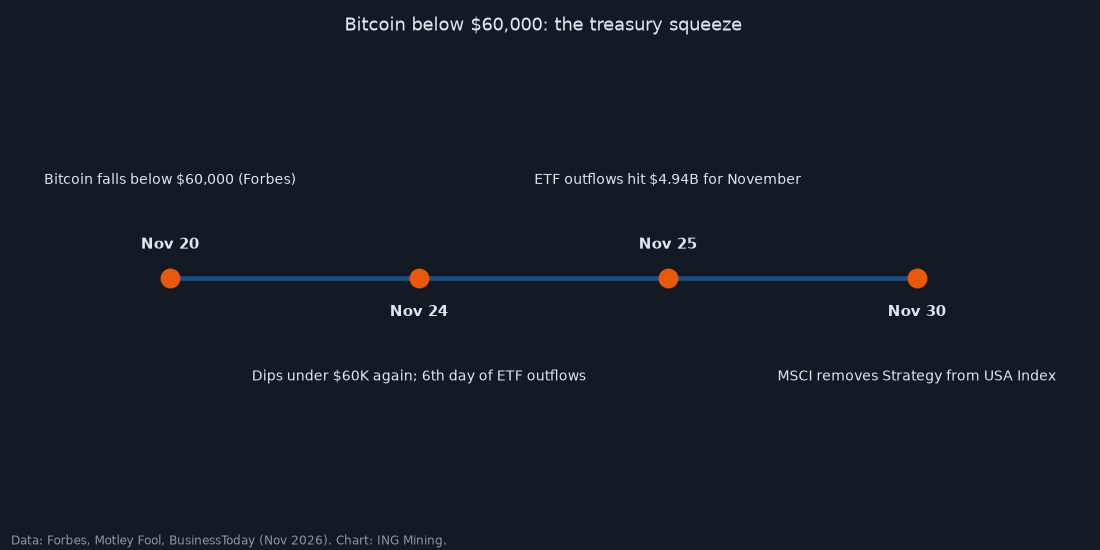
Bitcoin under $60,000 is the first real test of corporate crypto treasuries, and the biggest one is trading below the value of its coins. Strategy holds 850,849 BTC, and mNAV.com puts its market value at about 0.93 times that stack. The Motley Fool had it nearer 63% on Nov 21. The number moves with the formula.
Why corporate crypto treasuries are under strain
Forbes reports bitcoin slipped under $60,000 again on Nov 24 after a short Nvidia-fuelled rally. It first broke that level on Nov 20. BusinessToday counts $4.94 billion of ETF outflows in November so far.
The old playbook was simple. Trade at a premium to your coins, sell shares, buy more bitcoin. That only works while mNAV sits above 1.0. Below 1.0, selling stock to buy coins dilutes holders. The engine stalls.
The MSCI deadline for corporate crypto treasuries
MSCI will remove Strategy and Metaplanet from its indexes at the close of Nov 30, per the Fool. Index funds tracking MSCI must sell. Strategy calls the screen “pretextual” and says it expects no meaningful impact on its business. Other index providers have not copied the screen yet.
Nobody is forced to sell bitcoin tomorrow. Strategy said on a Nov call that it has bought back about $3 billion of its Stretch preferred stock at $95 to $99, per the same report. But a company that must fund dividends from a falling asset has fewer good choices each week. We would not call any of this a collapse. We would call it a stress test, and the weakest firms fail those first.
Why miners should care
Public miners also hold coins. Several have already sold, as CleanSpark and Keel showed. Treasury firms selling would add supply into a thin market. That pushes price down, and price sets your hashprice.
Miner math: bitcoin under $60,000
Here is the live maths on November 26. Bitcoin is $60,423 and the network is 1055 EH/s, so hashprice is about $25.92 per petahash per day. That is what one PH/s of hashing earns before power.
| Machine | 5c/kWh | 8c/kWh | 12c/kWh | Break-even |
|---|---|---|---|---|
| Antminer S19 (95 TH/s, 3250 W) | -$1.44 | -$3.78 | -$6.90 | 3.2c |
| Antminer S19k Pro (115 TH/s, 2645 W) | -$0.19 | -$2.10 | -$4.64 | 4.7c |
| Antminer S19 XP (141 TH/s, 3010 W) | $0.04 | -$2.12 | -$5.01 | 5.1c |
| Antminer S21 Pro (234 TH/s, 3510 W) | $1.85 | -$0.67 | -$4.04 | 7.2c |
Numbers are profit per day after electricity, at the three power prices shown. Break-even is the most you can pay per kilowatt-hour before the machine loses money. Specs are the manufacturer ratings; network data comes from mempool.space. Try your own power price in our free bitcoin mining profit calculator. See what these machines really sold for in our used ASIC miner price index. Want to run the same numbers on a machine you can buy today? See our used ASIC miners, or buy several at once through bulk lots.
If treasury selling pushed bitcoin down another 15%: the break-even power price on an S19k Pro falls from 4.7 to 4.0 cents per kilowatt-hour. At 8 cents, daily profit goes from -$2.10 to -$2.54.
Bitcoin is near $60,423 and the network near 1,055 EH/s in the table above. Be blunt with yourself: at 8 cents, older machines already lose money at this price. A further drop makes it worse for everyone except the cheapest power. Read our selloff report for the macro side.
What we would do
Do not guess the bottom. Check your break-even power price against your real rate. If you are under water, we buy used miners. If you want cheaper hardware while the market is weak, see bulk used lots and our mining economics guides.
-Nick
ING Mining
This is general information, not financial advice. Crypto is volatile, and exchanges can fail. Please do your own research.
How this story was made: drafted with the help of AI tools from public sources, then edited by Nick Squires. See our editorial policy. Spot an error? Email ns@ingmining.com.