CleanSpark bitcoin sales may soon outrun its mining. The public miner said on November 24 that it might sell more bitcoin than it mines each quarter, after a $987.1 million loss for fiscal 2026, per Bitcoin Magazine and crypto.news. Most of that loss is a paper loss. The message to miners is still blunt: even a big, cheap-power miner is cutting machines and selling coins.
What CleanSpark bitcoin results showed
For the year ended September 30, revenue was $576.5 million, down 25%. Adjusted EBITDA was a loss of $304.2 million. Bitcoin Magazine says $281.6 million of the loss came from the fair value of its bitcoin, against a $425.6 million gain a year earlier, plus a $177.1 million impairment. The CleanSpark bitcoin stack was 13,530 BTC at year-end, including pledged coins. It mined 7,253 BTC in the year, down 8%.
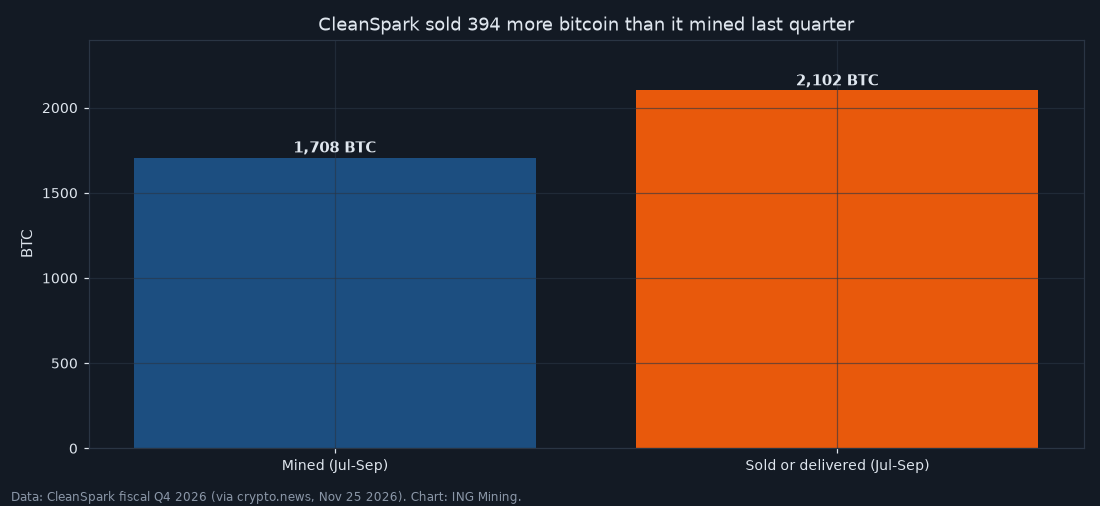
In the September quarter it mined 1,708 BTC but sold or delivered 2,102, about 23% more, per crypto.news. Some of that went out through call options. CFO Gary Vecchiarelli told Bitcoin Magazine that selling “a small amount of bitcoin in excess of the quarterly production” is one way of derisking. It is an option under review, not a firm plan.
Why CleanSpark bitcoin selling matters to miners
First, the fleet is shrinking. Bitcoin Magazine says about 200,000 machines were running in September, down from 225,000 in June, partly through curtailment. Second, the money is moving to AI. CleanSpark has a $6.6 billion, 20-year lease at its Sandersville site, funded by $2.276 billion of 7.875% notes. Third, the market noticed. CoinCentral reports the stock fell about 8%.
However, we see a pattern. A miner with 36 EH/s average hashrate, and a fleet efficiency of 14.8 J/TH per crypto.news, still chooses to sell coins and shift capital away from mining. If it cannot comfortably hold, a smaller miner with older machines is in worse shape. Our bitcoin price prediction page tracks the price side of this.
Miner math: what a CleanSpark-style squeeze looks like on your machine
Here is the live maths on November 25. Bitcoin is $59,094 and the network is 1040 EH/s, so hashprice is about $25.73 per petahash per day. That is what one PH/s of hashing earns before power.
| Machine | 5c/kWh | 8c/kWh | 12c/kWh | Break-even |
|---|---|---|---|---|
| Antminer S19 (95 TH/s, 3250 W) | -$1.46 | -$3.80 | -$6.92 | 3.1c |
| Antminer S19k Pro (115 TH/s, 2645 W) | -$0.22 | -$2.12 | -$4.66 | 4.7c |
| Antminer S19 XP (141 TH/s, 3010 W) | $0.02 | -$2.15 | -$5.04 | 5.0c |
| Antminer S21 Pro (234 TH/s, 3510 W) | $1.81 | -$0.72 | -$4.09 | 7.1c |
Numbers are profit per day after electricity, at the three power prices shown. Break-even is the most you can pay per kilowatt-hour before the machine loses money. Specs are the manufacturer ratings; network data comes from mempool.space. Try your own power price in our free bitcoin mining profit calculator. See what these machines really sold for in our used ASIC miner price index. Want to run the same numbers on a machine you can buy today? See our used ASIC miners, or buy several at once through bulk lots.
If CleanSpark’s roughly 25,000 curtailed machines (about 0.4% of network hashrate, our estimate) stay off: the break-even power price on an S19k Pro rises from 4.7 to 4.7 cents per kilowatt-hour. At 8 cents, daily profit goes from -$2.12 to -$2.11.
What it means for your machines
Bitcoin is $59,094 in our live data, with the network near 1040 EH/s. The table above shows the result: at 8 cents most of these machines lose money today, and only the best one clears 5 cents. Also, CleanSpark taking machines offline barely moves difficulty. It is under half a percent of the network on our estimate, so do not expect relief from it.
So what do we do? Price your own power first. If a machine loses money every day, selling beats holding it. We buy used miners, and you can browse bulk used lots or our mining economics guides before you buy anything.
-Nick
ING Mining
This is general information, not financial advice. Crypto is volatile, and exchanges can fail. Please do your own research.
How this story was made: drafted with the help of AI tools from public sources, then edited by Nick Squires. See our editorial policy. Spot an error? Email ns@ingmining.com.