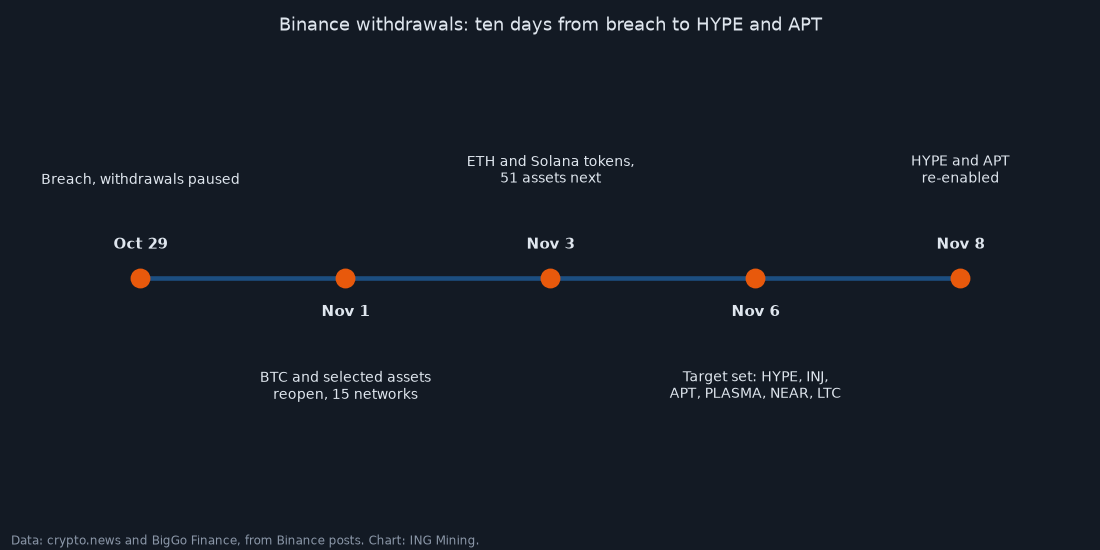
Binance withdrawals for HYPE and APT are back, ten days after the October 29 breach. crypto.news reports that Binance re-enabled both on November 8. However, the exchange has not confirmed the other four coins it named last week: INJ, PLASMA, NEAR and LTC.
Which Binance withdrawals are back
crypto.news quotes Binance’s X post: “Withdrawals have now been re-enabled for the following networks and assets.” The new additions are HYPE and APT. Earlier phases covered Ethereum stablecoins and tokens such as LINK and SHIB, plus Solana tokens such as BONK and JUP. crypto.news adds that Binance has not published a full list of what is still restricted.
On November 6, Binance said it was working to reopen HYPE, INJ, APT, PLASMA, NEAR and LTC by the end of the following week, per BigGo Finance and crypto.news. So two of six are done, and the deadline is not a calendar date. The latest update does not say whether the other four have finished their security checks. crypto.news says it asked Binance and had no reply by press time.
How the Binance recovery has gone so far
The path so far, per crypto.news: Bitcoin and selected assets reopened on November 1 across 15 networks. Reserve checks for ten coins were done on November 2. Ethereum and Solana token withdrawals expanded on November 3, with a next phase covering 51 assets.
As for the money, the figures differ by date. crypto.news says Binance had replenished about 95% when it reopened. BigGo, citing Binance’s November 4 update, says about 98%, and that Binance bought the last 2% through market and over-the-counter trades. These look like different dates rather than a conflict, but neither outlet says so. The breach itself is described as $6.3 billion by crypto.news. Other outlets have used $6.4 billion.
Binance also says it will restore its SAFU user fund to about $1 billion. BigGo adds that a zero-knowledge proof of reserves, covering 44 tokens instead of 10, would take 50 to 60 hours. All of this is Binance’s own account, and nobody has checked it independently. For the attack itself, see our earlier report on the Binance hack.
Miner math: why we keep miners paying to our own wallet
Here is the live maths on November 8. Bitcoin is $75,817 and the network is 983 EH/s, so hashprice is about $34.94 per petahash per day. That is what one PH/s of hashing earns before power.
| Machine | 5c/kWh | 8c/kWh | 12c/kWh | Break-even |
|---|---|---|---|---|
| Antminer S19 (95 TH/s, 3250 W) | -$0.58 | -$2.92 | -$6.04 | 4.3c |
| Antminer S19k Pro (115 TH/s, 2645 W) | $0.84 | -$1.06 | -$3.60 | 6.3c |
| Antminer S19 XP (141 TH/s, 3010 W) | $1.31 | -$0.85 | -$3.74 | 6.8c |
| Antminer S21 Pro (234 TH/s, 3510 W) | $3.96 | $1.44 | -$1.93 | 9.7c |
Numbers are profit per day after electricity, at the three power prices shown. Break-even is the most you can pay per kilowatt-hour before the machine loses money. Specs are the manufacturer ratings; network data comes from mempool.space. Try your own power price in our free bitcoin mining profit calculator. See what these machines really sold for in our used ASIC miner price index. Want to run the same numbers on a machine you can buy today? See our used ASIC miners, or buy several at once through bulk lots.
What we would do
Bitcoin is already fully usable. Hashrate stayed near 983 EH/s through the whole episode, per mempool.space, so mining never stopped. Therefore the lesson is the one we gave before: point your pool payouts at your own wallet and leave only trading funds on an exchange. If you hold HYPE, APT, INJ, PLASMA, NEAR or LTC on Binance, check the official channel before you plan around a date.
If your miners cost more to run than they earn, you can sell us your used miners. To start fresh, browse all miners.
-Nick
ING Mining
This is general information, not financial advice. Crypto is volatile, and exchanges can fail. Please do your own research.
How this story was made: drafted with the help of AI tools from public sources, then edited by Nick Squires. See our editorial policy. Spot an error? Email ns@ingmining.com.