
Binance laundering AI claims are not backed by the evidence so far. Elliptic says the movement of the stolen funds is automated, but “nothing we have seen shows an AI agent making decisions,” according to CoinDesk. Scripts written by people fit the pattern better.
What Elliptic found on Binance laundering and AI
First, the dates. The hack happened on October 29. The FBI blamed North Korea’s TraderTraitor group on October 31. Per CoinDesk, Elliptic counted about 20 automated services used in under three days. They included decentralized exchanges, lending protocols and cross-chain bridges.
Also, six bridges were first used inside a 100-minute window on October 30. Elliptic also saw repeated transfers, failed transactions, reused amounts and small test transfers before big ones. Co-founder Tom Robinson said the pattern “fits scripts written and supervised by people.”
Why the AI question came up
Chainalysis reported thousands of transactions in a short period, which it says suggests automation. It does not say AI. However, the AI framing comes from commentary, not from forensic findings. As a result, nobody has shown an AI agent at work here.
The numbers that matter more
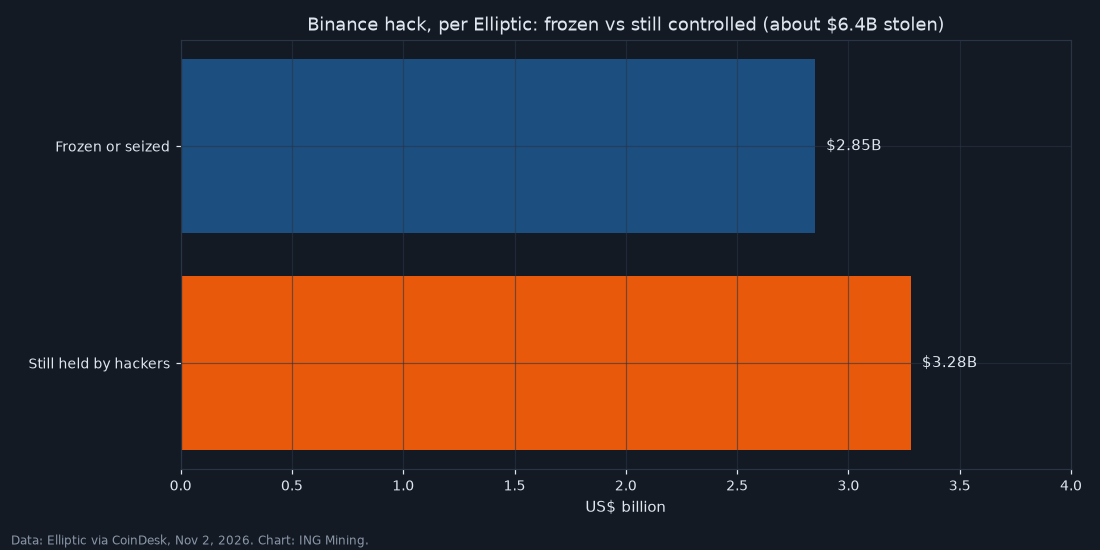
Binance put the loss at about $6.3 billion. Chainalysis says about $6.4 billion. Elliptic says about $2.85 billion, or 44%, has been frozen or seized. The hackers still control about $3.28 billion across more than 950 wallets. Those are Elliptic’s figures, and they will move.
For earlier context, see our pieces on the FBI naming North Korea and the stolen XRP split.
Miner math: what the Binance laundering means for your margin
Here is the live maths on November 2. Bitcoin is $77,798 and the network is 1047 EH/s, so hashprice is about $33.63 per petahash per day. That is what one PH/s of hashing earns before power.
| Machine | 5c/kWh | 8c/kWh | 12c/kWh | Break-even |
|---|---|---|---|---|
| Antminer S19 (95 TH/s, 3250 W) | -$0.70 | -$3.04 | -$6.16 | 4.1c |
| Antminer S19k Pro (115 TH/s, 2645 W) | $0.69 | -$1.21 | -$3.75 | 6.1c |
| Antminer S19 XP (141 TH/s, 3010 W) | $1.13 | -$1.04 | -$3.93 | 6.6c |
| Antminer S21 Pro (234 TH/s, 3510 W) | $3.66 | $1.13 | -$2.24 | 9.3c |
Numbers are profit per day after electricity, at the three power prices shown. Break-even is the most you can pay per kilowatt-hour before the machine loses money. Specs are the manufacturer ratings; network data comes from mempool.space. Try your own power price in our free bitcoin mining profit calculator. See what these machines really sold for in our used ASIC miner price index. Want to run the same numbers on a machine you can buy today? See our used ASIC miners, or buy several at once through bulk lots.
If the hack fallout pushes bitcoin down another 10%: the break-even power price on an S19k Pro falls from 6.1 to 5.5 cents per kilowatt-hour. At 8 cents, daily profit goes from -$1.21 to -$1.60.
The blunt answer for miners
In short, whether a script or an AI moves the money changes nothing on the bitcoin network. Hashrate sits near 1047 EH/s per mempool.space. Instead, what hits your margin is price. A forced sale of stolen bitcoin would push it down, and older machines lose first. Look at the table above for your power price. If your S19 is under water, see our we buy used miners page or the mining economics guides.
-Nick
ING Mining
This is general information, not financial advice. Crypto is volatile, and exchanges can fail. Please do your own research.