
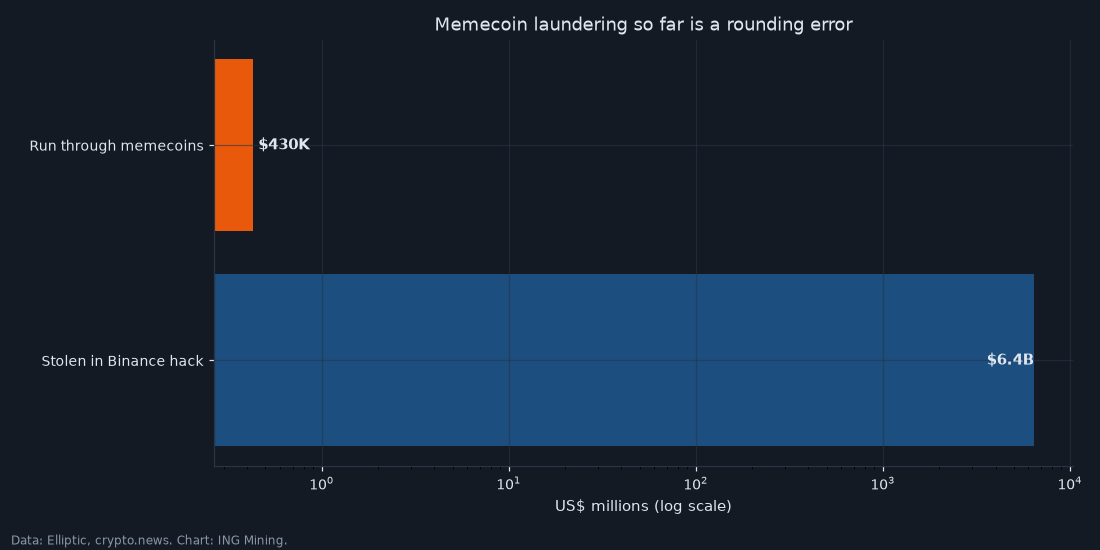
Binance hack memecoins are the launderers’ newest tool: about $430,000 of stolen money has gone through six throwaway tokens. Elliptic published the finding on November 9. It is tiny next to the $6.4 billion stolen, but the method matters.
How the Binance hack memecoins work
Per Elliptic, the launderers minted six tokens on the NEAR blockchain between November 5 and 7: FUK, OLCCL, MEILI, MMLI, DABI and SINU. Each cost around 25 NEAR, or about $90, to create (crypto.news reports the same figures). They paired each token with NEAR in a trading pool. One set of wallets paid stolen funds in and took tokens out. A second set sold the tokens back and withdrew clean-looking NEAR.
About 117,000 NEAR, roughly $430,000, moved that way. No coin ever passed straight from one wallet to the other. Elliptic ties the Binance heist to TraderTraitor, as it did the 2025 Bybit theft, and says it first saw this trick in the Bybit case.
How big is it?
Small. $430,000 is about 0.007% of $6.4 billion. Elliptic itself says the amounts are small so far and the trail can still be followed on-chain. The technique slows investigators down. It does not hide the money. Crypto.news also reports roughly 7,000 ETH linked to the theft reached Tornado Cash since November 8, and tracing across more than 20,000 wallets on 16 chains.
Our take: the stolen money is still moving
We read this as a sign the thieves are still busy washing. That matters because stolen funds that get dumped for cash add sell pressure. We covered the earlier steps in our reports on the XRP and Tron laundering and the Solana-to-Bitcoin swap. Nothing here says the coins will hit the bitcoin market soon, and we do not know that they will. Our bitcoin price prediction page tracks the daily range.
What the Binance hack memecoins mean for miners
Directly, almost nothing. $430,000 will not move hashprice. The risk is indirect: a large dump of stolen coins would hit price, and miners are paid in bitcoin. The table shows where margins sit today. Be blunt with yourself about your power price.
Miner math: bitcoin hashprice today
Here is the live maths on November 10. Bitcoin is $74,721 and the network is 967 EH/s, so hashprice is about $35.01 per petahash per day. That is what one PH/s of hashing earns before power.
| Machine | 5c/kWh | 8c/kWh | 12c/kWh | Break-even |
|---|---|---|---|---|
| Antminer S19 (95 TH/s, 3250 W) | -$0.57 | -$2.91 | -$6.03 | 4.3c |
| Antminer S19k Pro (115 TH/s, 2645 W) | $0.85 | -$1.05 | -$3.59 | 6.3c |
| Antminer S19 XP (141 TH/s, 3010 W) | $1.32 | -$0.84 | -$3.73 | 6.8c |
| Antminer S21 Pro (234 TH/s, 3510 W) | $3.98 | $1.45 | -$1.92 | 9.7c |
Numbers are profit per day after electricity, at the three power prices shown. Break-even is the most you can pay per kilowatt-hour before the machine loses money. Specs are the manufacturer ratings; network data comes from mempool.space. Try your own power price in our free bitcoin mining profit calculator. See what these machines really sold for in our used ASIC miner price index. Want to run the same numbers on a machine you can buy today? See our used ASIC miners, or buy several at once through bulk lots.
If stolen-fund selling pushes bitcoin down 5%: the break-even power price on an S19k Pro falls from 6.3 to 6.0 cents per kilowatt-hour. At 8 cents, daily profit goes from -$1.05 to -$1.25.
That is a “what if”, not a forecast. At a 5% drop the thinnest-margin machines go negative first. Our mining economics guides show the arithmetic.
If a machine no longer pays, sell us your used miners. Buyers can browse all miners.
-Nick
ING Mining
This is general information, not financial advice. Crypto is volatile, and exchanges can fail. Please do your own research.
How this story was made: drafted with the help of AI tools from public sources, then edited by Nick Squires. See our editorial policy. Spot an error? Email ns@ingmining.com.