
The Spain Sepblac crypto freeze is a real change: the country’s financial intelligence unit can now suspend crypto accounts on its own, with no judge. Decrypt and CoinDesk both reported it on November 26, 2026.
How the Spain Sepblac crypto freeze works
The rule sits inside a royal decree-law on consumer credit, published in Spain’s official gazette. It adds a new article to the 2010 anti-money laundering law. Sepblac can suspend a transaction in progress. It can also suspend a bank, payment or crypto-asset account, or a business relationship, when it sees signs of money laundering or terrorist financing.
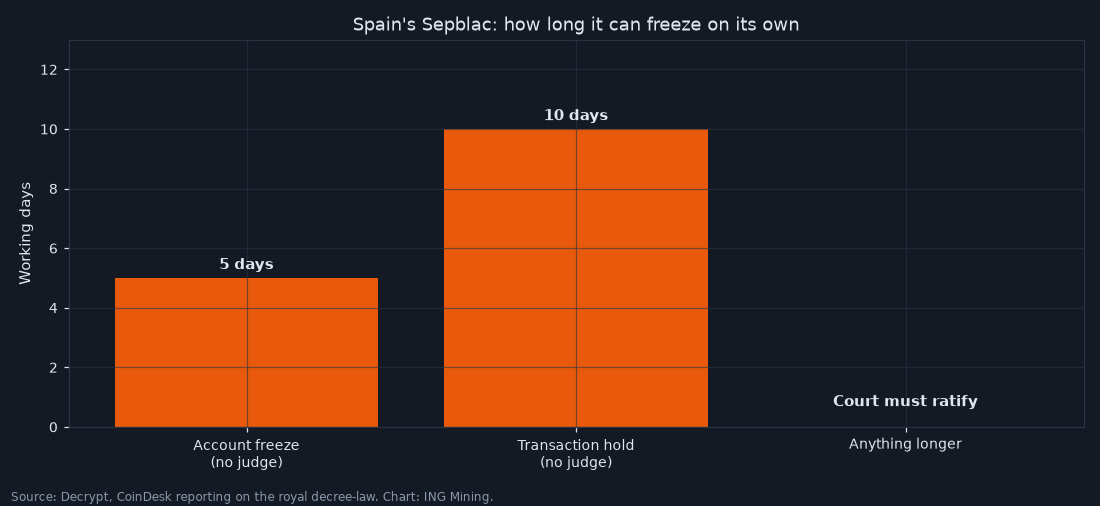
The limits are tight. Per Decrypt, a transaction can be held for up to 10 working days and an account for up to five. After that, the suspension ends unless a court ratifies or extends it at the request of the public prosecutor. Previously, Sepblac could only act when a foreign intelligence unit asked. Now it can act on its own analysis or at the request of Spanish police.
The numbers behind it
According to Sepblac’s annual report, as cited by Decrypt, it handled 204 foreign suspension requests in 2025, up from 175 in 2024 and 90 in 2023. Suspicious activity reports from crypto firms rose to 1,672 in 2025 from 972 in 2024. The government cites FATF standards and an EU directive. Spain’s next FATF evaluation visit is scheduled for February 2027.
What is not settled on the Sepblac freeze
First, the decree takes effect two months after publication. Second, as a royal decree-law it must be ratified by Spain’s Congress within 30 days. Some outlets headline it as already final, but MLQ.ai and Decrypt both note the parliamentary step. We found no reporting yet on how the power will be used or on any legal challenge.
Miner math: what Spain’s freeze power means for your margin
Here is the live maths on November 26. Bitcoin is $60,462 and the network is 1043 EH/s, so hashprice is about $26.23 per petahash per day. That is what one PH/s of hashing earns before power.
| Machine | 5c/kWh | 8c/kWh | 12c/kWh | Break-even |
|---|---|---|---|---|
| Antminer S19 (95 TH/s, 3250 W) | -$1.41 | -$3.75 | -$6.87 | 3.2c |
| Antminer S19k Pro (115 TH/s, 2645 W) | -$0.16 | -$2.06 | -$4.60 | 4.8c |
| Antminer S19 XP (141 TH/s, 3010 W) | $0.09 | -$2.08 | -$4.97 | 5.1c |
| Antminer S21 Pro (234 TH/s, 3510 W) | $1.92 | -$0.60 | -$3.97 | 7.3c |
Numbers are profit per day after electricity, at the three power prices shown. Break-even is the most you can pay per kilowatt-hour before the machine loses money. Specs are the manufacturer ratings; network data comes from mempool.space. Try your own power price in our free bitcoin mining profit calculator. See what these machines really sold for in our used ASIC miner price index. Want to run the same numbers on a machine you can buy today? See our used ASIC miners, or buy several at once through bulk lots.
If the regulation headlines shave 2% off the bitcoin price: the break-even power price on an S19k Pro falls from 4.8 to 4.7 cents per kilowatt-hour. At 8 cents, daily profit goes from -$2.06 to -$2.12.
The blunt answer for miners
In short, the Spain Sepblac crypto freeze does not touch your margin today. Spain’s power covers accounts at regulated firms, not the chain, and it lasts days, not months. Hashrate sits near 1043 EH/s per mempool.space. However, it matters if you sell mined coin through a Spanish exchange or bank. A flagged payout could be frozen for a week while you wait. So we would keep payouts clean, documented and split across more than one off-ramp.
If your machine already loses money at your power price, see our we buy used miners page or the mining economics guides. Our Bitcoin price prediction page has the ranges we expect.
-Nick
ING Mining
This is general information, not financial advice. Crypto is volatile, and exchanges can fail. Please do your own research.
How this story was made: drafted with the help of AI tools from public sources, then edited by Nick Squires. See our editorial policy. Spot an error? Email ns@ingmining.com.