
Ripple Yapi Kredi is the deal of the day: one of Turkey’s largest private banks will use Ripple Custody to hold crypto for its trading platform. The announcement came on Nov. 25, per Bitcoin.com News. But XRP still fell to about $0.90 the same day, and the deal does not require the bank to buy or use XRP.
What the Ripple Yapi Kredi deal actually is
Yapi Kredi runs Ripple Custody on its own premises to manage the digital assets of Yapi Kredi Kripto, its crypto trading platform. Turkey’s Capital Markets Board approved the bank’s custody application earlier this year, and platforms there must keep at least 95% of customer crypto with an authorized custodian, as Coinspeaker reports. Ripple says its technology is the only custody tech behind the leading Turkish banks licensed as custodians.
Ripple also says XRP is among Turkey’s most widely held digital assets. That is Ripple’s claim. 24/7 Wall St. points out the companies have not shared fees, contract length or which coins are covered, and that XRP is only named as a popular local asset.
Why the Ripple Yapi Kredi deal did not lift XRP
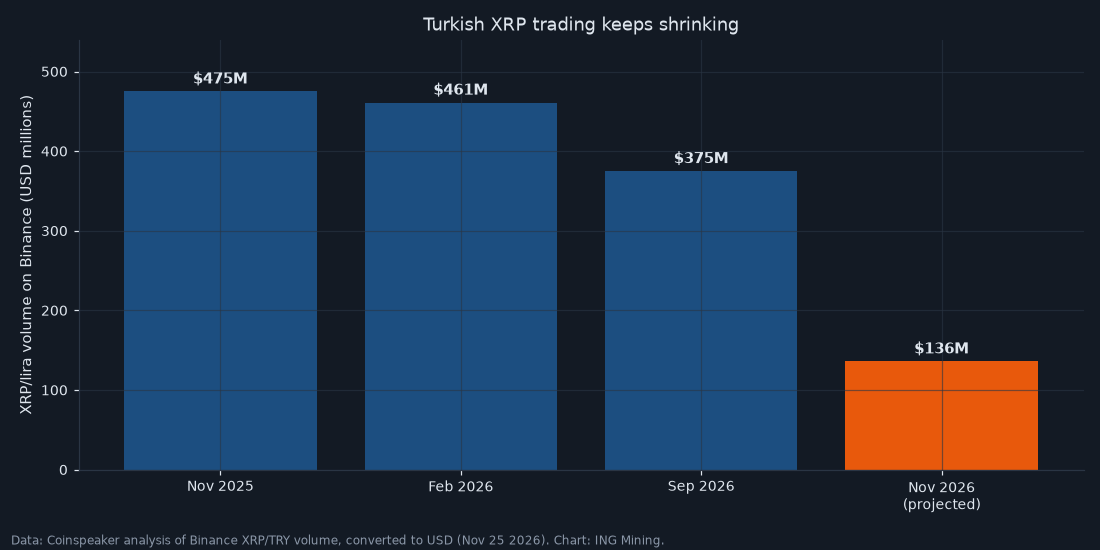
First, custody is a software and services business. It pays Ripple, a private company, not XRP holders. Coinspeaker’s Binance numbers show XRP trading against the lira at about $113 million so far in November, on pace for roughly $136 million. Meanwhile, a year ago it was $475 million. That is about 70% lower, by Coinspeaker’s count, and Turkish traders are chasing small caps instead.
Also, XRP traded near $0.92, down about 58% on the year, per the same report. Our read: a bank signing a custody contract is good for Ripple’s business and tells you little about XRP demand.
Miner math: what this Ripple deal does to your machine
Here is the live maths on November 25. Bitcoin is $59,694 and the network is 1040 EH/s, so hashprice is about $26.00 per petahash per day. That is what one PH/s of hashing earns before power.
| Machine | 5c/kWh | 8c/kWh | 12c/kWh | Break-even |
|---|---|---|---|---|
| Antminer S19 (95 TH/s, 3250 W) | -$1.43 | -$3.77 | -$6.89 | 3.2c |
| Antminer S19k Pro (115 TH/s, 2645 W) | -$0.18 | -$2.09 | -$4.63 | 4.7c |
| Antminer S19 XP (141 TH/s, 3010 W) | $0.05 | -$2.11 | -$5.00 | 5.1c |
| Antminer S21 Pro (234 TH/s, 3510 W) | $1.87 | -$0.66 | -$4.03 | 7.2c |
Numbers are profit per day after electricity, at the three power prices shown. Break-even is the most you can pay per kilowatt-hour before the machine loses money. Specs are the manufacturer ratings; network data comes from mempool.space. Try your own power price in our free bitcoin mining profit calculator. See what these machines really sold for in our used ASIC miner price index. Want to run the same numbers on a machine you can buy today? See our used ASIC miners, or buy several at once through bulk lots.
If this story moves bitcoin by nothing, which is our base case: it is an XRP and custody story: the break-even power price on an S19k Pro rises from 4.7 to 4.7 cents per kilowatt-hour. At 8 cents, daily profit goes from -$2.09 to -$2.09.
What it means for your machines
In short, nothing directly. Bitcoin is $59,694 in our live data, with the network near 1040 EH/s. Your margin comes from that and your power price. At 8 cents, most of the machines in the table lose money today, and a Turkish custody contract changes none of it.
So what do we do? Check your own power price against the table. If a machine runs at a loss, selling beats waiting for headlines. We buy used miners, and you can browse bulk used lots or our mining economics guides. For the coin itself, see our XRP exchange inflows report.
-Nick
ING Mining
This is general information, not financial advice. Crypto is volatile, and exchanges can fail. Please do your own research.
How this story was made: drafted with the help of AI tools from public sources, then edited by Nick Squires. See our editorial policy. Spot an error? Email ns@ingmining.com.