
The Moscow Exchange plans to start Moscow Exchange bitcoin trading on December 1, along with ether and Tether’s USDT. CoinDesk and Cointelegraph both report it on November 4. It is a plan, not a launch. Nothing trades yet.
What Moscow Exchange bitcoin trading will look like
Trading runs from 06:50 to 23:50 Moscow time, the same hours as its stock market. The National Clearing Centre clears the trades, with same-day or next-day settlement and swaps. Ordinary investors must pass a test and can buy up to 300,000 rubles, about $3,700, per year through each broker. Qualified investors face no cap, per both outlets. Russia’s crypto law took effect September 1. It allows regulated trading but still bans paying for goods with crypto.
The sanctions problem
The exchange and its clearing house are under US sanctions, since June 2024. Cointelegraph adds the UK sanctioned the exchange in June 2024 and the EU in July 2026. CoinDesk says Tether freezes wallets on the Treasury sanctions list, and it asked Tether how that applies to USDT held through the clearing house. We have not seen an answer. Therefore USDT on this venue is an open question, not a settled fact.
How big could Moscow Exchange bitcoin trading get?
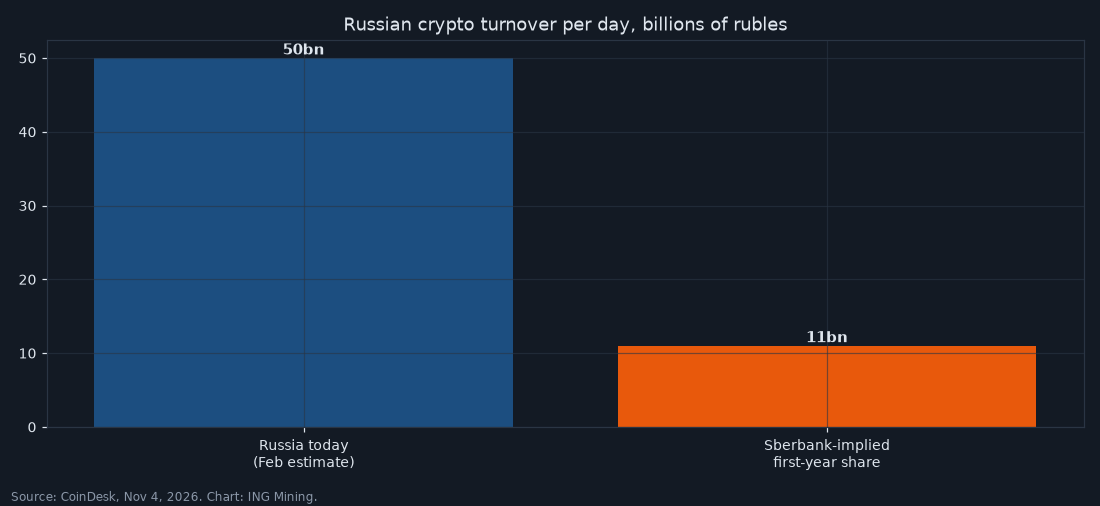
Deputy Chairman Anatoly Popov told TASS that trading could reach 4 trillion rubles, about $49 billion, in the first year. Deputy Finance Minister Ivan Chebeskov put Russian crypto turnover at 50 billion rubles a day in February. CoinDesk’s own arithmetic on Sberbank’s first-year figure gives roughly 11 billion rubles a day. However, that suggests most flow stays offshore or on peer-to-peer desks. Sergey Mendeleev of Exved is blunter. He says “neither the global nor the local market will notice anything at all,” and warns of “absolutely outrageous spreads.”
Miner math: what Russian exchange trading means for your margin
Here is the live maths on November 4. Bitcoin is $78,278 and the network is 1016 EH/s, so hashprice is about $34.88 per petahash per day. That is what one PH/s of hashing earns before power.
| Machine | 5c/kWh | 8c/kWh | 12c/kWh | Break-even |
|---|---|---|---|---|
| Antminer S19 (95 TH/s, 3250 W) | -$0.59 | -$2.93 | -$6.05 | 4.2c |
| Antminer S19k Pro (115 TH/s, 2645 W) | $0.84 | -$1.07 | -$3.61 | 6.3c |
| Antminer S19 XP (141 TH/s, 3010 W) | $1.31 | -$0.86 | -$3.75 | 6.8c |
| Antminer S21 Pro (234 TH/s, 3510 W) | $3.95 | $1.42 | -$1.95 | 9.7c |
Numbers are profit per day after electricity, at the three power prices shown. Break-even is the most you can pay per kilowatt-hour before the machine loses money. Specs are the manufacturer ratings; network data comes from mempool.space. Try your own power price in our free bitcoin mining profit calculator. See what these machines really sold for in our used ASIC miner price index. Want to run the same numbers on a machine you can buy today? See our used ASIC miners, or buy several at once through bulk lots.
If new Russian retail demand lifts bitcoin 2%: the break-even power price on an S19k Pro rises from 6.3 to 6.4 cents per kilowatt-hour. At 8 cents, daily profit goes from -$1.07 to -$0.99.
The blunt answer for miners
In short, nobody is buying anything on December 1 that moves your S19. Besides, a $3,700 cap per broker is small next to a global market. Even the 2% scenario above is generous, and we would not plan on it. Network hashrate sits near 1016 EH/s per mempool.space, and your margin still depends on your power price.
If a machine is under water at your rate, see our we buy used miners page or the mining economics guides. Our Bitcoin price prediction page has the ranges we expect.
-Nick
ING Mining
This is general information, not financial advice. Crypto is volatile, and exchanges can fail. Please do your own research.
How this story was made: drafted with the help of AI tools from public sources, then edited by Nick Squires. See our editorial policy. Spot an error? Email ns@ingmining.com.