
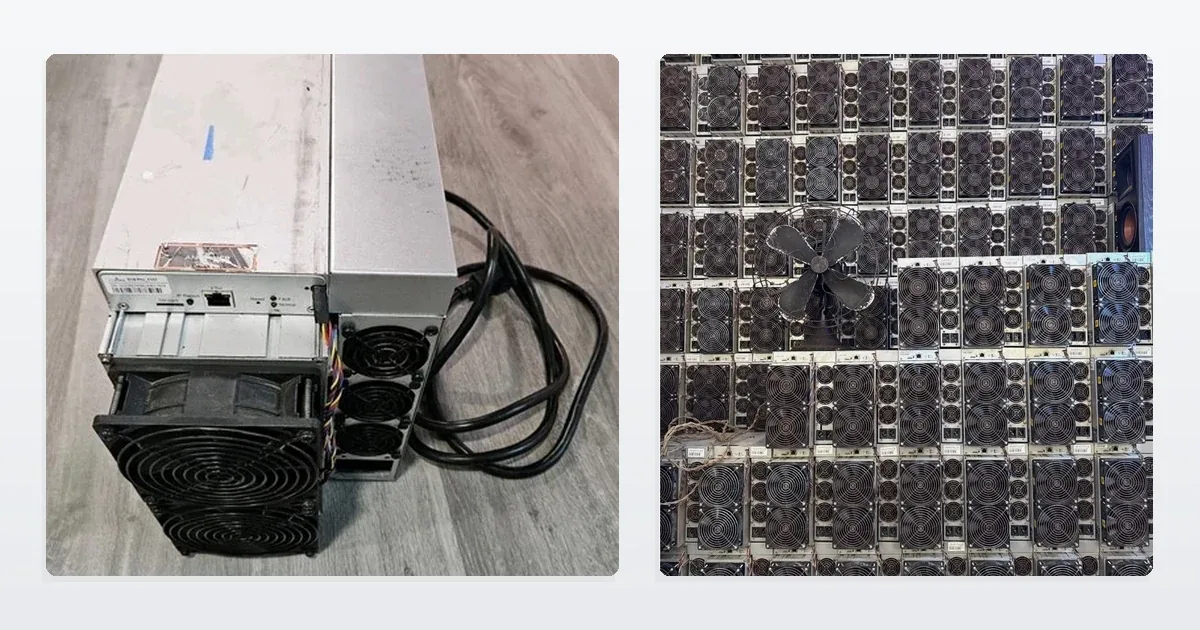
Bitcoin Cash uses SHA-256, which means the machine that mines Bitcoin can mine Bitcoin Cash without a single hardware change — and that is the beginning and end of the appeal. Your Antminer does not care which SHA-256 chain it is pointed at. What differs is what you get paid, how easily you can sell it, and how much the chain’s smaller size amplifies every risk. This page is an honest look at monetising SHA-256 hardware on BCH.
Measured on 30 July 2026, the two chains paid within six hundredths of one percent of each other — $32.12 per PH/s per day on Bitcoin Cash against $32.10 on Bitcoin. That is not a coincidence and it is not a market that happens to be balanced today; it is what a shared algorithm does. The arithmetic is below, along with the mechanism that keeps the gap that small and the two costs the equal payout hides.
We buy, repair, host and resell this hardware, so this is the version we would give a customer asking whether to point their fleet at BCH.
A correction, because this is widely misreported
Bitcoin Cash miners currently receive 3.125 BCH per block, plus transaction fees. BCH follows the same halving schedule as Bitcoin — the subsidy halves every 210,000 blocks — so the reward went 12.5 in 2016, 6.25 in 2020 and 3.125 at the April 2024 halving.
A great deal of material online, including an earlier version of this page, still quotes 12.5 BCH per block. That figure has been wrong since 2020. If you are reading any mining calculation that uses it, the numbers are overstating revenue by a factor of four. It is worth saying plainly because it is exactly the kind of stale figure that makes an unprofitable purchase look profitable.
What mining Bitcoin Cash involves
Mechanically it is identical to Bitcoin mining. Miners batch pending transactions, run the result through SHA-256 repeatedly until an output meets the difficulty target, and whoever succeeds publishes the block and takes the reward. Difficulty adjusts so blocks arrive at a target rate, and mining in a pool is the normal way to smooth the lottery into steady income.
Because the algorithm is the same, the hardware is the same. Any SHA-256 ASIC works: an Antminer S19, an S21 Pro, a Canaan Avalon Q. There is no BCH-specific machine to buy and you should be suspicious of anyone selling you one.
What BCH actually pays, measured against BTC
The standard way to compare two chains is hashprice: what the network pays for one PH/s of work for one day. It is the same division on both chains — the day’s issuance plus fees, divided by the hashrate that earned it — so the two numbers are directly comparable. Read live on 30 July 2026:
| Measured 30 July 2026 | Bitcoin | Bitcoin Cash |
|---|---|---|
| Difficulty | 126.23 T | 411.81 G |
| Network hashrate (24 h) | 917 EH/s | 2.79 EH/s |
| Coin price | $63,960 | $210.27 |
| Block subsidy | 3.125 BTC | 3.125 BCH |
| Fees as a share of miner revenue | 0.76% | 0.05% |
| Hashprice, subsidy + fees | $32.10 / PH / day | $32.12 / PH / day |
Bitcoin Cash paid 0.06% more that day. On a 234 TH/s machine that is a difference of half a cent a day — $7.51 against $7.52 gross, before power. On a used 95 TH/s S19 it does not show up until the third decimal place.
Run the numbers that actually decide a purchase and the two chains are indistinguishable. Break-even electricity price is hashprice ÷ (24 × J/TH), and at these hashprices it lands on the same figure to the hundredth of a cent:
| Machine efficiency | Break-even on BTC | Break-even on BCH |
|---|---|---|
| 15.0 J/TH (S21 Pro 234T) | 8.92 ¢/kWh | 8.92 ¢/kWh |
| 18.6 J/TH (Avalon Q 90T) | 7.19 ¢/kWh | 7.19 ¢/kWh |
| 23.0 J/TH (S19k Pro 120T) | 5.82 ¢/kWh | 5.82 ¢/kWh |
| 34.2 J/TH (used S19 95T) | 3.91 ¢/kWh | 3.91 ¢/kWh |
That is the whole answer to “should I switch to BCH to make my machine profitable”. If a machine loses money on Bitcoin at your power price, it loses money on Bitcoin Cash at your power price, by essentially the same margin. Coin choice is not a lever on electricity. These figures move daily — they are a snapshot taken on one day, not a forecast — but the relationship between them is structural, and that is the part worth understanding.
The mechanism: BCH re-targets every block
Bitcoin re-calculates difficulty once every 2,016 blocks, roughly a fortnight. Bitcoin Cash re-calculates it every single block, using the ASERT algorithm it adopted in November 2020 after earlier rule sets produced violent hashrate oscillations.
That difference is why the two hashprices sit on top of each other. Suppose BCH’s price rises and mining it becomes 10% more profitable. Hashrate arrives — and because there is so little of it on BCH to begin with, even a modest fleet moving across is a large proportional increase. Blocks come in fast, and the very next block’s difficulty is already higher. Within hours the extra reward per unit of work is gone. On Bitcoin the same imbalance would persist for up to two weeks until the next retarget.
So the practical picture is not “BCH pays more sometimes and you should watch for it”. It is: the gap opens on a price move and closes on a timescale shorter than the time it takes you to notice it. Pools that switch automatically between SHA-256 chains exist precisely because capturing that window by hand is not realistic.
The two costs the equal payout hides
Identical hashprice does not mean identical outcome. Two things differ, and both fall on the miner:
- Liquidity. BCH trades in far smaller volume than BTC. Converting meaningful quantities is harder and moves the price against you more — a real cost that never appears in a hashprice comparison. The mechanics are in how cryptocurrency prices are actually set.
- Security budget. On 30 July 2026 Bitcoin Cash was secured by about 2.8 EH/s against Bitcoin’s 917 — roughly 0.3% of all SHA-256 hashrate. Any operator with a few exahash of Bitcoin machines could point several times BCH’s entire hashrate at it for an afternoon. That is a structural property of a minority chain sharing an algorithm with a much larger one, not a criticism of the project, and it is the reason exchanges require far more confirmations on BCH deposits.
The fee cushion BCH does not have
This is the part almost nobody models, and it matters more the longer you plan to hold the hardware.
In the 24 hours to 30 July 2026, Bitcoin processed about 704,000 transactions at an average fee of $0.32; Bitcoin Cash processed about 10,200 at an average fee of under half a cent. As a share of what miners were actually paid, that is 0.76% on Bitcoin and 0.05% on Bitcoin Cash.
Neither is a large cushion today. But the direction matters: a Bitcoin miner’s revenue is 99.2% subsidy and slowly becoming less so, while a Bitcoin Cash miner’s is 99.95% subsidy with no visible trend toward fee income. The next halving, due in 2028, cuts the subsidy in half on both chains — and on BCH there is nothing else in the revenue line. If you are buying hardware today on a five-year horizon and planning to run it on a minority SHA-256 chain, that is the number to plan around, not the current 0.06% edge. What a halving does to hashprice and to used-machine prices is worked through in where new bitcoins come from.
When pointing hardware at BCH makes sense
- You want BCH specifically and would otherwise buy it on an exchange. Mining it is then a way of acquiring it, and the comparison is against the exchange purchase, not against BTC mining.
- Your pool supports automatic switching between SHA-256 chains by profitability, so you capture short windows without managing them by hand.
- You already own the hardware. Since there is no machine to buy, the decision costs nothing except attention.
And when it does not: if you are buying hardware because of a BCH calculation, check the block reward figure in that calculation first. Given how often 12.5 is still quoted, there is a real chance the whole model is wrong by four times. Then check whether it used a hashprice measured this week, because on a chain that re-targets every block, a month-old figure is describing a different network.
Switching a machine over, in practice
There is no firmware step and no hardware step. In the miner’s web interface you replace the stratum URL under pool configuration with your pool’s BCH endpoint, set the worker to a BCH address or account, save, and let the machine re-connect. Frequency, voltage, PSU and cooling are untouched, and so is the machine’s J/TH — it does the same work either way.
Two practical cautions from doing this. Minimum payout thresholds are set in coin, not in dollars, and a single 90 to 250 TH/s machine on a small BCH pool can take weeks to reach one; anything under the threshold sits with the pool. And you are now accumulating a thinner asset — if the plan is to sell mined coin monthly to pay the power bill, the liquidity point above stops being theoretical.
Related: what Bitcoin is and what mining actually does, hashprice itself in what a miner actually earns, the full method in the ASIC miner buying guide, and non-SHA-256 options in cryptocurrency mining hardware beyond Bitcoin. Machines are in the full inventory.
Frequently Asked Questions
How much do Bitcoin Cash miners earn per block?
The block subsidy is 3.125 BCH plus that block’s transaction fees. Bitcoin Cash halves on the same 210,000-block schedule as Bitcoin, so the subsidy went from 12.5 in 2016 to 6.25 in 2020 and to 3.125 at the April 2024 halving. Many pages still quote 12.5, which has been wrong since 2020 and overstates mining revenue by a factor of four. Fees add almost nothing on BCH: across the 24 hours to 30 July 2026 the average Bitcoin Cash transaction fee was under half a cent, so fees were about 0.05% of what miners were paid.
Can I mine Bitcoin Cash with an Antminer?
Yes. Bitcoin Cash uses SHA-256, the same algorithm as Bitcoin, so any SHA-256 ASIC mines it with no hardware change — an Antminer S19, an S21 Pro or a Canaan Avalon Q all work. Only the pool address changes. There is no Bitcoin Cash-specific machine, and anyone selling one as such is misrepresenting standard hardware.
Is mining Bitcoin Cash more profitable than mining Bitcoin?
Measured on 30 July 2026, no — and by almost nothing. Bitcoin Cash was paying about $32.12 per PH/s per day and Bitcoin about $32.10, a difference of six hundredths of one percent. Because both chains use SHA-256, hashrate moves between them freely, and Bitcoin Cash re-targets its difficulty every single block, so a gap closes in hours rather than the fortnight Bitcoin takes. Windows do open, but they are small and short, and BCH’s thinner liquidity makes converting what you mine harder. Switching chains does not fix an electricity cost problem.
Does mining Bitcoin Cash need different hardware or settings?
The hardware is identical; only the pool configuration changes. You point the miner at a pool that mines BCH rather than BTC, using that pool’s stratum address and your worker credentials. Some pools switch automatically between SHA-256 chains based on profitability, which is the practical way to capture short windows without monitoring them manually.
What are the risks of mining a minority SHA-256 chain?
Two structural ones and one that is often missed. Liquidity is thinner, so selling meaningful quantities moves the price against you. Security budget is thinner too: on 30 July 2026 Bitcoin Cash carried about 2.8 EH/s against Bitcoin’s 917 EH/s, so roughly 0.3% of all SHA-256 hashrate secured it, and a large operator could redirect several times that for a few hours. The missed one is the fee cushion — fees are about 0.05% of BCH miner revenue against 0.76% on Bitcoin, so a BCH miner is almost purely exposed to the subsidy, and the 2028 halving lands on that revenue with nothing to soften it.
How do I actually point a miner at Bitcoin Cash?
In the miner’s web interface, replace the stratum URL in the pool configuration with your chosen pool’s BCH endpoint and set the worker name to a BCH address or account on that pool, then save and let the machine re-connect. Nothing else changes: no firmware, no frequency or voltage change, no different PSU. Check that the pool’s minimum payout in BCH is one you will actually reach — at 90 to 250 TH/s that threshold can take weeks, and coins below it stay on the pool.