
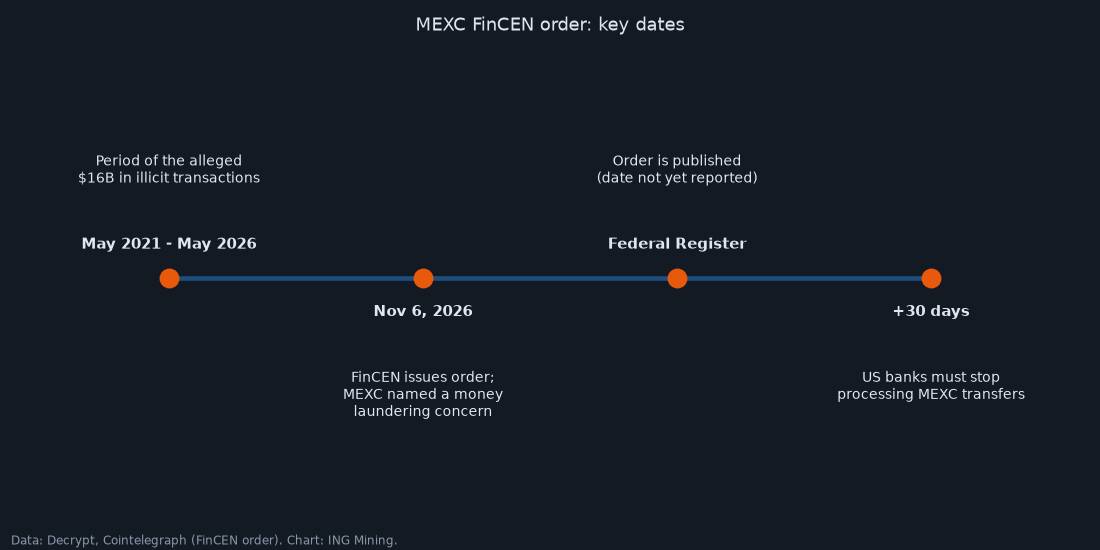
The MEXC FinCEN order cuts one of the world’s 20 largest crypto exchanges off from US banks. Decrypt reports that the Treasury’s Financial Crimes Enforcement Network issued the order on Friday, November 6. Cointelegraph carries the same core facts.
What the MEXC FinCEN order says
Both outlets say US financial institutions must stop processing transfers to or from MEXC Global. The order takes effect 30 days after it is published in the Federal Register. Neither outlet gives that publication date yet.
Treasury alleges that MEXC handled at least $16 billion in illicit transactions between May 2021 and May 2026. The countries named are Iran, North Korea and Russia. About $1.5 billion is tied to Russian sanctions evasion. These are Treasury’s allegations, not court findings.
Decrypt adds more detail. It says FinCEN used a provision of the Combating Russian Money Laundering Act and cited “severe deficiencies” in MEXC’s anti-money-laundering controls. It also lists $232 million in direct transactions with sanctioned entities, and about $22 million that benefited Iran’s central bank and its Revolutionary Guard. MEXC transacted with the sanctioned Russian exchanges Garantex and Grinex as recently as June 2026, per Decrypt.
Treasury Secretary Scott Bessent said: “Financial institutions cannot have it both ways.” Cointelegraph says it contacted MEXC and had no reply by publication. Decrypt reports no MEXC response.
How big is MEXC?
Decrypt puts MEXC at more than $1 billion in daily transactions and more than 3,000 listed tokens. It cites about $5 billion in reserves, a FinCEN figure. Cointelegraph, using DefiLlama, shows about $4.48 billion in total assets. The two measure different things, so treat both as rough.
Neither outlet says whether MEXC will be blocked for users outside the US. The order targets US banks and payment channels.
Miner math: what an exchange crackdown does to your margin
Here is the live maths on November 7. Bitcoin is $75,830 and the network is 1030 EH/s, so hashprice is about $33.37 per petahash per day. That is what one PH/s of hashing earns before power.
| Machine | 5c/kWh | 8c/kWh | 12c/kWh | Break-even |
|---|---|---|---|---|
| Antminer S19 (95 TH/s, 3250 W) | -$0.73 | -$3.07 | -$6.19 | 4.1c |
| Antminer S19k Pro (115 TH/s, 2645 W) | $0.66 | -$1.24 | -$3.78 | 6.0c |
| Antminer S19 XP (141 TH/s, 3010 W) | $1.09 | -$1.07 | -$3.96 | 6.5c |
| Antminer S21 Pro (234 TH/s, 3510 W) | $3.60 | $1.07 | -$2.30 | 9.3c |
Numbers are profit per day after electricity, at the three power prices shown. Break-even is the most you can pay per kilowatt-hour before the machine loses money. Specs are the manufacturer ratings; network data comes from mempool.space. Try your own power price in our free bitcoin mining profit calculator. See what these machines really sold for in our used ASIC miner price index. Want to run the same numbers on a machine you can buy today? See our used ASIC miners, or buy several at once through bulk lots.
Regulatory scares can hit price, so test it: if bitcoin falls 5%: the break-even power price on an S19k Pro falls from 6.0 to 5.7 cents per kilowatt-hour. At 8 cents, daily profit goes from -$1.24 to -$1.43.
The blunt answer for miners
This order does not change hashprice by itself. Network hashrate is near 1030 EH/s per mempool.space, and the table above decides who makes money. The real risk is indirect. Miners who sell coin through any exchange should check where their payouts go. We would keep an account at a second venue that is not under US action, and withdraw to your own wallet often.
If your machines are under water at your power price, see our we buy used miners page, or browse all miners. For the wider rules picture, read our mining economics coverage.
-Nick
ING Mining
This is general information, not financial advice. Crypto is volatile, and exchanges can fail. Please do your own research.
How this story was made: drafted with the help of AI tools from public sources, then edited by Nick Squires. See our editorial policy. Spot an error? Email ns@ingmining.com.