
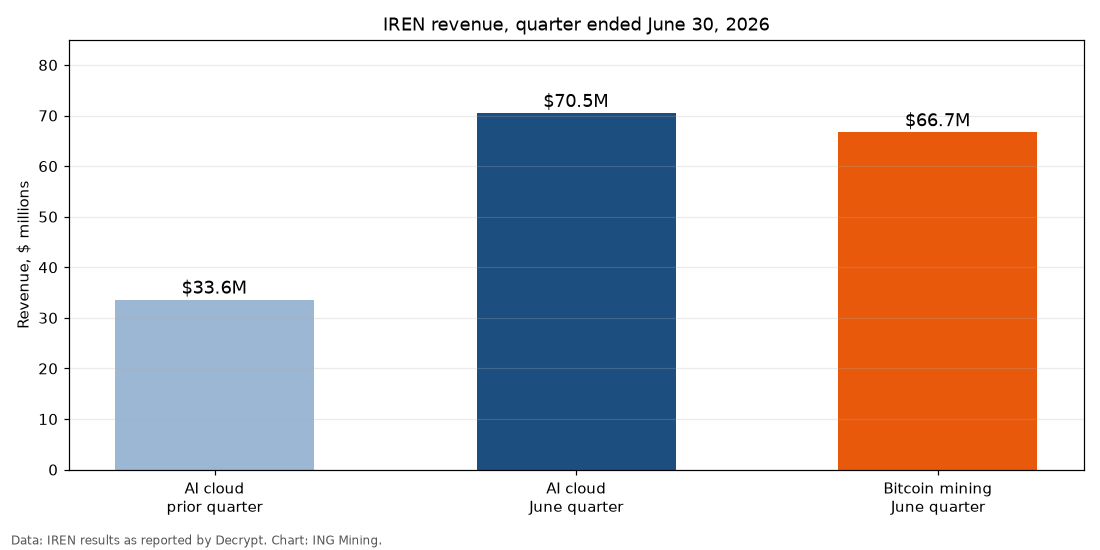
IREN’s AI revenue has passed its bitcoin mining revenue for the first time. In the quarter ended June 30, the company booked $70.5 million from AI cloud and $66.7 million from mining. It is the clearest sign yet that some listed miners are turning into AI landlords. Here is what the numbers say, and what we think it means for people who run ASICs.
What IREN reported
The figures come from IREN’s fiscal fourth-quarter results, as reported by Decrypt and ForkLog. AI cloud revenue was $70.5 million, up from $33.6 million the quarter before. That was 51.4% of the total. Mining revenue was $66.7 million, down 40% as sites were converted for AI.
Total revenue was $137.2 million, down 5%. The quarterly loss was $684 million. Most of that was non-cash: $450.4 million in impairments, mainly retired mining hardware, plus $127.2 million in write-downs on equipment held for sale or disposed of. Adjusted EBITDA fell to $19.2 million from $59.5 million.
The full year still favours mining
Do not over-read one quarter. For the full fiscal year, IREN’s 10-K shows $128.8 million of AI cloud revenue against $578.2 million from bitcoin mining. Mining still dominated the year. The crossover is a snapshot of where the business is heading, not where it has been.
The contracts behind it
IREN says it has $4 billion of contracted annualised AI revenue, with $1 billion operating as of August 26. It says the rest will be running by year-end. Those are company statements, and the revenue is not booked yet. The deals include a $9.7 billion, five-year cloud agreement with Microsoft and a $3.4 billion, five-year contract from Nvidia signed in May.
Co-CEO Daniel Roberts put the limit plainly: “the digital world can scale almost instantly, but the physical world cannot.” Power and buildings are the bottleneck. That is exactly what bitcoin miners already own.
Is this a wider trend?
CoinShares research, relayed by TFTC, says AI and HPC could reach up to 70% of listed miners’ revenue by the end of 2026, from about 30% at the start of the year. That is a projection, not a measurement. It also puts AI at about $1.5 million of revenue per megawatt per year, against about $500,000 for bitcoin mining. Converting a site costs far more, though, at $10 million to $15 million per megawatt by one estimate.
The pivot has not killed the network. Hashrate recovered above 1 ZH/s on a seven-day average on October 22, according to one report, and sources put it between 6.5% and 8.8% below its record. They disagree on the exact level, so we are giving the range and not picking one. Private operators and cheap-power regions look to be filling the gap.
What we think it means for ASIC owners
First, listed miners that retire machines are not buying more. Less demand for new hardware helps used-machine buyers. Second, the best power contracts are being bid for by AI, which makes cheap electricity harder to find. Third, a miner that moves to AI does not need its old fleet, and some of it will reach the used market.
None of that changes the basic test. Does the machine earn more than its power costs? Our mining economics guides work through that on real machines. You can browse every miner in stock, or sell us your used miners if the maths says it is time to get out. For where bitcoin itself may head, see our Bitcoin price prediction.
-Nick
ING Mining
This is general information, not financial advice. Crypto is volatile, and you can lose money. Please do your own research.