
The Hut 8 bitcoin sale is 3,102 BTC, and the cash paid for a $250 million stock buyback. Hut 8 reported its third quarter on November 4. 24/7 Wall St. gives the details, and the company’s own release confirms the buyback.
How the Hut 8 bitcoin sale funded the buyback
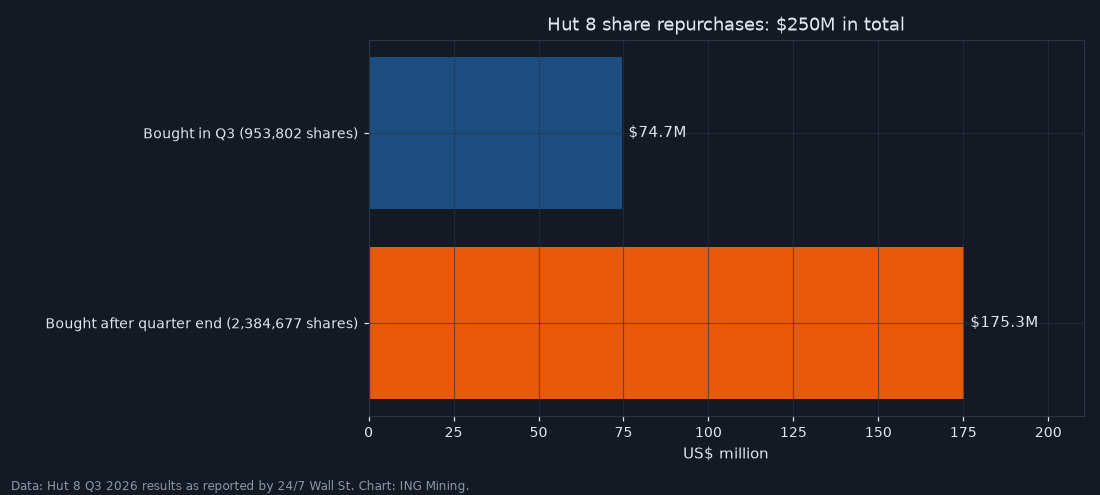
Hut 8 says it returned $250.0 million to shareholders through repurchases. According to 24/7 Wall St., it bought 3,338,479 shares in total. In addition, that was 953,802 shares for $74.7 million in the quarter, and 2,384,677 shares for $175.3 million after it ended. Meanwhile, the board then added $750 million on November 2. Overall, the total authorization is now $1 billion, with no expiry date.
The outlet says Hut 8 sold roughly 954 BTC in the quarter for $74.8 million, and kept selling afterwards. Likewise, it adds that Hut 8 did not disclose an average price for all 3,102 BTC or name a buyer. Also, we cannot fill that gap, so we will not guess.
CEO Asher Genoot is paraphrased as saying that paying with bitcoin kept cash on hand and cut exposure to bitcoin at the parent level. He also said “cash will be king” in a volatile market, per the same report.
The rest of the quarter
Revenue came in at $71.1 million, which 24/7 Wall St. says missed the $77 million analysts expected by 7.6%. In addition, net income was $189.5 million, driven mainly by a $413.8 million gain on digital assets. Meanwhile, that is a paper gain, not cash from mining. Overall, interest expense rose to $105.5 million.
The company says it fully commercialized its Beacon Point AI campus and closed a $1.07 billion revolving credit facility. Likewise, the outlet puts the AI contract pipeline at about $26.6 billion across 949 MW. Hut 8 held about 1,361 unencumbered BTC on November 1 and did not commit to keeping them. Also, we covered the setup in our Hut 8 earnings preview.
What this means for miners
Riot did it, and now Hut 8 did it too. Public miners are selling coins to fund AI buildouts and buybacks. In addition, the coins they hold are not a long-term floor under the price. As a result, a miner’s bitcoin pile tells you little about its plans.
Miner math: what the Hut 8 bitcoin sale means for your margin
Here is the live maths on November 4. Meanwhile, bitcoin is $80,310 and the network is 1021 EH/s, so hashprice is about $35.60 per petahash per day. Overall, that is what one PH/s of hashing earns before power.
| Machine | 5c/kWh | 8c/kWh | 12c/kWh | Break-even |
|---|---|---|---|---|
| Antminer S19 (95 TH/s, 3250 W) | -$0.52 | -$2.86 | -$5.98 | 4.3c |
| Antminer S19k Pro (115 TH/s, 2645 W) | $0.92 | -$0.98 | -$3.52 | 6.4c |
| Antminer S19 XP (141 TH/s, 3010 W) | $1.41 | -$0.76 | -$3.65 | 6.9c |
| Antminer S21 Pro (234 TH/s, 3510 W) | $4.12 | $1.59 | -$1.78 | 9.9c |
Numbers are profit per day after electricity, at the three power prices shown. Break-even is the most you can pay per kilowatt-hour before the machine loses money. Specs are the manufacturer ratings; network data comes from mempool.space. Try your own power price in our free bitcoin mining profit calculator. See what these machines really sold for in our used ASIC miner price index. Want to run the same numbers on a machine you can buy today? See our used ASIC miners, or buy several at once through bulk lots.
If miner selling pushes bitcoin down 5%: the break-even power price on an S19k Pro falls from 6.4 to 6.1 cents per kilowatt-hour. At 8 cents, daily profit goes from -$0.98 to -$1.19.
Our view is simple. Treasury sales by a handful of companies do not change difficulty. Your margin still comes from price, hashrate and your power rate. Likewise, run your own rate through the table above. If it fails, see our mining economics guides, or look at bulk used ASIC lots only if the maths clears.
-Nick
ING Mining
This is general information, not financial advice. Crypto is volatile, and exchanges can fail. Please do your own research.
How this story was made: drafted with the help of AI tools from public sources, then edited by Nick Squires. See our editorial policy. Spot an error? Email ns@ingmining.com.