
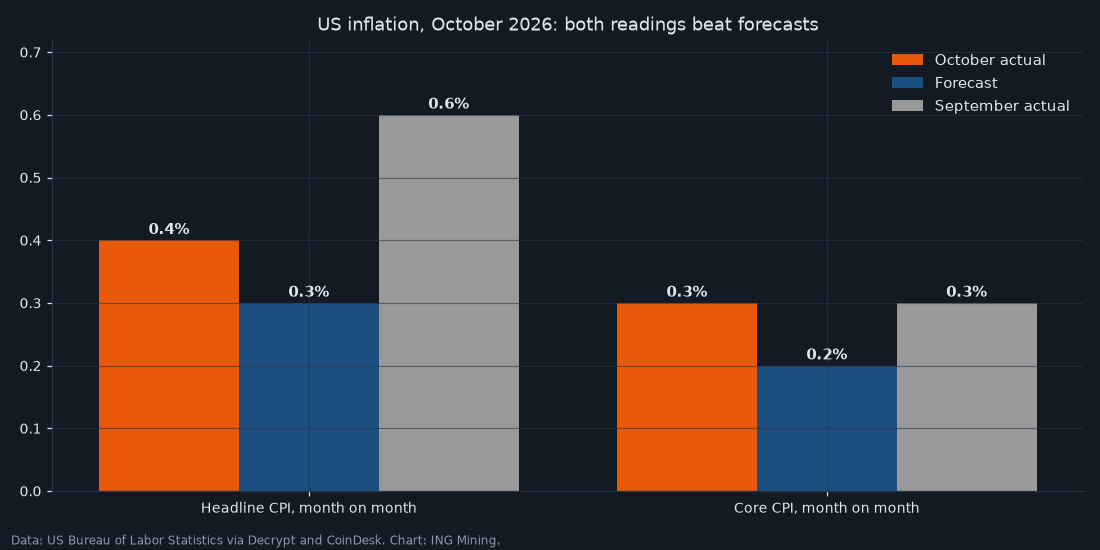
A hot CPI hit bitcoin on November 10. Consumer prices rose 0.4% in October against a 0.3% forecast, and core prices rose 0.3% against 0.2%, according to Decrypt and CoinDesk. Bitcoin briefly fell to about $73,525.
What the hot CPI report said
Headline inflation slowed from 0.6% in September, but traders had wanted a bigger slowdown. Core CPI, which strips out food and energy, matched September’s 0.3% for a third month. Decrypt notes it was the third hotter-than-expected reading in a row. Food rose 0.5% and energy 0.7%.
There is one gap. The government did not publish the usual annual rate, because there was no October 2025 report during the shutdown. The last annual headline figure available was 3.7% for September, according to Decrypt.
How bitcoin and rates reacted
Bitcoin traded near $74,200 before the release and dipped to roughly $73,525. Decrypt reports about $178 million of leveraged long positions were liquidated within an hour. CoinDesk says the 2-year Treasury yield rose 14 basis points to 4.69%, and the 10-year rose 6.5 basis points to 4.93%.
Fed Governor Christopher Waller added fuel hours earlier. He said he would back a quarter-point hike in December, and that a 50-basis-point move “should be considered” if core CPI stayed hot. Per Reuters, as cited by Decrypt, the market put roughly a 15% chance on a 50-basis-point hike. The Fed’s range is currently 3.75% to 4%.
Why a hot CPI matters to miners
Higher rates hurt miners twice. First, they weigh on the bitcoin price, which sets the dollar value of every block. Second, they raise the cost of the loans many miners use to buy machines and build sites. Spot bitcoin ETFs also saw $201 million of net outflows on Monday, per Decrypt.
We can show the first effect of a hot CPI with numbers. The table below uses live data. Then we test a further drop in price.
Miner math: bitcoin hashprice today
Here is the live maths on November 10. Bitcoin is $73,383 and the network is 962 EH/s, so hashprice is about $34.60 per petahash per day. That is what one PH/s of hashing earns before power.
| Machine | 5c/kWh | 8c/kWh | 12c/kWh | Break-even |
|---|---|---|---|---|
| Antminer S19 (95 TH/s, 3250 W) | -$0.61 | -$2.95 | -$6.07 | 4.2c |
| Antminer S19k Pro (115 TH/s, 2645 W) | $0.80 | -$1.10 | -$3.64 | 6.3c |
| Antminer S19 XP (141 TH/s, 3010 W) | $1.27 | -$0.90 | -$3.79 | 6.8c |
| Antminer S21 Pro (234 TH/s, 3510 W) | $3.88 | $1.36 | -$2.01 | 9.6c |
Numbers are profit per day after electricity, at the three power prices shown. Break-even is the most you can pay per kilowatt-hour before the machine loses money. Specs are the manufacturer ratings; network data comes from mempool.space. Try your own power price in our free bitcoin mining profit calculator. See what these machines really sold for in our used ASIC miner price index. Want to run the same numbers on a machine you can buy today? See our used ASIC miners, or buy several at once through bulk lots.
If bitcoin slips another 5% after the CPI: the break-even power price on an S19k Pro falls from 6.3 to 6.0 cents per kilowatt-hour. At 8 cents, daily profit goes from -$1.10 to -$1.30.
Our verdict: inflation data will keep driving the price near term, and miners cannot control it. What they can control is power cost and machine cost. Run your own break-even against the table, using our mining economics guides. Our Bitcoin price prediction page tracks the ranges we expect. If the maths fails, sell us your used miners, or look at all miners if it holds.
-Nick
ING Mining
This is general information, not financial advice. Crypto is volatile, and exchanges can fail. Please do your own research.
How this story was made: drafted with the help of AI tools from public sources, then edited by Nick Squires. See our editorial policy. Spot an error? Email ns@ingmining.com.