The FCA DeFi rules will be tougher in the UK than in the US or EU. The Financial Times reported it on Thursday, November 26, and Decrypt, Finance Magnates and crypto.news all repeat the core of it. The regulator points to the Binance hack as a reason.
What the FCA plans for DeFi platforms
Britain’s Financial Conduct Authority plans to make DeFi platforms get authorized under its incoming crypto regime. UK-regulated exchanges will not be allowed to execute retail trades on DeFi platforms. Jane Moore, the FCA’s head of payments and digital assets, told the FT the divide is deliberate because DeFi has little consumer protection, per Decrypt.
Also, the FCA plans to require all UK retail equity orders, tokenized or not, to run on a regulated platform. That cuts off offshore DeFi venues for tokenized stocks.
Why the FCA cites the Binance hack
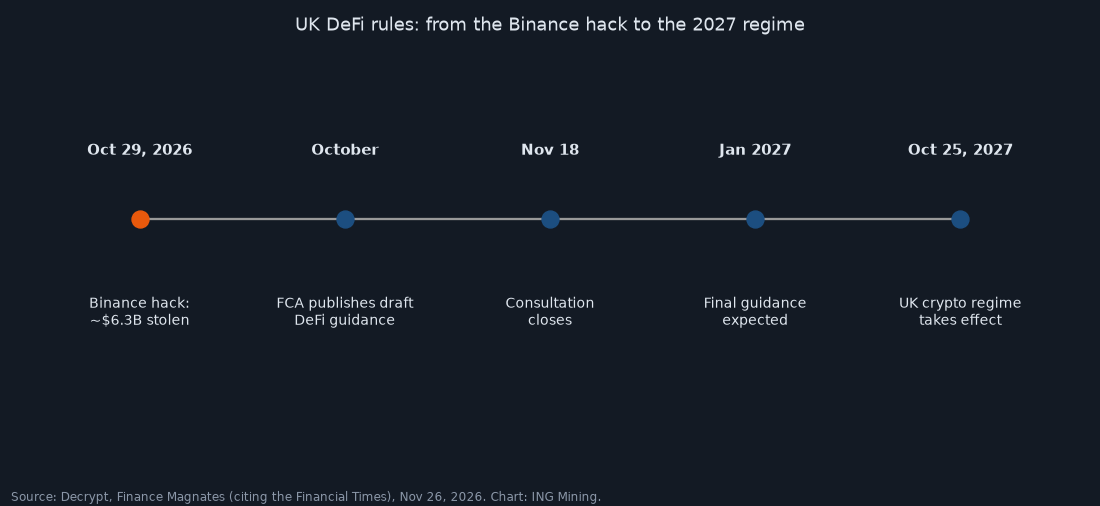
The regulator pointed to the record hack of Binance in October. Decrypt gives the figure as $6.4 billion. Finance Magnates and crypto.news say $6.3 billion. Sources differ, so call it roughly $6.3 to $6.4 billion. Finance Magnates dates the attack to October 29.
Binance is a centralized exchange. The point is where the money went next. Decrypt says the hackers moved large sums through decentralized exchanges, which do not freeze funds. Moore said the speed and scale of that movement can frustrate attempts to freeze and block transfers. Finance Magnates adds that attackers linked to North Korea reportedly used protocols including THORChain. That attribution is reported, not proven here.
What is still not final
Still, this is a plan, not a rule. Per Decrypt, the FCA published draft DeFi guidance in October and the consultation closed on November 18. It expects final guidance in January 2027. The crypto regime takes effect on October 25, 2027. Aave Labs and Coinbase say the UK risks falling behind the US and EU, which are building regulated routes to DeFi. CryptoUK has also pushed back, per the reports.
Miner math: what the FCA DeFi rules mean for your margin
Here is the live maths on November 26. Bitcoin is $60,632 and the network is 1057 EH/s, so hashprice is about $25.94 per petahash per day. That is what one PH/s of hashing earns before power.
| Machine | 5c/kWh | 8c/kWh | 12c/kWh | Break-even |
|---|---|---|---|---|
| Antminer S19 (95 TH/s, 3250 W) | -$1.44 | -$3.78 | -$6.90 | 3.2c |
| Antminer S19k Pro (115 TH/s, 2645 W) | -$0.19 | -$2.10 | -$4.63 | 4.7c |
| Antminer S19 XP (141 TH/s, 3010 W) | $0.05 | -$2.12 | -$5.01 | 5.1c |
| Antminer S21 Pro (234 TH/s, 3510 W) | $1.86 | -$0.67 | -$4.04 | 7.2c |
Numbers are profit per day after electricity, at the three power prices shown. Break-even is the most you can pay per kilowatt-hour before the machine loses money. Specs are the manufacturer ratings; network data comes from mempool.space. Try your own power price in our free bitcoin mining profit calculator. See what these machines really sold for in our used ASIC miner price index. Want to run the same numbers on a machine you can buy today? See our used ASIC miners, or buy several at once through bulk lots.
If regulation fear knocks bitcoin down 5%: the break-even power price on an S19k Pro falls from 4.7 to 4.5 cents per kilowatt-hour. At 8 cents, daily profit goes from -$2.10 to -$2.24.
The blunt answer for miners
Nothing here touches your hashrate or your block reward. The final rules are due in 2027. Network hashrate sits near 1057 EH/s per mempool.space. The only channel to your margin is price, and the FCA DeFi rules are a small input to that. We would not trade on it.
However, the bigger lesson is the hack itself. Regulators now use one exchange breach to justify rules on a whole sector. If your machine loses money at your power price, see our we buy used miners page or the mining economics guides. Our Bitcoin price prediction page has the ranges we expect.
-Nick
ING Mining
This is general information, not financial advice. Crypto is volatile, and exchanges can fail. Please do your own research.
How this story was made: drafted with the help of AI tools from public sources, then edited by Nick Squires. See our editorial policy. Spot an error? Email ns@ingmining.com.