
House Democrats are discussing a broader crypto market structure bill for the next Congress. Journalist Eleanor Terrett broke the scoop on November 4, and Decrypt reported it. The plan would give the SEC more power over crypto markets and limit the role of the CFTC, sources told Terrett.
What the crypto market structure bill would change
The idea is to expand the Crypto Investor and Consumer Bill of Rights, a Clarity Act amendment from Rep. Maxine Waters in 2025. It would grow into a full market structure bill. At this stage it is a report based on sources, and no text has been released.
The Clarity Act itself stalled in the Senate earlier this year. Democrats pushed back on it, citing Trump’s crypto conflicts of interest. Sen. Elizabeth Warren wants a ban on officials and their families profiting from the sector.
What the midterms did for crypto
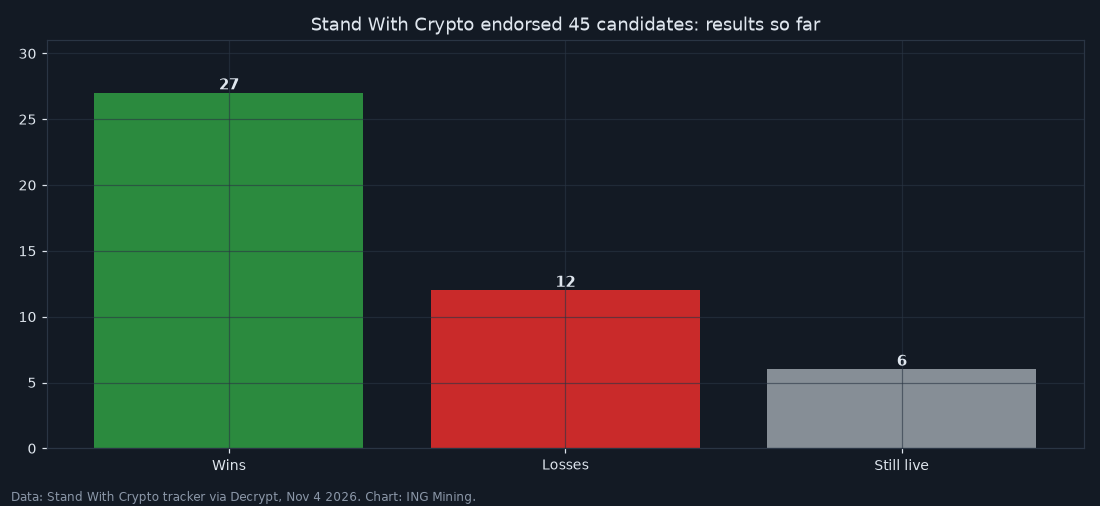
The picture is mixed. Stand With Crypto endorsed 45 candidates. Per its tracker, 27 won, 12 lost and six races were still live when Decrypt wrote. Nearly half of the endorsed candidates were Democrats. The group also counts more than 50 pro-crypto new members heading to Congress.
On the other side, CoinShares’ research head James Butterfill called the loss of Rep. Bryan Steil a “meaningful loss”. Steil chaired the House digital assets subcommittee. Butterfill added that crypto is relying less on the Clarity Act, because the SEC and CFTC are pushing for clarity without Congress. As a result, the bigger question is whether support turns into law.
We covered the other side of this recently in our post on what the House result means for bitcoin miners. Meanwhile, bitcoin trades near $75,903. See our bitcoin price prediction for the ranges.
Miner math: what policy risk does not change about your S19
Here is the live maths on November 5. Bitcoin is $75,903 and the network is 1015 EH/s, so hashprice is about $33.90 per petahash per day. That is what one PH/s of hashing earns before power.
| Machine | 5c/kWh | 8c/kWh | 12c/kWh | Break-even |
|---|---|---|---|---|
| Antminer S19 (95 TH/s, 3250 W) | -$0.68 | -$3.02 | -$6.14 | 4.1c |
| Antminer S19k Pro (115 TH/s, 2645 W) | $0.72 | -$1.18 | -$3.72 | 6.1c |
| Antminer S19 XP (141 TH/s, 3010 W) | $1.17 | -$1.00 | -$3.89 | 6.6c |
| Antminer S21 Pro (234 TH/s, 3510 W) | $3.72 | $1.19 | -$2.18 | 9.4c |
Numbers are profit per day after electricity, at the three power prices shown. Break-even is the most you can pay per kilowatt-hour before the machine loses money. Specs are the manufacturer ratings; network data comes from mempool.space. Try your own power price in our free bitcoin mining profit calculator. See what these machines really sold for in our used ASIC miner price index. Want to run the same numbers on a machine you can buy today? See our used ASIC miners, or buy several at once through bulk lots.
If clearer rules lift bitcoin 5%: the break-even power price on an S19k Pro rises from 6.1 to 6.4 cents per kilowatt-hour. At 8 cents, daily profit goes from -$1.18 to -$0.98.
The blunt answer for miners
None of the sources we read mention mining at all. Therefore, we cannot say this bill changes anything for a miner. It is about market oversight, not hashing. What moves your margin is price and hashrate, now near 1015 EH/s. A bill that is only at the discussion stage moves neither. Still, rules that reach exchanges and token sales can sway sentiment, and sentiment moves price. In short, watch the text when it appears. Until then, run the table at your power price.
To check a machine, use our mining economics guides, or browse the miners in stock.
-Nick
ING Mining
This is general information, not financial advice. Crypto is volatile, and exchanges can fail. Please do your own research.
How this story was made: drafted with the help of AI tools from public sources, then edited by Nick Squires. See our editorial policy. Spot an error? Email ns@ingmining.com.