
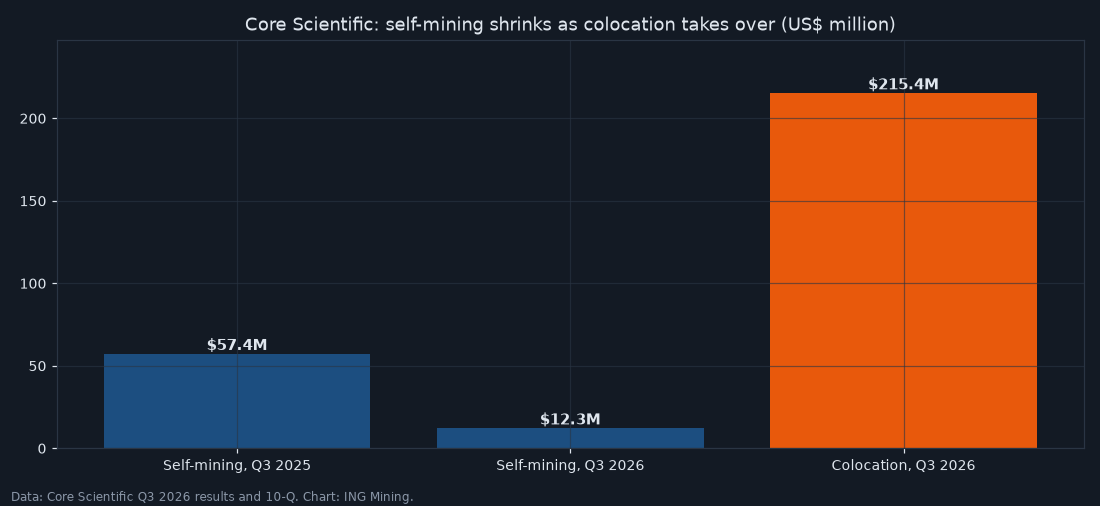
The Core Scientific mining exit is nearly done. Self-mining brought in just $12.3 million in the third quarter, down from $57.4 million a year earlier, according to the company’s 10-Q filing. As a result, colocation for AI customers now earns almost everything.
What the Core Scientific mining exit looks like in the numbers
In its third-quarter release, Core Scientific put total revenue at $232.9 million, up from $81.1 million a year ago. Colocation revenue was $215.4 million. Adjusted EBITDA was $133.6 million. Furthermore, the company was billing for 485 MW of capacity, up from 395 MW in the second quarter.
Net income was $1.18 billion. However, the company says that was driven mainly by the change in fair value of its warrants, not by operations. Also, capital spending in the quarter was $985.1 million, so the build-out is still eating cash.
When the Core Scientific mining exit finishes
Management said on the earnings call that it had nearly 50% fewer miners online at the end of September than at the end of 2025. In short, it expects to finish the wind-down in the fourth quarter and enter 2027 as a pure colocation provider. That timing comes from the call, as summarised from the transcript, and not from a signed filing. Earlier in the year, the company also paid $41.9 million to end a chip supply deal with Block and its Proto unit, as Forklog reported.
For context, bitcoin trades near $76,023 today. Our bitcoin price prediction page tracks where the model sees it going.
Miner math: what a big miner leaving does to your margin
Here is the live maths on November 5. Bitcoin is $76,023 and the network is 1015 EH/s, so hashprice is about $33.96 per petahash per day. That is what one PH/s of hashing earns before power.
| Machine | 5c/kWh | 8c/kWh | 12c/kWh | Break-even |
|---|---|---|---|---|
| Antminer S19 (95 TH/s, 3250 W) | -$0.67 | -$3.01 | -$6.13 | 4.1c |
| Antminer S19k Pro (115 TH/s, 2645 W) | $0.73 | -$1.17 | -$3.71 | 6.2c |
| Antminer S19 XP (141 TH/s, 3010 W) | $1.18 | -$0.99 | -$3.88 | 6.6c |
| Antminer S21 Pro (234 TH/s, 3510 W) | $3.73 | $1.21 | -$2.16 | 9.4c |
Numbers are profit per day after electricity, at the three power prices shown. Break-even is the most you can pay per kilowatt-hour before the machine loses money. Specs are the manufacturer ratings; network data comes from mempool.space. Try your own power price in our free bitcoin mining profit calculator. See what these machines really sold for in our used ASIC miner price index. Want to run the same numbers on a machine you can buy today? See our used ASIC miners, or buy several at once through bulk lots.
If the network lost 3% of its hashrate as more miners follow Core Scientific: the break-even power price on an S19k Pro rises from 6.2 to 6.3 cents per kilowatt-hour. At 8 cents, daily profit goes from -$1.17 to -$1.05.
The blunt answer for miners
Core Scientific’s mining was a small slice of a network running near 1015 EH/s. Therefore, its exit alone will not rescue anyone’s margin. Still, the direction is clear. Public miners keep choosing AI hosting over hashing, so the machines they retire have to go somewhere. In addition, fewer big miners can mean slower difficulty growth, and that helps the rest of us a little. For that reason, we would not buy a rig on that hope. Read the table against your own power price first.
If the maths says a machine loses money for you, see our we buy used miners page. If you want to buy at today’s used prices, browse the miners in stock.
-Nick
ING Mining
This is general information, not financial advice. Crypto is volatile, and exchanges can fail. Please do your own research.
How this story was made: drafted with the help of AI tools from public sources, then edited by Nick Squires. See our editorial policy. Spot an error? Email ns@ingmining.com.