
The Coldcard exploit slipped past at least 15 security reviews over five years, according to the maker’s own postmortem. Decrypt and CryptoSlate both cover the report, which Coinkite published on November 24. Here is what went wrong, how much was taken, and what a bitcoin holder should do.
What caused the Coldcard exploit
From March 2021 until July 2026, Coldcard firmware made wallet seeds with a software random-number generator. It should have used the hardware chip. Decrypt says this left seeds with roughly 40 to 72 bits of effective randomness, not the 128-bit target. That is weak enough for attackers to rebuild private keys offline, without touching a device.
Coinkite says it found the defect on July 30, after the first reported thefts, and shipped corrected firmware the next day, per CryptoSlate. Per CryptoSlate, five models were affected: Mk2, Mk3, Mk4, Mk5 and Q.
Why 15 reviews missed it
Coinkite counts at least 15 review efforts from 2021 to 2026. They include two paid audits and an AI-assisted review that produced 85 findings. None caught the flaw. The report says release checks confirmed the hardware code existed, but not that seed generation used it. In its words, each check answered “a nearby question rather than the critical one”.
How much was stolen
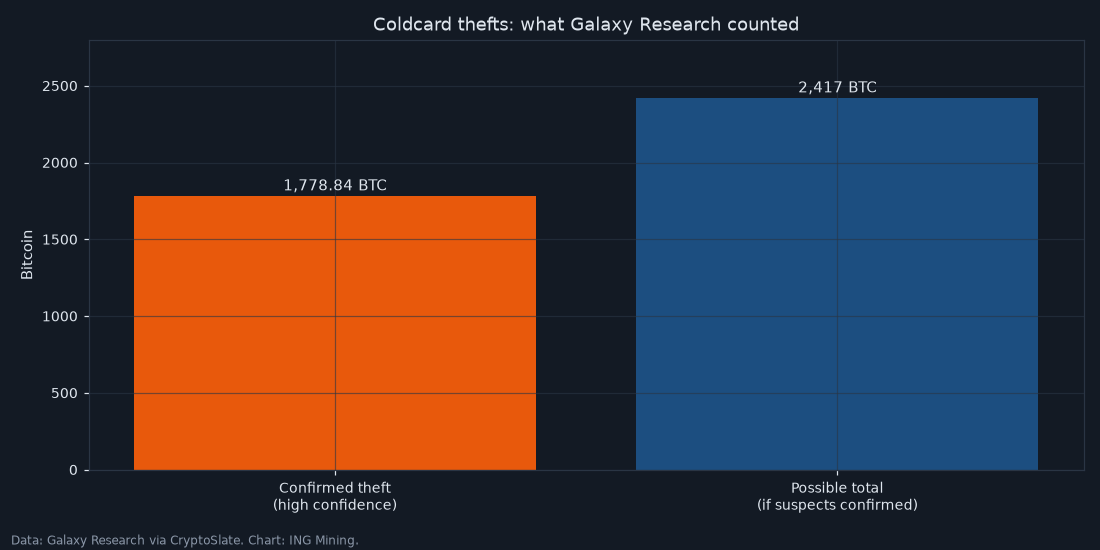
Galaxy Research identified 1,778.84 BTC, worth $112.7 million at the time, taken from more than 8,600 addresses. Galaxy says losses could reach 2,417 BTC, about $153 million, if more suspected thefts are confirmed. Coinkite matched about 300 support tickets to roughly 236 to 242 accounts, depending on the outlet. The company says its own count and Galaxy’s count measure different things. We cannot add them up.
What to do after the Coldcard exploit
The fix does not repair old seeds. Decrypt and CryptoSlate both say affected owners must create a new seed and move their coins. Coinkite bases the advice on how the original recovery phrase was made, and it lists an exception for qualifying private dice rolls. Check its postmortem for your case.
Miners should note one thing here. Many of us hold our rewards in hardware wallets. A wallet is only as good as the randomness behind its seed. We would audit where every coin sits, as we said in our Binance withdrawals report.
Miner math: bitcoin hashprice today
Here is the live maths on November 28. Bitcoin is $59,443 and the network is 1008 EH/s, so hashprice is about $26.74 per petahash per day. That is what one PH/s of hashing earns before power.
| Machine | 5c/kWh | 8c/kWh | 12c/kWh | Break-even |
|---|---|---|---|---|
| Antminer S19 (95 TH/s, 3250 W) | -$1.36 | -$3.70 | -$6.82 | 3.3c |
| Antminer S19k Pro (115 TH/s, 2645 W) | -$0.10 | -$2.00 | -$4.54 | 4.8c |
| Antminer S19 XP (141 TH/s, 3010 W) | $0.16 | -$2.01 | -$4.90 | 5.2c |
| Antminer S21 Pro (234 TH/s, 3510 W) | $2.04 | -$0.48 | -$3.85 | 7.4c |
Numbers are profit per day after electricity, at the three power prices shown. Break-even is the most you can pay per kilowatt-hour before the machine loses money. Specs are the manufacturer ratings; network data comes from mempool.space. Try your own power price in our free bitcoin mining profit calculator. See what these machines really sold for in our used ASIC miner price index. Want to run the same numbers on a machine you can buy today? See our used ASIC miners, or buy several at once through bulk lots.
If wallet-security fears cost bitcoin 5%: the break-even power price on an S19k Pro falls from 4.8 to 4.6 cents per kilowatt-hour. At 8 cents, daily profit goes from -$2.00 to -$2.16.
That is a what-if. This theft does not change hashprice, but it can change how you store what you earn. See the mining economics guides, browse all miners, or sell us your used miners.
-Nick
ING Mining
This is general information, not financial advice. Crypto is volatile, and exchanges can fail. Please do your own research.
How this story was made: drafted with the help of AI tools from public sources, then edited by Nick Squires. See our editorial policy. Spot an error? Email ns@ingmining.com.