
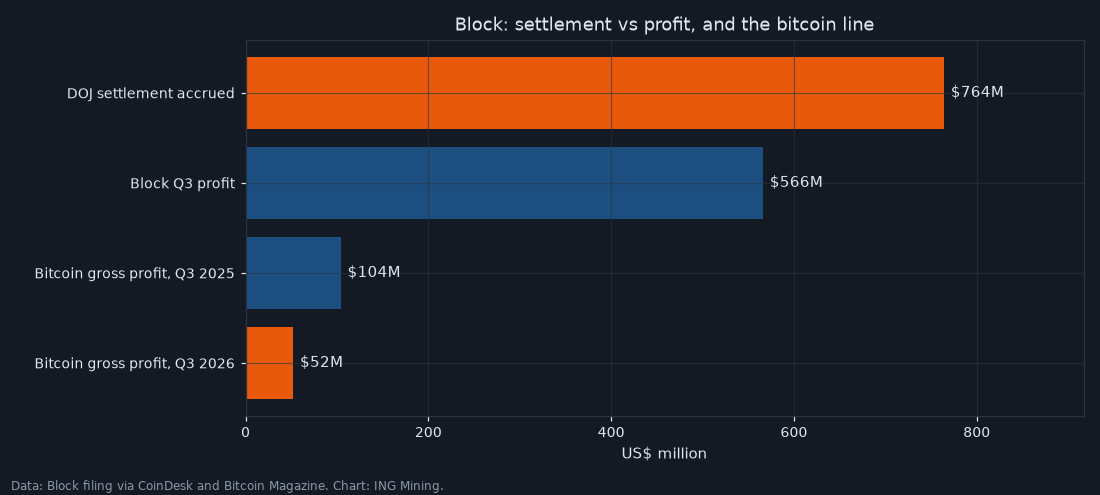
The Block DOJ settlement is $764 million, bigger than the $566 million profit Block earned in the third quarter. Block agreed in principle to pay it to end a Justice Department anti-money-laundering probe, per CoinDesk and Bitcoin Magazine. Block also said its bitcoin gross profit halved.
What the Block DOJ settlement covers
Both outlets cite a 10-Q filed on November 3. In addition, the deal was reached in October. Meanwhile, it would defer a criminal charge for three years. Overall, the charge is failing to maintain an effective anti-money-laundering program under the Bank Secrecy Act. Likewise, the gross figure is about $964 million, cut to $764 million after credits for earlier settlements. Block has accrued the full $764 million.
Two caveats matter. Block says it disputes the basis and methodology of the government’s assessment. Block also says further losses above the accrual are reasonably possible, and the deal still needs final approval. Also, it is not final until then.
The probe traces back to a 2023 short-seller report, which Block called inaccurate and misleading. In addition, the SEC closed its own probe in March without recommending enforcement. In April 2025, New York regulators fined Block $40 million.
Block bitcoin profit fell 50%
Bitcoin gross profit dropped 50% to $52 million from $104 million. Meanwhile, bitcoin revenue fell 11% to $1.8 billion. Block blames its decision to cut fees on certain bitcoin transactions. Overall gross profit still rose 22% to $3.24 billion, led by Cash App.
What the Block DOJ settlement means for miners
Block is a large bitcoin buyer through Cash App, so retail demand matters to the price. Overall, lower fees can bring more users, but they cut Block’s own take. A $764 million cash charge does not stop that buying by itself. Likewise, we have no evidence that it will, and Block has not said so.
Miner math: what Block’s bitcoin slowdown means for your S19
Here is the live maths on November 4. Also, bitcoin is $80,315 and the network is 1020 EH/s, so hashprice is about $35.64 per petahash per day. In addition, that is what one PH/s of hashing earns before power.
| Machine | 5c/kWh | 8c/kWh | 12c/kWh | Break-even |
|---|---|---|---|---|
| Antminer S19 (95 TH/s, 3250 W) | -$0.51 | -$2.85 | -$5.97 | 4.3c |
| Antminer S19k Pro (115 TH/s, 2645 W) | $0.92 | -$0.98 | -$3.52 | 6.5c |
| Antminer S19 XP (141 TH/s, 3010 W) | $1.41 | -$0.75 | -$3.64 | 7.0c |
| Antminer S21 Pro (234 TH/s, 3510 W) | $4.13 | $1.60 | -$1.77 | 9.9c |
Numbers are profit per day after electricity, at the three power prices shown. Break-even is the most you can pay per kilowatt-hour before the machine loses money. Specs are the manufacturer ratings; network data comes from mempool.space. Try your own power price in our free bitcoin mining profit calculator. See what these machines really sold for in our used ASIC miner price index. Want to run the same numbers on a machine you can buy today? See our used ASIC miners, or buy several at once through bulk lots.
If weaker retail demand trims bitcoin 3%: the break-even power price on an S19k Pro falls from 6.5 to 6.3 cents per kilowatt-hour. At 8 cents, daily profit goes from -$0.98 to -$1.10.
Plainly, this is a compliance story, not a hashprice story. Your margin still depends on bitcoin, difficulty and power. For the wider exchange picture, see our Coinbase cold storage report and our mining economics guides. Sellers can use we buy used miners.
-Nick
ING Mining
This is general information, not financial advice. Crypto is volatile, and exchanges can fail. Please do your own research.
How this story was made: drafted with the help of AI tools from public sources, then edited by Nick Squires. See our editorial policy. Spot an error? Email ns@ingmining.com.