
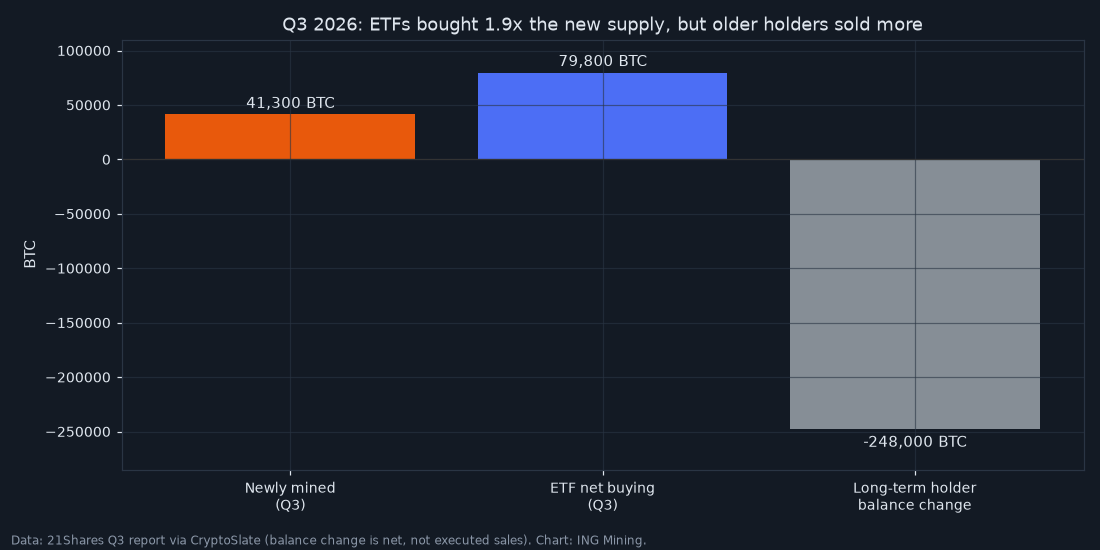
Bitcoin ETF buying in Q3 was 79,800 BTC. Miners produced 41,300 BTC. That is about 1.9 times the new supply, per a 21Shares report that CryptoSlate covered on November 6. The same day brought a reminder of how fragile that demand is: about $430 million left the US spot funds on Thursday, November 5.
What the numbers say
The 79,800 and 41,300 BTC figures come from 21Shares, covering Q3 through September 30. The “nearly twice” ratio is our own division of those two numbers. Most of the buying was bunched up. August 17-27 and September 21-25 made up 91% of Q3 ETF inflows measured in bitcoin.
The report also shows long-term-holder balances falling by 248,000 BTC in Q3. CryptoSlate stresses this is a net balance change, not a measured total of executed sales. So the honest read is simple, and also less comfortable: funds soaked up new supply, but older holders moved a lot more coin than the funds bought.
The $430 million outflow
Farside Investors data, cited by CryptoSlate and crypto.news, puts the US spot bitcoin ETF net outflow at $430 million on November 5. Fidelity’s FBTC was the biggest part, at roughly $200 million. We covered the wider $530 million bitcoin-plus-ether day in our ETF outflow report. This piece is about the supply comparison.
However, a quarter of strong buying does not mean steady buying. Two short windows did almost all of the work, so steady bitcoin ETF buying is not what the data shows. Meanwhile, the latest week is going the other way.
Miner math: what ETF demand versus miner supply means for your margin
Here is the live maths on November 6. Bitcoin is $75,925 and the network is 1032 EH/s, so hashprice is about $33.40 per petahash per day. That is what one PH/s of hashing earns before power.
| Machine | 5c/kWh | 8c/kWh | 12c/kWh | Break-even |
|---|---|---|---|---|
| Antminer S19 (95 TH/s, 3250 W) | -$0.73 | -$3.07 | -$6.19 | 4.1c |
| Antminer S19k Pro (115 TH/s, 2645 W) | $0.67 | -$1.24 | -$3.78 | 6.1c |
| Antminer S19 XP (141 TH/s, 3010 W) | $1.10 | -$1.07 | -$3.96 | 6.5c |
| Antminer S21 Pro (234 TH/s, 3510 W) | $3.60 | $1.08 | -$2.29 | 9.3c |
Numbers are profit per day after electricity, at the three power prices shown. Break-even is the most you can pay per kilowatt-hour before the machine loses money. Specs are the manufacturer ratings; network data comes from mempool.space. Try your own power price in our free bitcoin mining profit calculator. See what these machines really sold for in our used ASIC miner price index. Want to run the same numbers on a machine you can buy today? See our used ASIC miners, or buy several at once through bulk lots.
If ETF outflows continue and bitcoin drops another 10%: the break-even power price on an S19k Pro falls from 6.1 to 5.4 cents per kilowatt-hour. At 8 cents, daily profit goes from -$1.24 to -$1.62.
What bitcoin ETF buying means for miners
Miners sell new coin into this market every day. Q3 issuance of 41,300 BTC was absorbed because ETF buyers showed up in bursts. When the bursts stop, the price has to find other buyers, and you feel it in hashprice first. Our live bitcoin price is $75,925 and hashrate sits near 1032 EH/s per mempool.space. At 8 cents most older machines lose money today, and a 10% drop makes it worse. If you run S19-class hardware above 6 cents, check our we buy used miners page, or read the mining economics guides. Price ranges are on our Bitcoin price prediction page.
-Nick
ING Mining
This is general information, not financial advice. Crypto is volatile, and exchanges can fail. Please do your own research.
How this story was made: drafted with the help of AI tools from public sources, then edited by Nick Squires. See our editorial policy. Spot an error? Email ns@ingmining.com.