
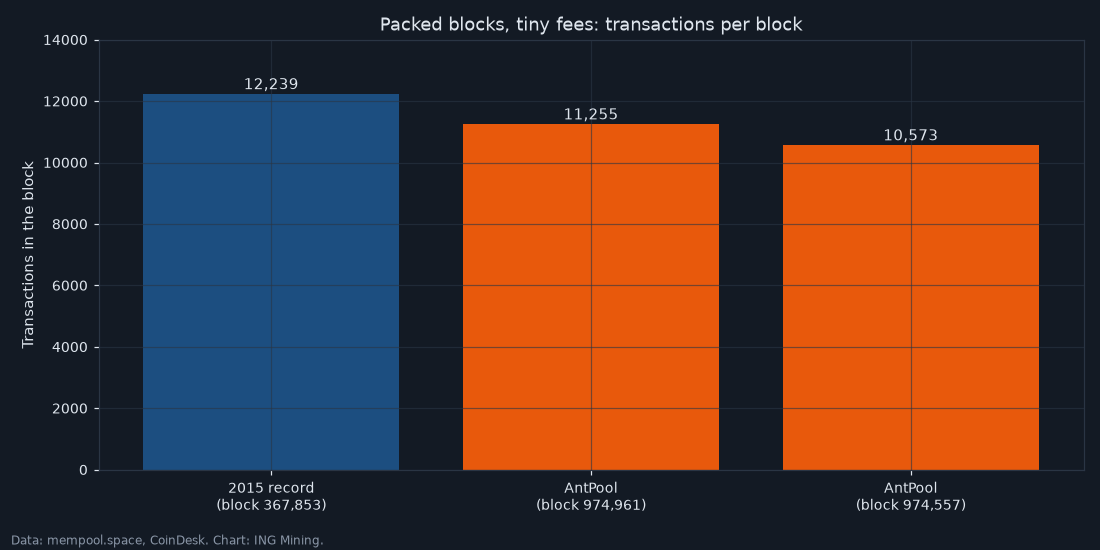
A bitcoin block record nearly fell on Saturday, and miners earned almost nothing extra for it. AntPool mined block 974,961 with 11,255 transactions, according to CoinDesk. The fees came to 240,533 satoshis, about $180. We checked the block data on mempool.space ourselves, and the counts match.
What the bitcoin block record story says
The all-time record is 12,239 transactions, set by F2Pool in block 367,853 on August 1, 2015. Saturday’s block fell 984 short. CoinDesk calls it the second-busiest block ever. Notably, it was the second such block in a week. On November 4, AntPool’s block 974,557 held 10,573 transactions.
The money is the odd part. The block paid out 3.1274 BTC in total, per mempool.space. Of that total, 3.125 BTC is the fixed subsidy. The fees were 0.0024 BTC. Therefore the fees were under 0.1% of the payout. CoinDesk says sampled transactions paid a single satoshi each, and the median fee rate rounds to zero.
Why the bitcoin block record paid so little
CoinDesk reports a run of 80-byte transactions in the block, each paying one satoshi and carrying a small data output. That rate sits below the default relay floor in Bitcoin Core 29.1. The floor is a node policy, not a network rule, so the block is still valid. However, CoinDesk notes that public data does not show how those transactions reached AntPool. We do not know either, so we will not guess.
What it means for miners after the halving
Fees matter more every year, because the subsidy keeps shrinking. It halves to 1.5625 BTC at block 1,050,000, projected for around April 2028, per CoinDesk. Saturday’s fees would cover less than 0.2% of the subsidy miners stand to lose. So, a busy block does not mean a rich block. Fee income is not ready to replace the subsidy.
Miner math: what a machine earns today, fees included
Here is the live maths on November 9. Bitcoin is $74,632 and the network is 968 EH/s, so hashprice is about $35.01 per petahash per day. That is what one PH/s of hashing earns before power.
| Machine | 5c/kWh | 8c/kWh | 12c/kWh | Break-even |
|---|---|---|---|---|
| Antminer S19 (95 TH/s, 3250 W) | -$0.57 | -$2.91 | -$6.03 | 4.3c |
| Antminer S19k Pro (115 TH/s, 2645 W) | $0.85 | -$1.05 | -$3.59 | 6.3c |
| Antminer S19 XP (141 TH/s, 3010 W) | $1.32 | -$0.84 | -$3.73 | 6.8c |
| Antminer S21 Pro (234 TH/s, 3510 W) | $3.98 | $1.45 | -$1.92 | 9.7c |
Numbers are profit per day after electricity, at the three power prices shown. Break-even is the most you can pay per kilowatt-hour before the machine loses money. Specs are the manufacturer ratings; network data comes from mempool.space. Try your own power price in our free bitcoin mining profit calculator. See what these machines really sold for in our used ASIC miner price index. Want to run the same numbers on a machine you can buy today? See our used ASIC miners, or buy several at once through bulk lots.
If difficulty falls about 6.5% at the next adjustment, as the live estimate says: the break-even power price on an S19k Pro rises from 6.3 to 6.8 cents per kilowatt-hour. At 8 cents, daily profit goes from -$1.05 to -$0.77.
Read the table plainly. Hashprice, not block fullness, sets your margin. If your power costs more than the break-even column, a busy mempool will not rescue you. Our mining economics guides show how to check your own number.
If your machines no longer pay, you can sell us your used miners. To buy, see all miners.
-Nick
ING Mining
This is general information, not financial advice. Crypto is volatile, and exchanges can fail. Please do your own research.
How this story was made: drafted with the help of AI tools from public sources, then edited by Nick Squires. See our editorial policy. Spot an error? Email ns@ingmining.com.