
The Bank of England quantum warning is now official. In its Financial Stability Report, published November 26, 2026, the Bank says “quantum computing could compromise widely used cryptography and hence cyber security.” Crypto.news ties it to Bitcoin and Ethereum. It is a long-range risk, not a threat to your miner tomorrow.
What the Bank of England quantum warning says
The report says this “makes an orderly transition to quantum-resistant cryptography a priority.” It also says firms must act now, and it cites a joint consultation paper from the Bank, the PRA and the FCA, published November 19, on cyber risk and resilience. However, the wording is “further ahead.” The Bank does not say a quantum attack is close, and it names no crypto asset in the text we read.
Be careful with the stronger versions. Crypto.news quotes the Bank as calling it an “immediate” priority, and that does not match the report text we read. Crypto Briefing says Governor Andrew Bailey warned that quantum risk should not get lost behind AI, but gives no direct quote. Also, crypto.news reports migration milestones ending in 2035. We could not confirm those in the Bank’s text, so treat them as unconfirmed.
Why Bitcoin and Ethereum are in the story
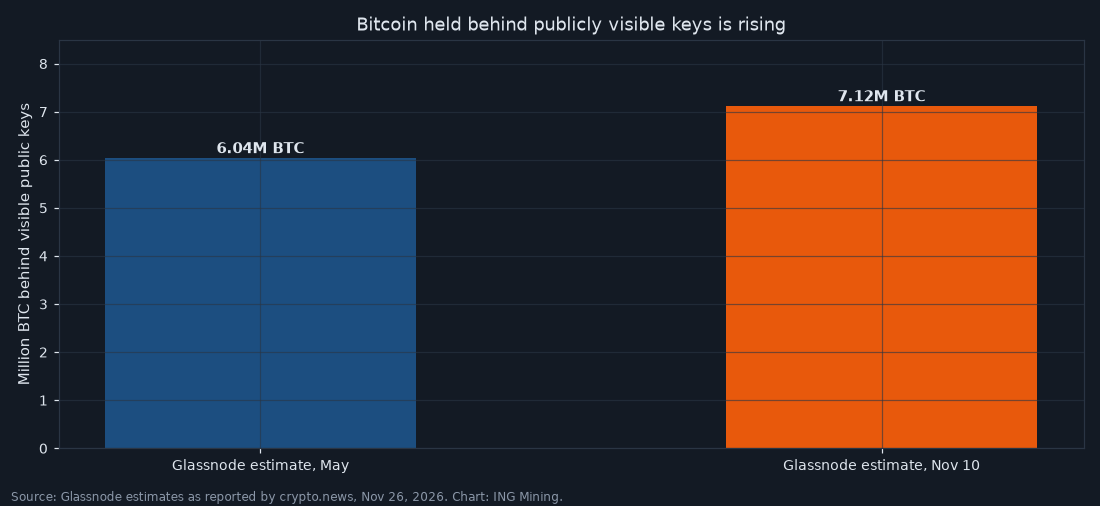
Crypto.news cites Glassnode: about 7.12 million BTC, 35.4% of supply, sat behind publicly visible keys on November 10. The May estimate was 6.04 million BTC. Meanwhile, two proposals, BIP 360 and BIP 361, are under discussion, and crypto.news says neither is active on mainnet. For Ethereum, however, it says researcher Justin Drake proposed December 2028 as a target to finish the cryptographic transition. We covered the Foundation’s side in our Ethereum Foundation quantum piece.
Mining itself is a different question. Quantum attacks target signatures, not the SHA-256 proof of work your rigs run. Still, that is our reading, and the Bank’s text does not discuss mining at all.
Miner math: what the Bank of England quantum warning means for your margin
Here is the live maths on November 26. Bitcoin is $60,810 and the network is 1049 EH/s, so hashprice is about $26.22 per petahash per day. That is what one PH/s of hashing earns before power.
| Machine | 5c/kWh | 8c/kWh | 12c/kWh | Break-even |
|---|---|---|---|---|
| Antminer S19 (95 TH/s, 3250 W) | -$1.41 | -$3.75 | -$6.87 | 3.2c |
| Antminer S19k Pro (115 TH/s, 2645 W) | -$0.16 | -$2.06 | -$4.60 | 4.8c |
| Antminer S19 XP (141 TH/s, 3010 W) | $0.09 | -$2.08 | -$4.97 | 5.1c |
| Antminer S21 Pro (234 TH/s, 3510 W) | $1.92 | -$0.60 | -$3.97 | 7.3c |
Numbers are profit per day after electricity, at the three power prices shown. Break-even is the most you can pay per kilowatt-hour before the machine loses money. Specs are the manufacturer ratings; network data comes from mempool.space. Try your own power price in our free bitcoin mining profit calculator. See what these machines really sold for in our used ASIC miner price index. Want to run the same numbers on a machine you can buy today? See our used ASIC miners, or buy several at once through bulk lots.
If quantum fear knocks 5% off the bitcoin price: the break-even power price on an S19k Pro falls from 4.8 to 4.5 cents per kilowatt-hour. At 8 cents, daily profit goes from -$2.06 to -$2.21.
The blunt answer for miners
Nothing changes in your margin today. A central bank report is not a price event on its own. Hashrate sits near 1049 EH/s per mempool.space, and the table above shows who is profitable now. Overall, the real risk is slow: if quantum fear ever hits the price, a 5% drop is what the scenario shows, and that is small next to a power bill.
If your machine already loses money at your power price, see our we buy used miners page or the mining economics guides. Our Bitcoin price prediction page has the ranges we expect.
-Nick
ING Mining
This is general information, not financial advice. Crypto is volatile, and exchanges can fail. Please do your own research.
How this story was made: drafted with the help of AI tools from public sources, then edited by Nick Squires. See our editorial policy. Spot an error? Email ns@ingmining.com.