
The American Bitcoin Q3 profit of about $126 million is not a mining profit. It is a bitcoin price gain. The company reported on November 4 that it swung from a $57.2 million loss in Q2 to $126 million net income, while mining revenue fell and the cost of each coin it mined rose. The numbers come from the SEC filing, and The Block and CoinDesk report the same headline figures. The miner math is below.
What the American Bitcoin Q3 profit is made of
All figures here are from the company’s own release. Net income was about $126.0 million. Adjusted EBITDA was about $220.8 million. But the release shows a non-cash gain on digital assets of $197.3 million, partly offset by a $64.3 million loss on derivatives. Strip those out and the core business is a smaller story.
Mining revenue was $63.4 million, down from $67.0 million in Q2. Gross profit was about $25.8 million, a 41% margin, against about $33.0 million and 49% a quarter earlier. CoinDesk reports the revenue missed analyst estimates. The release itself makes no such comparison.
Cost per coin is the number miners should watch
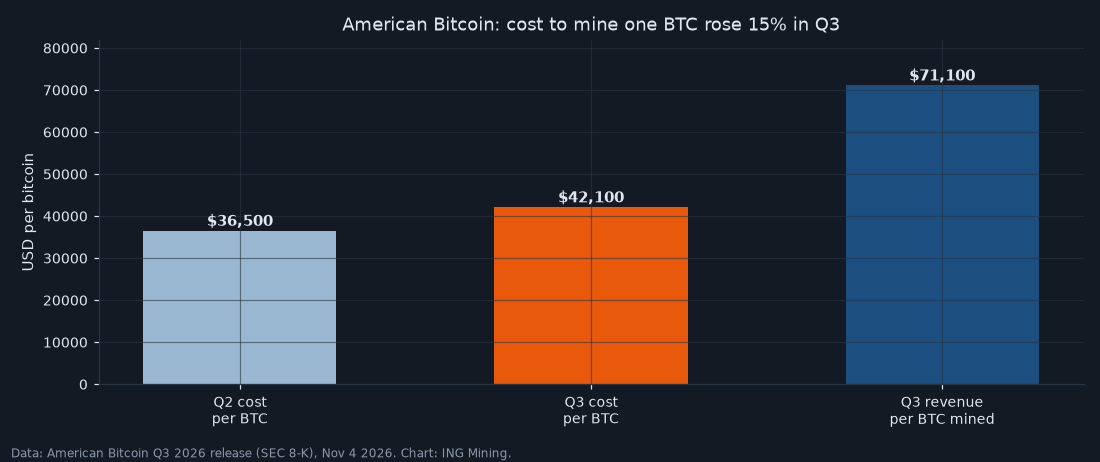
American Bitcoin mined about 891 BTC in Q3, down from about 932 in Q2. Its cost to mine one bitcoin rose to about $42,100 from about $36,500. That is a 15% jump in one quarter. The company blames “higher seasonal power costs across our sites.”
Revenue per coin mined was about $71,100. So the company kept roughly $29,000 on each coin on its own accounting. That is a healthy spread. However, the spread shrank, and it was measured over the quarter, not at today’s price.
Holdings, Bitmain and the fleet
Bitcoin holdings rose to about 8,427 BTC at September 30 from about 8,002 at June 30, a gain of about 425 BTC, or 5%. A footnote says that figure includes about 3,090 BTC pledged for miner purchases under agreements with Bitmain. The CEO said the company did not buy bitcoin or sell shares through its at-the-market program in the quarter.
The release lists an owned fleet of about 89,242 miners with about 28.1 EH/s of capacity at quarter end. We have not checked earlier releases, so we treat that as the company’s claim.
Miner math: the same power-cost squeeze on a single machine today
Here is the live maths on November 5. Bitcoin is $76,118 and the network is 1018 EH/s, so hashprice is about $33.86 per petahash per day. That is what one PH/s of hashing earns before power.
| Machine | 5c/kWh | 8c/kWh | 12c/kWh | Break-even |
|---|---|---|---|---|
| Antminer S19 (95 TH/s, 3250 W) | -$0.68 | -$3.02 | -$6.14 | 4.1c |
| Antminer S19k Pro (115 TH/s, 2645 W) | $0.72 | -$1.18 | -$3.72 | 6.1c |
| Antminer S19 XP (141 TH/s, 3010 W) | $1.16 | -$1.01 | -$3.89 | 6.6c |
| Antminer S21 Pro (234 TH/s, 3510 W) | $3.71 | $1.18 | -$2.19 | 9.4c |
Numbers are profit per day after electricity, at the three power prices shown. Break-even is the most you can pay per kilowatt-hour before the machine loses money. Specs are the manufacturer ratings; network data comes from mempool.space. Try your own power price in our free bitcoin mining profit calculator. See what these machines really sold for in our used ASIC miner price index. Want to run the same numbers on a machine you can buy today? See our used ASIC miners, or buy several at once through bulk lots.
American Bitcoin earned its profit from price gains, so test the reverse: if bitcoin falls another 10%: the break-even power price on an S19k Pro falls from 6.1 to 5.5 cents per kilowatt-hour. At 8 cents, daily profit goes from -$1.18 to -$1.57.
The blunt answer for ASIC owners
A company with a $42,100 cost per coin still shows a 41% margin. Bitcoin trades near $76,118 today and network hashrate is near 1018 EH/s per mempool.space. Most small operators pay more for power than a large fleet does, so the table above is the honest picture for you. If your row is red, a rising price will not fix it for long.
We think the lesson is simple. Even a well-funded miner saw costs climb 15% in one quarter, and its profit came from holding coins. Mining margin alone did not carry the quarter. See our we buy used miners page, browse all miners, or read the mining economics guides.
-Nick
ING Mining
This is general information, not financial advice. Crypto is volatile, and exchanges can fail. Please do your own research.
How this story was made: drafted with the help of AI tools from public sources, then edited by Nick Squires. See our editorial policy. Spot an error? Email ns@ingmining.com.