
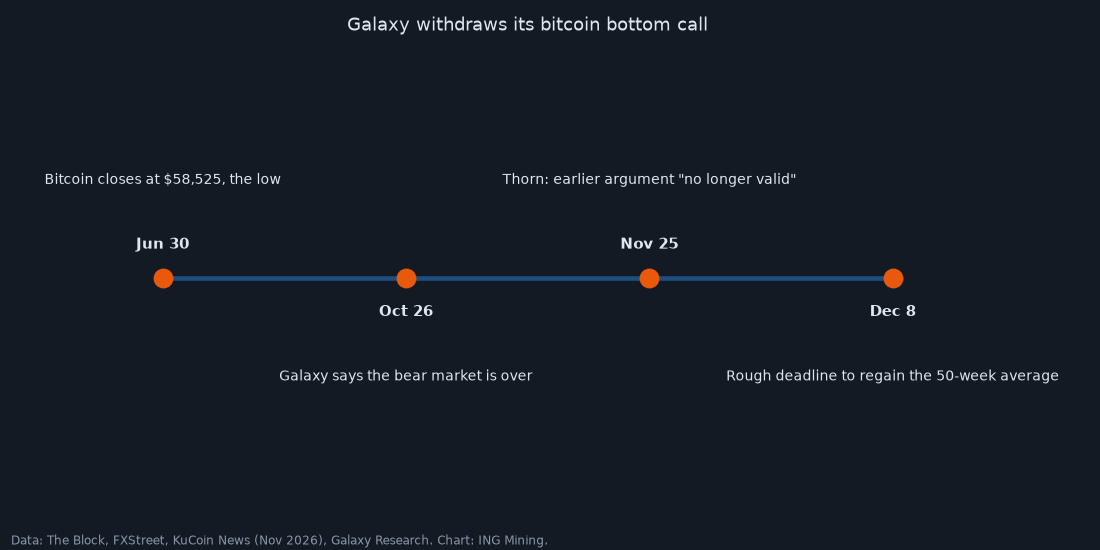
The Galaxy bitcoin bottom call is dead. Galaxy Research has withdrawn its October view that the bear market ended in June, and it now says a daily close below $58,525 would point to a much lower low. The Block reported the note on Nov 26.
What Galaxy said about the bitcoin bottom
Alex Thorn, Galaxy’s head of firmwide research, wrote that the team’s earlier technical argument is “no longer valid,” per The Block. That argument rested on bitcoin reclaiming its 50-week moving average in September. Bitcoin then closed back below it in early November, and later below the 200-week average.
The $58,525 level is the June 30 closing low. Thorn calls a daily close under it a “break of a standing low.” Galaxy says that in all seven prior bear markets where bitcoin broke a similar low, prices fell at least another 17%. Bitcoin also has until about Dec. 8 to regain the 50-week average, which Thorn calls unlikely.
KuCoin News adds that only 2 of Galaxy’s 13 historical bottom signals have fired. FXStreet says applying past drawdowns to the June close implies about $48,500, and $28,200 in the worst historical case. Those are Galaxy’s historical comparisons, not a price target.
What the data around it shows
Per the same report, U.S. spot bitcoin ETPs have shed 71,339 BTC ($4.95 billion) since Oct. 4, with outflows on 22 of 35 sessions. Bitcoin rose 2.4% to about $60,677 on Wednesday after dipping near $57,300 earlier in the day. Galaxy says a weekly close back above the 200-week and then the 50-week average would bring it back toward its October view.
One note of balance: Galaxy has flipped before, and other desks still argue the low is in. A reversal note is a view, not a fact about where price goes.
What it means for miner margins
Bitcoin is near $60,957 and the network near 1,052 EH/s in the table below. Hashprice follows price. If Galaxy is right, the June low is a floor you cannot count on.
Miner math: the Galaxy bitcoin bottom call
Here is the live maths on November 26. Bitcoin is $60,957 and the network is 1052 EH/s, so hashprice is about $26.21 per petahash per day. That is what one PH/s of hashing earns before power.
| Machine | 5c/kWh | 8c/kWh | 12c/kWh | Break-even |
|---|---|---|---|---|
| Antminer S19 (95 TH/s, 3250 W) | -$1.41 | -$3.75 | -$6.87 | 3.2c |
| Antminer S19k Pro (115 TH/s, 2645 W) | -$0.16 | -$2.06 | -$4.60 | 4.7c |
| Antminer S19 XP (141 TH/s, 3010 W) | $0.08 | -$2.08 | -$4.97 | 5.1c |
| Antminer S21 Pro (234 TH/s, 3510 W) | $1.92 | -$0.61 | -$3.98 | 7.3c |
Numbers are profit per day after electricity, at the three power prices shown. Break-even is the most you can pay per kilowatt-hour before the machine loses money. Specs are the manufacturer ratings; network data comes from mempool.space. Try your own power price in our free bitcoin mining profit calculator. See what these machines really sold for in our used ASIC miner price index. Want to run the same numbers on a machine you can buy today? See our used ASIC miners, or buy several at once through bulk lots.
If bitcoin breaks $58,525 and falls the 17% Galaxy cites as the minimum: the break-even power price on an S19k Pro falls from 4.7 to 3.9 cents per kilowatt-hour. At 8 cents, daily profit goes from -$2.06 to -$2.58.
Be blunt with yourself. At 8 cents, older machines already lose money here, and a 17% drop makes it worse for everyone except the cheapest power. Read our treasury stress test for the other side of the squeeze.
What we would do
Do not trade on one research note. Check your break-even power price against your real rate. If you are under water, we buy used miners. If you want cheaper hardware while the market is weak, see bulk used lots and our mining economics guides.
-Nick
ING Mining
This is general information, not financial advice. Crypto is volatile, and exchanges can fail. Please do your own research.
How this story was made: drafted with the help of AI tools from public sources, then edited by Nick Squires. See our editorial policy. Spot an error? Email ns@ingmining.com.