
IBIT outflows have now run for seven straight sessions. BlackRock’s iShares Bitcoin Trust lost $213 million on Monday, November 9, taking the streak since October 30 to $1.66 billion, per Farside Investors data cited by Cointelegraph and Bitcoinist.
The IBIT outflows in numbers
All US spot bitcoin ETFs together lost $201 million on Monday. That is slower than Friday’s $412 million. The Morgan Stanley Bitcoin Trust took in $22 million, which softened the total. Over the past six sessions the funds have lost around $1.5 billion.
Ether funds fared worse. Spot Ether ETFs lost about $185 million on Monday, their biggest daily withdrawal since October 6.
A year that flipped from inflows to outflows
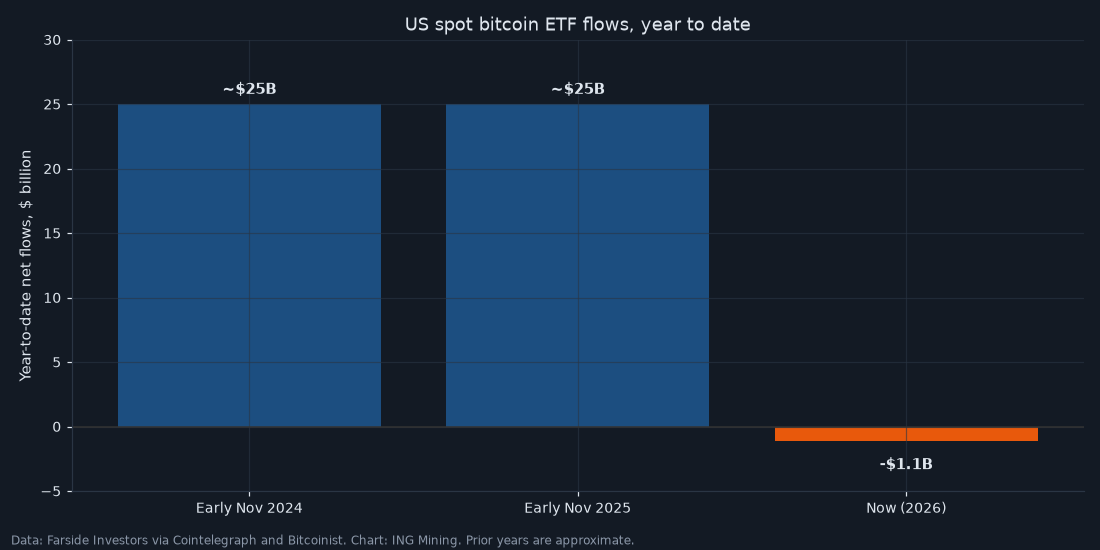
Year to date, the funds are down about $1.1 billion. By early November in both 2024 and 2025, they were up roughly $25 billion. Cointelegraph and Bitcoinist both report this comparison. It is the clearest sign that the big buyer of the last two years has stepped back.
Sentiment is weak but improving slightly. The Crypto Fear & Greed Index rose to 32 from 29, and from 26 a week earlier. It still reads “Fear”. Bitcoin traded near $74,000 to $74,600 at publication. Then Tuesday’s hot inflation report pushed it lower, as we covered in our CPI report.
What the IBIT outflows mean for miners
ETF flows move the bitcoin price at the margin, and the price sets what each block is worth. We cannot prove cause and effect from a seven-day streak. Even so, steady redemptions remove a source of demand just as miners are selling more of their output. One trader quoted by Cointelegraph says crypto barely reacted to Coinbase’s new bank charter. That is one trader’s read, not a measured fact.
Here is the miner maths today, with a scenario for continued selling.
Miner math: bitcoin hashprice today
Here is the live maths on November 10. Bitcoin is $73,345 and the network is 962 EH/s, so hashprice is about $34.58 per petahash per day. That is what one PH/s of hashing earns before power.
| Machine | 5c/kWh | 8c/kWh | 12c/kWh | Break-even |
|---|---|---|---|---|
| Antminer S19 (95 TH/s, 3250 W) | -$0.62 | -$2.96 | -$6.08 | 4.2c |
| Antminer S19k Pro (115 TH/s, 2645 W) | $0.80 | -$1.10 | -$3.64 | 6.3c |
| Antminer S19 XP (141 TH/s, 3010 W) | $1.26 | -$0.90 | -$3.79 | 6.7c |
| Antminer S21 Pro (234 TH/s, 3510 W) | $3.88 | $1.35 | -$2.02 | 9.6c |
Numbers are profit per day after electricity, at the three power prices shown. Break-even is the most you can pay per kilowatt-hour before the machine loses money. Specs are the manufacturer ratings; network data comes from mempool.space. Try your own power price in our free bitcoin mining profit calculator. See what these machines really sold for in our used ASIC miner price index. Want to run the same numbers on a machine you can buy today? See our used ASIC miners, or buy several at once through bulk lots.
If the outflows push bitcoin down another 8%: the break-even power price on an S19k Pro falls from 6.3 to 5.8 cents per kilowatt-hour. At 8 cents, daily profit goes from -$1.10 to -$1.42.
Our verdict: outflows alone do not break a miner. A price drop on top of high power costs does. Check your own break-even in the table, and read our mining economics guides. The Bitcoin price prediction page shows our expected ranges. Owners with machines that no longer clear can sell us their used miners. Buyers can see all miners.
-Nick
ING Mining
This is general information, not financial advice. Crypto is volatile, and exchanges can fail. Please do your own research.
How this story was made: drafted with the help of AI tools from public sources, then edited by Nick Squires. See our editorial policy. Spot an error? Email ns@ingmining.com.