
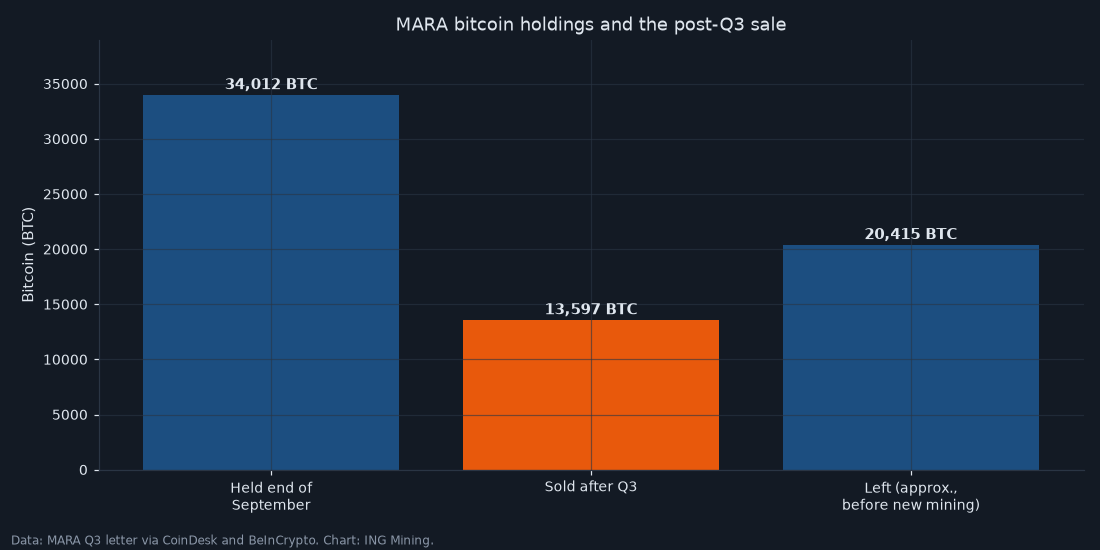
The MARA bitcoin sale is big: 13,597 BTC for about $1.1 billion, in six weeks, with more to come. CoinDesk reported it on November 10 from MARA’s third-quarter letter. Here is what MARA said, and what it means for your margin.
What the MARA bitcoin sale actually was
Per BeInCrypto, MARA sold the coins after the quarter ended at an average of about $81,039. That is roughly 40% of the 34,012 BTC it held at the end of September. About $750 million went to repaying bitcoin-backed loans, which released collateral. Those are MARA’s own figures, as relayed by the outlets.
Crypto Briefing adds that MARA posted a $632.1 million Q3 profit while revenue fell. MARA says it intends to keep using bitcoin to build cash for AI infrastructure and similar uses. One outlet also reports a buyback program of up to $500 million. One estimate puts the remainder near 20,415 BTC, before coins mined since.
Why this matters to miners
Two years ago MARA promised to hold every coin it mined. Now it sells them. The biggest public miner has decided cash and AI beat holding. That is a signal about how the sector sees mining economics today.
It is also supply. At 144 blocks a day and 3.125 BTC a block, the network issues about 450 BTC daily, so 13,597 BTC is roughly 30 days of new supply. It was spread over six weeks, so it is not a one-day dump. But it is real selling from a holder that used to be a pure buyer.
What the MARA bitcoin sale does to your margin
Our blunt read: the sale does not change your hashprice by itself. Price and network hashrate do. If big miners sell and pivot to AI, some hashrate could leave. If they keep mining and selling, price pressure sits on everyone. Check your power price against the table.
Miner math: bitcoin hashprice today
Here is the live maths on November 10. Bitcoin is $74,720 and the network is 966 EH/s, so hashprice is about $35.03 per petahash per day. That is what one PH/s of hashing earns before power.
| Machine | 5c/kWh | 8c/kWh | 12c/kWh | Break-even |
|---|---|---|---|---|
| Antminer S19 (95 TH/s, 3250 W) | -$0.57 | -$2.91 | -$6.03 | 4.3c |
| Antminer S19k Pro (115 TH/s, 2645 W) | $0.85 | -$1.05 | -$3.59 | 6.3c |
| Antminer S19 XP (141 TH/s, 3010 W) | $1.33 | -$0.84 | -$3.73 | 6.8c |
| Antminer S21 Pro (234 TH/s, 3510 W) | $3.99 | $1.46 | -$1.91 | 9.7c |
Numbers are profit per day after electricity, at the three power prices shown. Break-even is the most you can pay per kilowatt-hour before the machine loses money. Specs are the manufacturer ratings; network data comes from mempool.space. Try your own power price in our free bitcoin mining profit calculator. See what these machines really sold for in our used ASIC miner price index. Want to run the same numbers on a machine you can buy today? See our used ASIC miners, or buy several at once through bulk lots.
If miner selling pushes bitcoin down 5%: the break-even power price on an S19k Pro falls from 6.3 to 6.0 cents per kilowatt-hour. At 8 cents, daily profit goes from -$1.05 to -$1.25.
If 5% of hashrate leaves for AI work: the break-even power price on an S19k Pro rises from 6.3 to 6.7 cents per kilowatt-hour. At 8 cents, daily profit goes from -$1.05 to -$0.84.
Those are “what ifs”, not forecasts. A price drop hurts the thin-margin machines first. A hashrate exit helps whoever stays. Our mining economics guides show the arithmetic.
We think the lesson is simple. If a machine only pays at cheap power, do not count on a price rescue. Owners who want out can sell us their used miners. Buyers can browse all miners.
-Nick
ING Mining
This is general information, not financial advice. Crypto is volatile, and exchanges can fail. Please do your own research.
How this story was made: drafted with the help of AI tools from public sources, then edited by Nick Squires. See our editorial policy. Spot an error? Email ns@ingmining.com.