
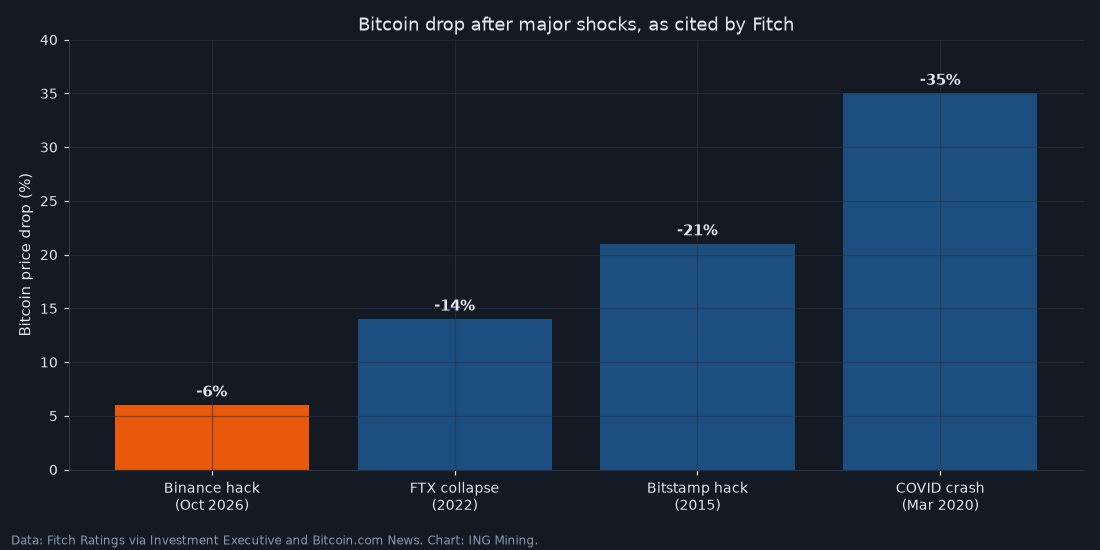
Fitch says bitcoin shrugged off the Binance hack: a 6% drop after a $6.3 billion theft. Investment Executive carried the Fitch Ratings note on November 9. Here is what Fitch said, what it did not say, and what it means for miners.
What Fitch said about the Binance hack
Per Bitcoin.com News, Fitch calls the hack a $6.3 billion theft that began on October 29 and spanned several blockchains. Reported losses included about 18,270 BTC. Bitcoin fell about 6% in the 10 hours after the attack was reported. Fitch says broader market weakness and leveraged positions also played a part.
Fitch compares that with earlier shocks. Bitcoin fell 14% after FTX in 2022, 21% after the 2015 Bitstamp hack, and 35% in the March 2020 COVID crash. Those are Fitch’s figures, and we have not recomputed them.
Why the Fitch bitcoin view is “resilience”
Fitch says daily bitcoin trading volume rose 67% to about $40.9 billion. That compares with a 30-day average of $27 billion, using CoinMarketCap data. It argues the market has grown and no longer depends on one venue, even Binance, the largest by volume (Anadolu Agency reports the same note). Fitch also says the hack alone does not change its view of bitcoin-backed securities. It flags cybersecurity as an ongoing operational risk.
Our take on the Fitch bitcoin Binance hack note
Still, a 6% dip is small, but it is one data point. The market fell during a week when ETF money also left, and we covered that in our ETF outflows report. Fitch is grading the price reaction. It is not saying the stolen coins are gone for good or that the next hack will be small. Our bitcoin price prediction page tracks the daily range.
What it means for bitcoin miners
Good news first: a market that absorbs a $6.3 billion theft with a 6% dip keeps hashprice steadier. Miners are paid in bitcoin, so a calm price is a calm margin. The bad news is that calm does not make a machine profitable. Check your power price against the table.
Miner math: bitcoin hashprice today
Here is the live maths on November 9. Bitcoin is $74,986 and the network is 962 EH/s, so hashprice is about $35.41 per petahash per day. That is what one PH/s of hashing earns before power.
| Machine | 5c/kWh | 8c/kWh | 12c/kWh | Break-even |
|---|---|---|---|---|
| Antminer S19 (95 TH/s, 3250 W) | -$0.54 | -$2.88 | -$6.00 | 4.3c |
| Antminer S19k Pro (115 TH/s, 2645 W) | $0.90 | -$1.01 | -$3.55 | 6.4c |
| Antminer S19 XP (141 TH/s, 3010 W) | $1.38 | -$0.79 | -$3.68 | 6.9c |
| Antminer S21 Pro (234 TH/s, 3510 W) | $4.07 | $1.55 | -$1.82 | 9.8c |
Numbers are profit per day after electricity, at the three power prices shown. Break-even is the most you can pay per kilowatt-hour before the machine loses money. Specs are the manufacturer ratings; network data comes from mempool.space. Try your own power price in our free bitcoin mining profit calculator. See what these machines really sold for in our used ASIC miner price index. Want to run the same numbers on a machine you can buy today? See our used ASIC miners, or buy several at once through bulk lots.
If bitcoin repeats Fitch’s 6% hack-day drop: the break-even power price on an S19k Pro falls from 6.4 to 6.0 cents per kilowatt-hour. At 8 cents, daily profit goes from -$1.01 to -$1.25.
That is a “what if”, not a forecast. At a 6% drop, the machines with the thinnest margin are the first to turn negative. Our mining economics guides show the arithmetic.
If a machine no longer pays, sell us your used miners. Buyers can browse all miners.
-Nick
ING Mining
This is general information, not financial advice. Crypto is volatile, and exchanges can fail. Please do your own research.
How this story was made: drafted with the help of AI tools from public sources, then edited by Nick Squires. See our editorial policy. Spot an error? Email ns@ingmining.com.