
Vitalik Buterin ETH comments on November 8 changed the pitch for the second-largest crypto. In an X thread, the Ethereum co-founder said ETH should be valued as a store of value, not as a fee-burning token. The Block, BeInCrypto and crypto.news all report it. For bitcoin miners the short answer: it does not move your hashprice.
What Vitalik Buterin said about ETH
He argued that “ETH as store of value” makes “much more sense to focus on” than “ETH as fee-burning token,” per The Block. He did not call for dropping the burn. EIP-1559 “is fine and good,” he wrote, and Ethereum should not “feel sad if fee burn is < 10% of breakeven indefinitely.”
Moreover, he said the popular burn-floor model was “never a true floor.” The example in the thread: a $1 billion yearly burn at a 4% discount rate implies a $25 billion floor. He says that only works if the revenue behind it is external to crypto.
The numbers behind the Vitalik Buterin ETH argument
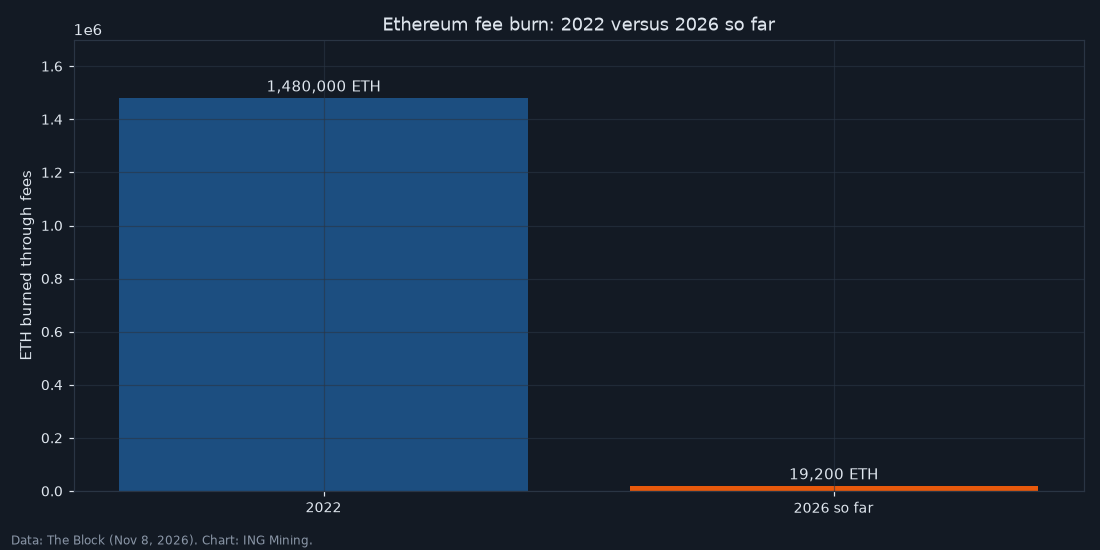
The Block puts the burn at about 1.48 million ETH in 2022, roughly $3.6 billion. So far in 2026 it is about 19,200 ETH, roughly $43 million. ETH traded near $2,236 on Sunday morning, with a market cap near $273 billion, according to The Block.
Vitalik also ran the other direction. Justifying a roughly $270 billion cap through fees would make Ethereum look like L’Oreal. Matching that kind of R&D spend would need about 700,000 ETH a year in protocol funding, he said, and cut validator revenue by two-thirds. Higher gas prices to chase burn, he added, “may price out users.”
This all comes about five weeks after the authors withdrew EIP-8363, a proposal to burn a rising share of validator rewards, The Block says. Solana’s Anatoly Yakovenko agreed that you “can’t focus on fees as the product.” Reactions are opinions, not data.
What it means for bitcoin miners
Blunt version: nothing direct. Ethereum is proof of stake, so no ETH ASIC hashrate is involved. Your S19 earns bitcoin, not ETH. The indirect effect is sentiment. A big ETH narrative reset can shift money around the market, and bitcoin price drives the maths below.
Miner math: bitcoin hashprice today
Here is the live maths on November 9. Bitcoin is $74,901 and the network is 965 EH/s, so hashprice is about $35.21 per petahash per day. That is what one PH/s of hashing earns before power.
| Machine | 5c/kWh | 8c/kWh | 12c/kWh | Break-even |
|---|---|---|---|---|
| Antminer S19 (95 TH/s, 3250 W) | -$0.55 | -$2.89 | -$6.01 | 4.3c |
| Antminer S19k Pro (115 TH/s, 2645 W) | $0.88 | -$1.03 | -$3.57 | 6.4c |
| Antminer S19 XP (141 TH/s, 3010 W) | $1.35 | -$0.81 | -$3.70 | 6.9c |
| Antminer S21 Pro (234 TH/s, 3510 W) | $4.03 | $1.50 | -$1.87 | 9.8c |
Numbers are profit per day after electricity, at the three power prices shown. Break-even is the most you can pay per kilowatt-hour before the machine loses money. Specs are the manufacturer ratings; network data comes from mempool.space. Try your own power price in our free bitcoin mining profit calculator. See what these machines really sold for in our used ASIC miner price index. Want to run the same numbers on a machine you can buy today? See our used ASIC miners, or buy several at once through bulk lots.
If a crypto-wide sentiment dip takes bitcoin down 5%: the break-even power price on an S19k Pro falls from 6.4 to 6.1 cents per kilowatt-hour. At 8 cents, daily profit goes from -$1.03 to -$1.23.
At 965 EH/s network hashrate, the break-even power price is what matters, not Ethereum’s valuation story. We would not trade a mining decision on this thread. See our mining economics guides for the real levers.
If your machines no longer pay, you can sell us your used miners. To buy, see all miners.
-Nick
ING Mining
This is general information, not financial advice. Crypto is volatile, and exchanges can fail. Please do your own research.
How this story was made: drafted with the help of AI tools from public sources, then edited by Nick Squires. See our editorial policy. Spot an error? Email ns@ingmining.com.