
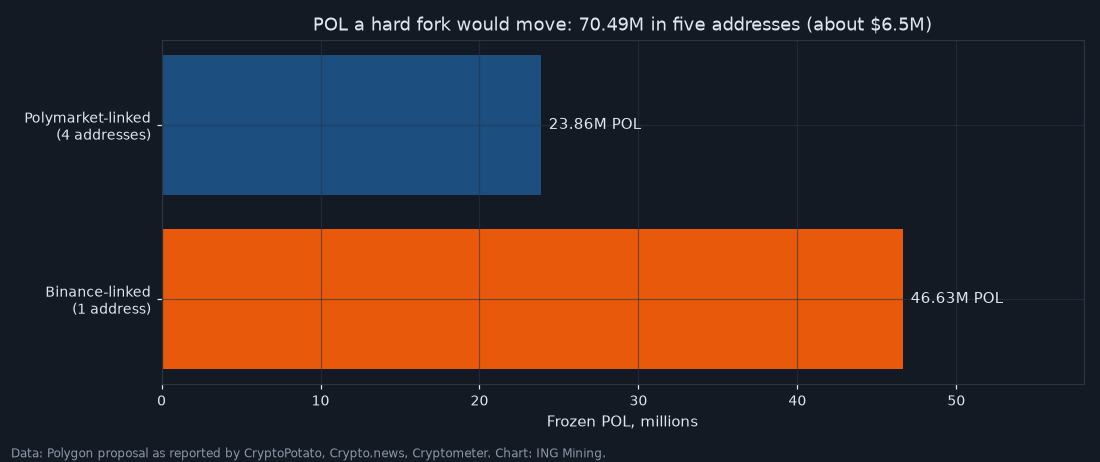
A Polygon hard fork is on the table to claw back 70.49 million POL, worth about $6.5 million, stolen in the Binance and Polymarket hacks. CryptoPotato, Crypto.news and Cointelegraph all report it. It is a proposal, not a decision.
What the Polygon hard fork would do
Per the reports, a Polygon Labs validator-support team member proposed a one-time balance adjustment at a set block. It would zero out five addresses and credit recovery wallets. Total POL supply would not change.
The tokens sit in four Polymarket-linked addresses (about 23.86 million POL) and one Binance-linked address (about 46.63 million POL). The proposal values them at $0.0924 per POL, the 29 October spot price. Outlets quote the dollar value between $6.5 million and $7 million, so treat it as a rough figure.
Why a fork, and what is still open
The POL is frozen, but reports say Polygon’s existing block list has no way to return it to the owners. Binance’s stolen USDT was reportedly frozen by Tether, so the fork would not touch it. Polymarket and Binance have already reimbursed most affected users themselves.
Validators still have to approve the change and test it. Nothing is scheduled. Some readers will also dislike the principle: a chain that edits balances after a theft sets a precedent. We lay out that tension without picking a side. For the bigger story behind it, see our report on the Fed and OCC checks after the Binance hack.
Miner math: what the Polygon hard fork does to your margin today
Here is the live maths on November 5. Bitcoin is $76,294 and the network is 1020 EH/s, so hashprice is about $33.93 per petahash per day. That is what one PH/s of hashing earns before power.
| Machine | 5c/kWh | 8c/kWh | 12c/kWh | Break-even |
|---|---|---|---|---|
| Antminer S19 (95 TH/s, 3250 W) | -$0.68 | -$3.02 | -$6.14 | 4.1c |
| Antminer S19k Pro (115 TH/s, 2645 W) | $0.73 | -$1.18 | -$3.72 | 6.1c |
| Antminer S19 XP (141 TH/s, 3010 W) | $1.17 | -$1.00 | -$3.89 | 6.6c |
| Antminer S21 Pro (234 TH/s, 3510 W) | $3.73 | $1.20 | -$2.17 | 9.4c |
Numbers are profit per day after electricity, at the three power prices shown. Break-even is the most you can pay per kilowatt-hour before the machine loses money. Specs are the manufacturer ratings; network data comes from mempool.space. Try your own power price in our free bitcoin mining profit calculator. See what these machines really sold for in our used ASIC miner price index. Want to run the same numbers on a machine you can buy today? See our used ASIC miners, or buy several at once through bulk lots.
Polygon is a proof-of-stake chain, so this does nothing to bitcoin hashrate. The only channel is trust. If bitcoin slips 3% on more hack headlines: the break-even power price on an S19k Pro falls from 6.1 to 6.0 cents per kilowatt-hour. At 8 cents, daily profit goes from -$1.18 to -$1.29.
The blunt answer for ASIC owners
Zero direct effect. A fork on Polygon does not touch the bitcoin network, which runs near 1020 EH/s per mempool.space. The table above decides who makes money, not this proposal.
We think the useful lesson is this: stolen funds on a proof-of-work chain cannot be rolled back by a vote, and that is the point of it. If you hold mined coin, keep it in your own wallet, not on an exchange.
If your power price sits above the break-even column, look at we buy used miners, browse all miners, or read the mining economics guides.
-Nick
ING Mining
This is general information, not financial advice. Crypto is volatile, and exchanges can fail. Please do your own research.
How this story was made: drafted with the help of AI tools from public sources, then edited by Nick Squires. See our editorial policy. Spot an error? Email ns@ingmining.com.