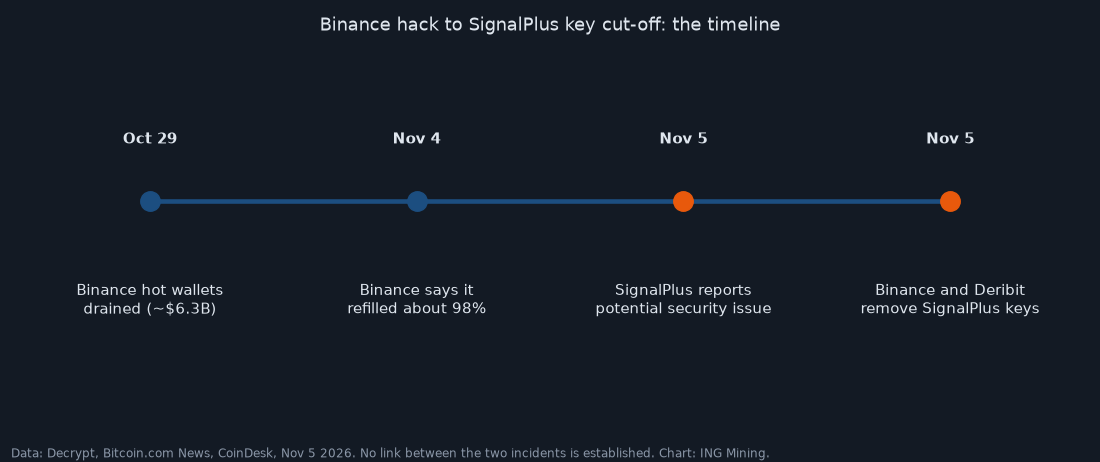
Binance removed every Binance SignalPlus API keys link on November 5 after SignalPlus reported a “potential security issue.” Decrypt, Bitcoin.com News and CoinDesk all carry it. Nobody has said what the flaw is or whether any money was lost.
What happened to the Binance SignalPlus API keys
Binance said on X that it “proactively removed all API keys linked to SignalPlus as an immediate precautionary measure.” It also said its own systems are unaffected and user funds remain safe. Those are Binance’s own statements.
SignalPlus is a Hong Kong-based firm that sells trading tools for options and derivatives. It connects to exchanges through API keys, so any strategy that ran through it on Binance has stopped until users create new keys. Deribit has reportedly pulled its SignalPlus keys too, per CoinDesk and other outlets.
What to do with your Binance SignalPlus API keys
Binance tells SignalPlus users to log in directly and check positions and open orders. It says to wait until SignalPlus confirms the issue is fully fixed before reconnecting, and to turn on IP whitelisting. Co-founder Changpeng Zhao went further: “If you use SignalPlus for any other exchange platform, it’s time to revoke all your API keys.” He added that people should generally not store API keys with any third-party platform.
What nobody knows yet
None of the three outlets we read quotes a SignalPlus statement. The nature of the problem, the number of affected users and any losses are all unreported. The timing is awkward, because Binance lost about $6.3 billion from hot wallets on October 29. However, Bitcoin.com says no evidence connects the two incidents, so we will not connect them either. See our Binance hack interview report for that earlier story.
Miner math: what the SignalPlus cut-off does to your margin today
Here is the live maths on November 5. Bitcoin is $75,989 and the network is 1015 EH/s, so hashprice is about $33.94 per petahash per day. That is what one PH/s of hashing earns before power.
| Machine | 5c/kWh | 8c/kWh | 12c/kWh | Break-even |
|---|---|---|---|---|
| Antminer S19 (95 TH/s, 3250 W) | -$0.68 | -$3.02 | -$6.14 | 4.1c |
| Antminer S19k Pro (115 TH/s, 2645 W) | $0.73 | -$1.18 | -$3.71 | 6.1c |
| Antminer S19 XP (141 TH/s, 3010 W) | $1.17 | -$0.99 | -$3.88 | 6.6c |
| Antminer S21 Pro (234 TH/s, 3510 W) | $3.73 | $1.20 | -$2.17 | 9.4c |
Numbers are profit per day after electricity, at the three power prices shown. Break-even is the most you can pay per kilowatt-hour before the machine loses money. Specs are the manufacturer ratings; network data comes from mempool.space. Try your own power price in our free bitcoin mining profit calculator. See what these machines really sold for in our used ASIC miner price index. Want to run the same numbers on a machine you can buy today? See our used ASIC miners, or buy several at once through bulk lots.
This is a security story, not a hashrate event, so test the risk that matters: if bitcoin falls 5% on more exchange-trust fear: the break-even power price on an S19k Pro falls from 6.1 to 5.8 cents per kilowatt-hour. At 8 cents, daily profit goes from -$1.18 to -$1.37.
The blunt answer for ASIC owners
This story does not move hashprice. Network hashrate is near 1015 EH/s per mempool.space, and the table above decides who makes money. No source says miners are affected.
We think the lesson is simple. If a bot or tool holds a key to your exchange account, that tool is part of your attack surface. Miners who sell coin through an exchange API should check which third parties hold keys, strip withdrawal rights, and whitelist IPs. That costs nothing.
If your power costs more than the break-even column, no security fix helps. See our we buy used miners page, browse all miners, or read the mining economics guides.
-Nick
ING Mining
This is general information, not financial advice. Crypto is volatile, and exchanges can fail. Please do your own research.
How this story was made: drafted with the help of AI tools from public sources, then edited by Nick Squires. See our editorial policy. Spot an error? Email ns@ingmining.com.