
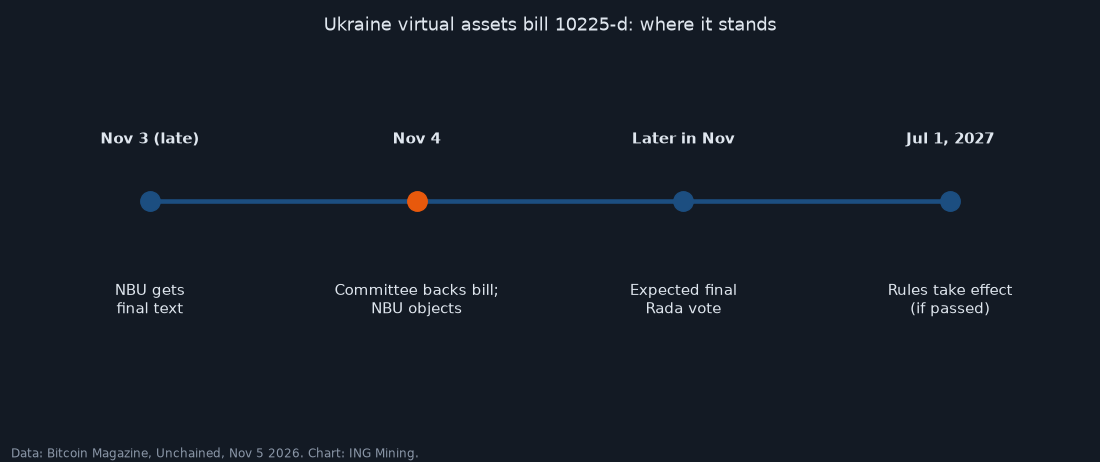
The Ukraine crypto bill is one vote from becoming law, and the country’s central bank says it cannot back it. On November 4 the National Bank of Ukraine (NBU) said it does not support draft law No. 10225-d in its current form, the same day a Rada committee recommended it for the second reading. Bitcoin Magazine and Unchained both report it. For miners the effect today is small, and we show the numbers below.
What the NBU said about the Ukraine crypto bill
The Rada’s finance committee recommended adopting the bill at second reading and as a whole. Parliament has not voted yet. Bitcoin Magazine says a final vote is expected later in November. If it passes, the rules are expected to take effect on July 1, 2027.
The NBU says it received the final text only late on November 3 and that the process was not transparent enough. It still backs the aim: detailed rules for virtual assets in the spirit of the EU’s MiCA. Its objections are specific:
- Foreign tokens: tokens that work like electronic money could enter without matching oversight, which the NBU says threatens monetary sovereignty and financial stability.
- Parity: simplified entry for foreign assets must not dodge the rules that apply to Ukrainian ones.
- Trading platforms: the NBU flags monopoly and corruption risk in how the securities commission would license operators, because the final draft drops a clear cap on their number.
Ukraine crypto bill tax rules in the draft
According to Bitcoin Magazine, trading income would face standard personal income tax. A reduced 5% rate would apply through the end of 2028 for assets acquired before the law takes effect. Crypto-to-crypto exchanges would not be taxed, and virtual-asset deals would sit outside VAT. Supervision would be split between the NBU and the securities commission. However, these are the draft’s terms as reported, and they can still change before the vote.
Miner math: what this Ukraine vote does to your margin today
Here is the live maths on November 5. Bitcoin is $75,952 and the network is 1023 EH/s, so hashprice is about $33.63 per petahash per day. That is what one PH/s of hashing earns before power.
| Machine | 5c/kWh | 8c/kWh | 12c/kWh | Break-even |
|---|---|---|---|---|
| Antminer S19 (95 TH/s, 3250 W) | -$0.70 | -$3.04 | -$6.16 | 4.1c |
| Antminer S19k Pro (115 TH/s, 2645 W) | $0.69 | -$1.21 | -$3.75 | 6.1c |
| Antminer S19 XP (141 TH/s, 3010 W) | $1.13 | -$1.04 | -$3.93 | 6.6c |
| Antminer S21 Pro (234 TH/s, 3510 W) | $3.66 | $1.13 | -$2.24 | 9.3c |
Numbers are profit per day after electricity, at the three power prices shown. Break-even is the most you can pay per kilowatt-hour before the machine loses money. Specs are the manufacturer ratings; network data comes from mempool.space. Try your own power price in our free bitcoin mining profit calculator. See what these machines really sold for in our used ASIC miner price index. Want to run the same numbers on a machine you can buy today? See our used ASIC miners, or buy several at once through bulk lots.
This is a regulation story, not a hashrate event, so test the risk that matters: if bitcoin falls 5% on regulatory noise: the break-even power price on an S19k Pro falls from 6.1 to 5.8 cents per kilowatt-hour. At 8 cents, daily profit goes from -$1.21 to -$1.40.
The blunt answer for ASIC owners
Nothing in this bill changes hashprice today. Network hashrate is near 1023 EH/s per mempool.space, and the table above decides who makes money. Also, none of the sources we read say the bill covers mining directly, so we will not guess. We think the real signal is the fight itself: a central bank wants more control over foreign tokens and exchange licences. So, expect the same tension in other countries. The Ukraine crypto bill is just the latest example.
If your power costs more than the break-even column, no vote in Kyiv fixes that. See our we buy used miners page, browse all miners, or read the mining economics guides.
-Nick
ING Mining
This is general information, not financial advice. Crypto is volatile, and exchanges can fail. Please do your own research.
How this story was made: drafted with the help of AI tools from public sources, then edited by Nick Squires. See our editorial policy. Spot an error? Email ns@ingmining.com.