
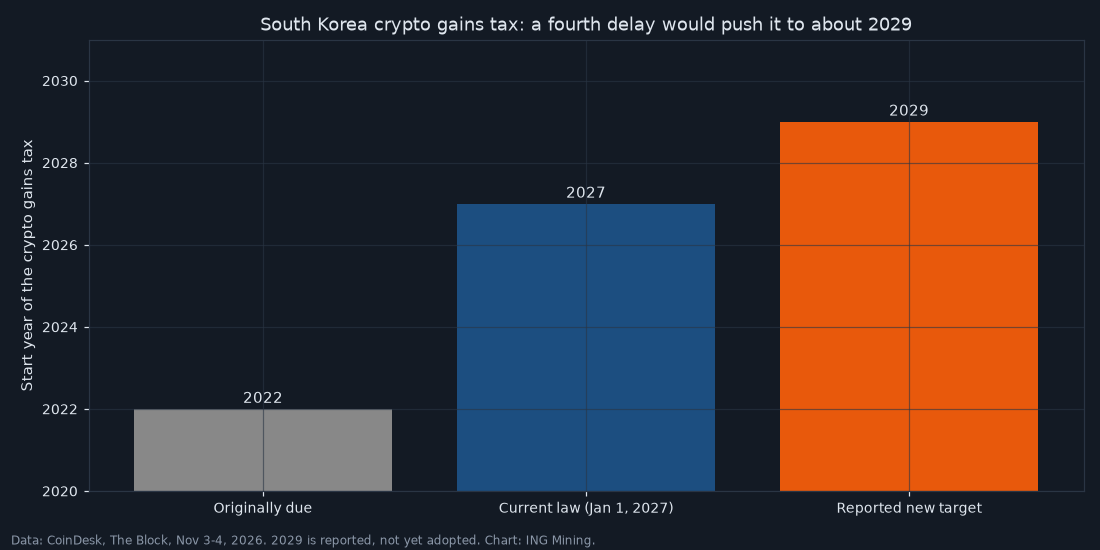
The South Korea crypto tax may be delayed for a fourth time. The ruling Democratic Party wants to push back the levy, now due January 1, 2027, according to CoinDesk and The Block. Nothing is final yet. Here is what is confirmed and what it means for a miner.
What the South Korea crypto tax delay says
Under current law the tax is 20% of annual crypto profit above 2.5 million won, plus a 2% local levy. That is 22% in total, with a basic deduction of about $1,870, per The Block. It was first legislated in 2020 and has been postponed three times already.
The Block reports that party leader Kim Min-seok raised the delay at a supreme council meeting. He said the party would give “companies and investors time to adapt.” CoinDesk adds that Democratic Party lawmakers on the Strategy and Finance Committee agreed on November 3 to recommend about a two-year deferral to party leadership.
Why the party wants more time
Both outlets give the same core reasons. The Digital Asset Basic Act, a wider crypto law, should come first. The tax data link between the tax service and exchanges needs testing. CoinDesk also points to an international tax information-sharing system due around 2029.
However, the sources differ on the date. The Block says the party has not named one, and that the presidential office was reportedly weighing 2029. CoinDesk says “about two years,” meaning 2029. So we treat 2029 as a likely target, not a decision. Finance Minister Lee Hyoung-il reportedly wants the original schedule, while exchange group DAXA wants a delay. The proposal still needs party and legislative approval.
Does it matter for bitcoin?
Probably a little, and only at the edges. A delay removes a tax bill that Korean traders would otherwise face in 2027. It is mildly friendly for Korean exchange volume. It does nothing to hashrate or block rewards. Price context is on our Bitcoin price prediction page, with bitcoin near $77,909.
Miner math: what the South Korea crypto tax delay means for your margin
Here is the live maths on November 4. Bitcoin is $77,909 and the network is 1032 EH/s, so hashprice is about $34.17 per petahash per day. That is what one PH/s of hashing earns before power.
| Machine | 5c/kWh | 8c/kWh | 12c/kWh | Break-even |
|---|---|---|---|---|
| Antminer S19 (95 TH/s, 3250 W) | -$0.65 | -$2.99 | -$6.11 | 4.2c |
| Antminer S19k Pro (115 TH/s, 2645 W) | $0.76 | -$1.15 | -$3.69 | 6.2c |
| Antminer S19 XP (141 TH/s, 3010 W) | $1.21 | -$0.96 | -$3.85 | 6.7c |
| Antminer S21 Pro (234 TH/s, 3510 W) | $3.78 | $1.26 | -$2.11 | 9.5c |
Numbers are profit per day after electricity, at the three power prices shown. Break-even is the most you can pay per kilowatt-hour before the machine loses money. Specs are the manufacturer ratings; network data comes from mempool.space. Try your own power price in our free bitcoin mining profit calculator. See what these machines really sold for in our used ASIC miner price index. Want to run the same numbers on a machine you can buy today? See our used ASIC miners, or buy several at once through bulk lots.
If Korean retail demand adds 3% to bitcoin (a generous guess): the break-even power price on an S19k Pro rises from 6.2 to 6.4 cents per kilowatt-hour. At 8 cents, daily profit goes from -$1.15 to -$1.03.
The blunt answer for miners
This story is not a margin story. Even a 3% bump does not rescue older machines, since hashrate sits near 1032 EH/s per mempool.space and the table above shows who is underwater. At 8 cents most S19-class machines lose money today. If that is you, look at our we buy used miners page, or read the mining economics guides. Do not wait on a tax vote to decide.
-Nick
ING Mining
This is general information, not financial advice. Crypto is volatile, and exchanges can fail. Please do your own research.
How this story was made: drafted with the help of AI tools from public sources, then edited by Nick Squires. See our editorial policy. Spot an error? Email ns@ingmining.com.