
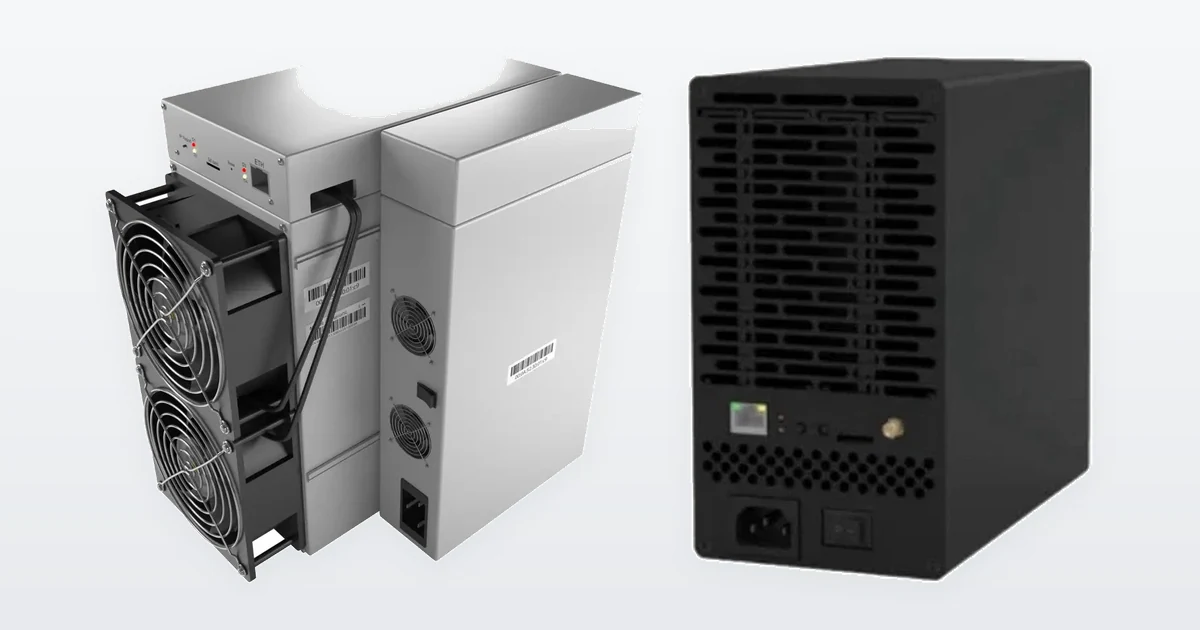
The algorithm is the part of the purchase you cannot change afterwards. An ASIC is silicon cut for exactly one function — a SHA-256 machine cannot mine Litecoin, a Scrypt machine cannot mine Bitcoin, and no firmware update will ever bridge the two. You are not choosing a hashrate so much as choosing which chain’s economics you are exposed to for the life of the hardware.
That is a much bigger commitment on a minor algorithm than on SHA-256, because Bitcoin will still be there and a smaller chain might not. The algorithm-by-algorithm risk is covered in altcoin mining risks.
What the algorithm actually decides
Three things, all of them fixed at purchase. What the machine can ever mine — one hash function, for the life of the silicon. What units its efficiency is quoted in — joules per terahash on SHA-256 and kHeavyHash, joules per gigahash on Scrypt, and those numbers cannot be compared with each other. And how fast the reward it earns decays, which is written into the chain’s emission schedule and is the most underrated of the three.
The first thing to know is which algorithms still have a home for a general buyer, and whether “ASIC-resistant” ever survived contact with the market:
| Algorithm | Main coin | What actually mines it in 2026 | Is it ASIC-resistant? |
|---|---|---|---|
| SHA-256 | Bitcoin, Bitcoin Cash | ASICs only | No, and it never was |
| Scrypt | Litecoin, Dogecoin (merge-mined) | ASICs only — the Antminer L-series | No. Scrypt ASICs have shipped since 2014 |
| kHeavyHash | Kaspa | ASICs only — KS-series and IceRiver | No, not since 2022 |
| Ethash | Ethereum Classic | GPUs, and Ethash ASICs (Antminer E9, Innosilicon A10/A11) | Partly. It resists ASICs by needing memory bandwidth, but ASICs exist and win |
| Equihash | Zcash | ASICs (Antminer Z15 class); GPUs are no longer competitive | No, not since 2018 |
| X11 | Dash | ASICs only | No. X11 ASICs have shipped since 2016 |
| RandomX | Monero | CPUs | Yes, deliberately, and it has held |
Read the right-hand column as a history rather than a promise. Scrypt was going to keep ASICs out and Scrypt ASICs shipped in 2014. Equihash held until 2018. kHeavyHash held until 2022. RandomX, which is deliberately built to favour a CPU’s general-purpose instruction set and large working set, has held since 2019 — it is the only entry in that column that has stayed true, and Monero is where the argument for ASIC resistance actually lives. Buying hardware on the assumption that an algorithm will stay ASIC-free is buying against a perfect record of failure.
What each algorithm pays per unit of work today
This is the number that turns an algorithm into a purchase decision, and it is worth deriving rather than looking up. Take the coin’s block reward, its difficulty and its price, and you get gross revenue per unit of hashrate per day. Divide by the machine’s efficiency and you get the electricity price at which it stops earning. Measured on 15 August 2026:
| Algorithm | Gross revenue per unit of work | Break-even electricity price | Example |
|---|---|---|---|
| SHA-256 (Bitcoin) | $0.03132 per TH/day | 130.5 ÷ (J/TH) ¢/kWh | S21 Pro at 15.0 J/TH → 8.70 ¢ |
| Scrypt (Litecoin + Dogecoin) | $0.42731 per GH/day | 1,780 ÷ (J/GH) ¢/kWh | L9 17G at 210 J/GH → 8.48 ¢ |
| kHeavyHash (Kaspa) | $0.15437 per TH/day | 643 ÷ (J/TH) ¢/kWh | KS5 Pro at 150 J/TH → 4.29 ¢ |
Those constants come from a hashprice of $31.32/PH/day for Bitcoin (difficulty 127.48 T, BTC $63,072), $0.06089 per GH/day from Litecoin plus $0.36642 from Dogecoin for Scrypt, and 1,997,970 KAS a day spread across 330,228 TH/s for Kaspa. They move daily. What does not move is the shape: the only honest cross-algorithm comparison is the break-even electricity price, because it has dollars on top and kilowatt-hours underneath on every chain. Comparing a Kaspa machine’s 150 J/TH with a Scrypt machine’s 210 J/GH produces a number with no meaning, and that mistake is the single most expensive one on this topic — it is worked through in full in Kaspa miner vs Litecoin miner.
One consequence worth stating plainly, because it is not what people expect: the best Scrypt machine on our shelf survives a slightly higher power price than the best Bitcoin machine we sell today. That is not a permanent property of Scrypt. It is a statement about the Dogecoin price this week, and 85.7% of a Scrypt machine’s revenue is Dogecoin.
The decay schedule is part of the algorithm you are buying
Every chain cuts what it pays over time, and the schedules are wildly different. This is the part of the decision that a hashrate figure hides completely:
| Chain | Reward schedule | What it does to a machine bought today |
|---|---|---|
| Bitcoin | Halves every four years; next expected around 2028 | One step, well telegraphed, and the fee share partly offsets it |
| Litecoin | Halves every four years; next at block 3,360,000 | Only 14.3% of a Scrypt machine’s income, so a haircut rather than a hit |
| Dogecoin | Fixed at 10,000 per block since 2015, no halving | Does not decay at all — 85.7% of Scrypt revenue sits here |
| Kaspa | Halves every twelve months, in monthly steps of about 5.6% | This year’s revenue is next year’s double |
The Kaspa row is not a projection. On 30 July 2026 we measured the block reward at 2.44997148 KAS; on 15 August 2026 the same API returned 2.31246515. The ratio is 0.9439 against a theoretical monthly step of 0.94387 — that is an annual halving in monthly instalments, observed rather than assumed. In break-even terms the KS5 Pro went from 5.32 ¢/kWh to 4.29 ¢/kWh across those sixteen days, part emission and part coin price, and in twelve months it lands near 2.1 ¢ if nothing else moves. Any machine on a fast-decaying chain has to be paid back inside that window, and the payback arithmetic has to be run at next year’s reward, not this year’s.
What this means when you buy
Default to SHA-256 unless you have a specific reason not to. Bitcoin is the deepest market for both the coin you mine and the machine you own, the parts supply is a commodity, and there is always someone to sell a used S19 to. Everything else is a smaller market in all three of those dimensions at once.
Match the algorithm to how long you intend to hold. A chain that halves annually is a two-year machine at best. A chain with a fixed reward is exposed to price and nothing else. Bitcoin is exposed to a scheduled cut you can see coming from three years out.
Check the parts market before the spec sheet. An S19-family hashboard is a commodity with a deep secondhand supply; a KS-series board is scarce because the installed base is small, and a repairable diagnosis you cannot source a part for is still a dead machine. Fitment detail is in our parts compatibility guide.
Do not buy an algorithm for a coin you would not hold. Mining is a way of accumulating a specific asset at a specific cost, and if you would rather own the coin than the machine, buying the coin is usually cheaper above quite low electricity prices. That is arithmetic, not scepticism, and it is on our own product pages where it applies.
If your interest is Scrypt because you want exposure to both Litecoin and Dogecoin from one machine, the mechanics of getting paid on two chains at once are in the multi-coin mining guide, and how long the hardware stays viable is in mining hardware lifespan. Every machine we sell is ranked by its break-even in the comparison table, and the used ladder is on the used ASIC miner shelf.
Frequently Asked Questions
Can one ASIC mine more than one algorithm?
No. The hash function is etched into the silicon, so a SHA-256 machine mines Bitcoin or Bitcoin Cash and nothing else, and a Scrypt machine mines Litecoin and merge-mined Dogecoin and nothing else. What looks like multi-coin mining is either two chains secured by the same work — Litecoin and Dogecoin through AuxPoW — or software switching between coins on the same algorithm. No firmware update has ever bridged two algorithms and none ever will.
Which mining algorithm is the most profitable right now?
Compare them by break-even electricity price, never by hashrate or by J-per-unit. On 15 August 2026 SHA-256 pays $0.03132 per TH/day, Scrypt $0.42731 per GH/day and kHeavyHash $0.15437 per TH/day, which puts an S21 Pro at 8.70 ¢/kWh, an Antminer L9 17G at 8.48 ¢ and a KS5 Pro at 4.29 ¢. The two leaders are within a quarter of a cent of each other and the ranking moves with coin prices, so re-derive it on the day you buy.
Is ASIC-resistance real?
Only for RandomX so far. Scrypt was meant to keep ASICs out and Scrypt ASICs shipped in 2014; Equihash lasted until 2018; kHeavyHash until 2022; Ethash spawned the Antminer E9 and the Innosilicon A10/A11. RandomX deliberately targets a CPU’s instruction set and cache behaviour, and it has held since 2019. Buying hardware on the assumption that a chain will stay ASIC-free is betting against an unbroken record.
How fast does a mining reward decay on each chain?
Bitcoin and Litecoin halve every four years, Dogecoin’s 10,000-per-block reward has not changed since 2015 and has no halving schedule, and Kaspa halves every twelve months in monthly steps of about 5.6%. That last one is measurable rather than theoretical: we read 2.44997148 KAS per block on 30 July 2026 and 2.31246515 on 15 August 2026, a ratio of 0.9439 against the theoretical 0.94387. A machine on an annually halving chain has to pay for itself inside about a year.
More on algorithms and hardware
- What Actually Moves Mining Margin: Five Levers, With the Arithmetic
- Mining 101: A Beginner’s Guide to Cryptocurrency Mining
- Why Your Miner Is Earning Less: Diagnosing ASIC Faults
- Optimal Mining Pool Selection for Crypto Miners: Key Factors
Scrypt hardware for LTC and DOGE
The Scrypt hardware we stock for merged LTC and DOGE:
- Bitmain Antminer L7 9300M Scrypt ASIC Miner | LTC & DOGE
- Bitmain Antminer L7 9050M Scrypt ASIC Miner | LTC & DOGE
- Bitmain Antminer L7 8800M Scrypt Miner | LTC & DOGE
More in LTC+Doge+Bel Miner, or the full ASIC miner inventory.