The 1Password breach is real, but 1Password says no vaults or passwords were taken. Binance founder CZ told users on X to change every password anyway. Android Authority and crypto.news both report 1Password disagrees.
What the 1Password breach took
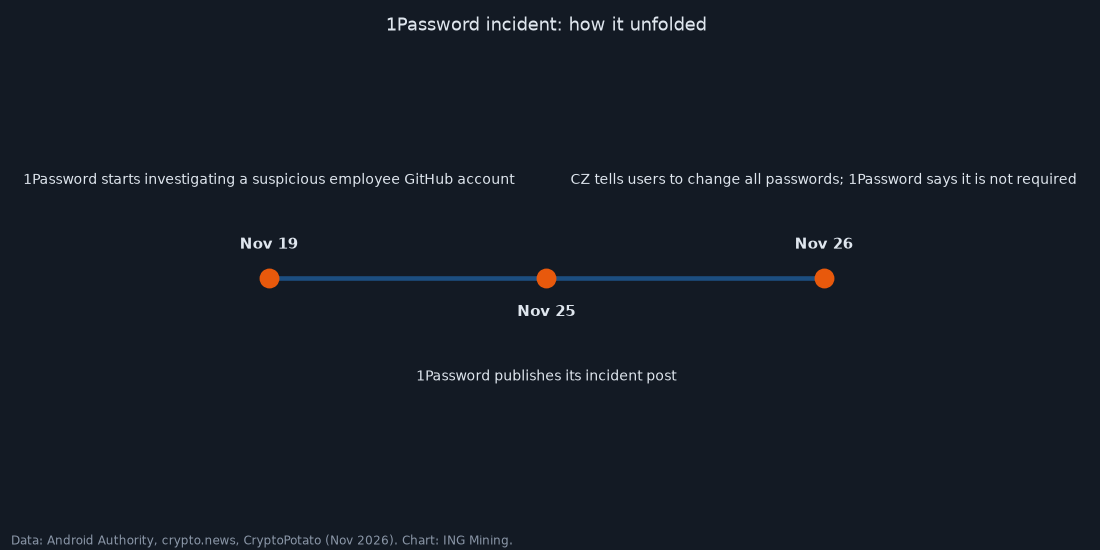
1Password says it began investigating on Nov. 19 after suspicious activity on an employee’s corporate GitHub account. It published its incident post on Nov. 25. Per crypto.news, the attacker reached source code and backend services. The data taken includes customer names, email addresses, account identifiers, and sign-up and last-login times. It also includes public SRP keys and some account recovery, invitation and provisioning tokens.
1Password says customer vaults, stored passwords and their encryption keys were not accessed. It also says it found no evidence of account takeovers. It has not said how many customers are affected. These are the company’s own statements, and we cannot verify them.
CZ says change everything. 1Password says no.
CZ wrote on X: “If you use 1Password, recommend you to change ALL your passwords. It’s a pain in the neck, but necessary.” CryptoPotato carried the same story. 1Password’s guidance is the opposite: users do not need to change their passwords. Instead, ignore unsolicited recovery emails and invitations, and type your credentials only into the official app or site.
Why miners should care
Miners hold pool logins, exchange accounts and wallet notes. Stolen emails and login times are the raw material for phishing. A fake “1Password recovery” email aimed at a known customer is the realistic risk here. A pool account hijack can redirect your payouts.
Our advice is simple. Turn on two-factor authentication on every pool and exchange. Use a hardware key where you can. Set a withdrawal address whitelist on your pool. Rotating a few high-value passwords costs little, so we would do it for exchange and pool logins as CZ suggests.
What it does to miner margins
Nothing directly. A password manager breach does not touch hashprice. Bitcoin is near $60,751 in our live data, and network hashrate is about 1,054 EH/s. The cost is your time and your payout security, not your margin.
Miner math: does the 1Password breach change your margin?
Here is the live maths on November 26. Bitcoin is $60,751 and the network is 1054 EH/s, so hashprice is about $26.07 per petahash per day. That is what one PH/s of hashing earns before power.
| Machine | 5c/kWh | 8c/kWh | 12c/kWh | Break-even |
|---|---|---|---|---|
| Antminer S19 (95 TH/s, 3250 W) | -$1.42 | -$3.76 | -$6.88 | 3.2c |
| Antminer S19k Pro (115 TH/s, 2645 W) | -$0.18 | -$2.08 | -$4.62 | 4.7c |
| Antminer S19 XP (141 TH/s, 3010 W) | $0.06 | -$2.10 | -$4.99 | 5.1c |
| Antminer S21 Pro (234 TH/s, 3510 W) | $1.89 | -$0.64 | -$4.01 | 7.2c |
Numbers are profit per day after electricity, at the three power prices shown. Break-even is the most you can pay per kilowatt-hour before the machine loses money. Specs are the manufacturer ratings; network data comes from mempool.space. Try your own power price in our free bitcoin mining profit calculator. See what these machines really sold for in our used ASIC miner price index. Want to run the same numbers on a machine you can buy today? See our used ASIC miners, or buy several at once through bulk lots.
If security fear knocks the market down 2%: the break-even power price on an S19k Pro falls from 4.7 to 4.6 cents per kilowatt-hour. At 8 cents, daily profit goes from -$2.08 to -$2.14.
Even a 2% drop only trims the table. At 8 cents most older machines still lose money. Your power rate decides this, not a leaked email list.
What we would do
We would lock down pool and exchange logins today, then check break-even. If the table fails your power price, we buy used miners. If it passes, see our bulk used lots, our mining economics guides and our Bitcoin price prediction.
-Nick
ING Mining
This is general information, not financial advice. Crypto is volatile, and exchanges can fail. Please do your own research.
How this story was made: drafted with the help of AI tools from public sources, then edited by Nick Squires. See our editorial policy. Spot an error? Email ns@ingmining.com.