
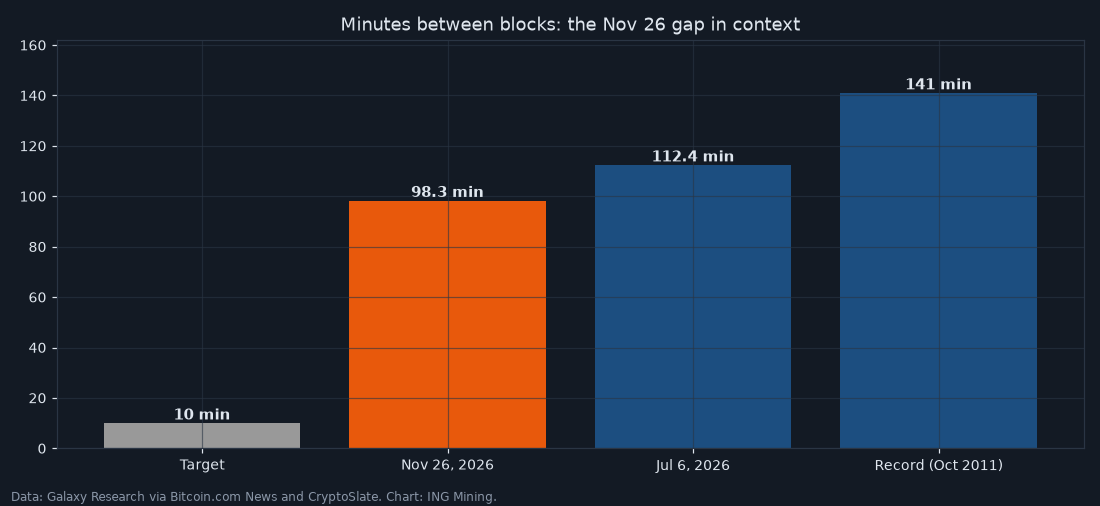
The bitcoin block gap on November 26 was 98 minutes and 19 seconds, the longest since July. It is rare, but it is not a sign that the network is breaking. Bitcoin.com News and CryptoSlate both cite Galaxy Digital research for the figure.
What the bitcoin block gap looked like
Alex Thorn, head of firmwide research at Galaxy Digital, said 98 minutes and 19 seconds passed between blocks 977,697 and 977,698. The target is ten minutes, so the gap was almost ten times longer. Galaxy ranks it as the 69th-longest interval since 2011.
Foundry USA found block 977,698 in the end, according to CryptoSlate. It held 3,723 transactions and 0.1562 BTC in fees.
How rare is a 98-minute wait?
Less rare than it sounds. Galaxy says that, with a steady ten-minute average, a gap this long is expected about once every 18,600 blocks. That is roughly once every four months. The last bigger one came on July 6, when block 956,953 took 112 minutes and 26 seconds. The record is 141 minutes and one second, from October 13, 2011.
Block finding is random. Miners do not search on a schedule, so long gaps and quick ones both happen. Therefore one gap tells us little on its own.
Why people are reading it as miner stress
The timing matters. Glassnode data shows hashrate on November 24 was 8% below a year earlier. Luxor data puts hashprice at $29.36 per petahash per day on November 23. Meanwhile, some public miners are switching machines to AI work. However, the sources say plainly that one long gap is not proof of capitulation. We agree. A sustained fall in hashrate with slower blocks across a whole difficulty period would be the real signal.
Miner math: what the bitcoin block gap means for your S19
Here is the live maths on November 27. Bitcoin is $59,998 and the network is 1025 EH/s, so hashprice is about $26.57 per petahash per day. That is what one PH/s of hashing earns before power.
| Machine | 5c/kWh | 8c/kWh | 12c/kWh | Break-even |
|---|---|---|---|---|
| Antminer S19 (95 TH/s, 3250 W) | -$1.38 | -$3.72 | -$6.84 | 3.2c |
| Antminer S19k Pro (115 TH/s, 2645 W) | -$0.12 | -$2.02 | -$4.56 | 4.8c |
| Antminer S19 XP (141 TH/s, 3010 W) | $0.13 | -$2.03 | -$4.92 | 5.2c |
| Antminer S21 Pro (234 TH/s, 3510 W) | $2.01 | -$0.52 | -$3.89 | 7.4c |
Numbers are profit per day after electricity, at the three power prices shown. Break-even is the most you can pay per kilowatt-hour before the machine loses money. Specs are the manufacturer ratings; network data comes from mempool.space. Try your own power price in our free bitcoin mining profit calculator. See what these machines really sold for in our used ASIC miner price index. Want to run the same numbers on a machine you can buy today? See our used ASIC miners, or buy several at once through bulk lots.
If hashrate fell 5% as weak machines switch off: the break-even power price on an S19k Pro rises from 4.8 to 5.1 cents per kilowatt-hour. At 8 cents, daily profit goes from -$2.02 to -$1.86.
The blunt answer for miners
A long gap does not cost you anything by itself. Your machine hashed the whole time, and the luck evens out. What matters is the margin table above, at 1025 EH/s. At 8 cents, most of these machines lose money today. We would check your real power price first, then decide whether to hold.
If the numbers say sell, see our we buy used miners page. You can also read the mining economics guides and our Bitcoin price prediction.
-Nick
ING Mining
This is general information, not financial advice. Crypto is volatile, and exchanges can fail. Please do your own research.
How this story was made: drafted with the help of AI tools from public sources, then edited by Nick Squires. See our editorial policy. Spot an error? Email ns@ingmining.com.