
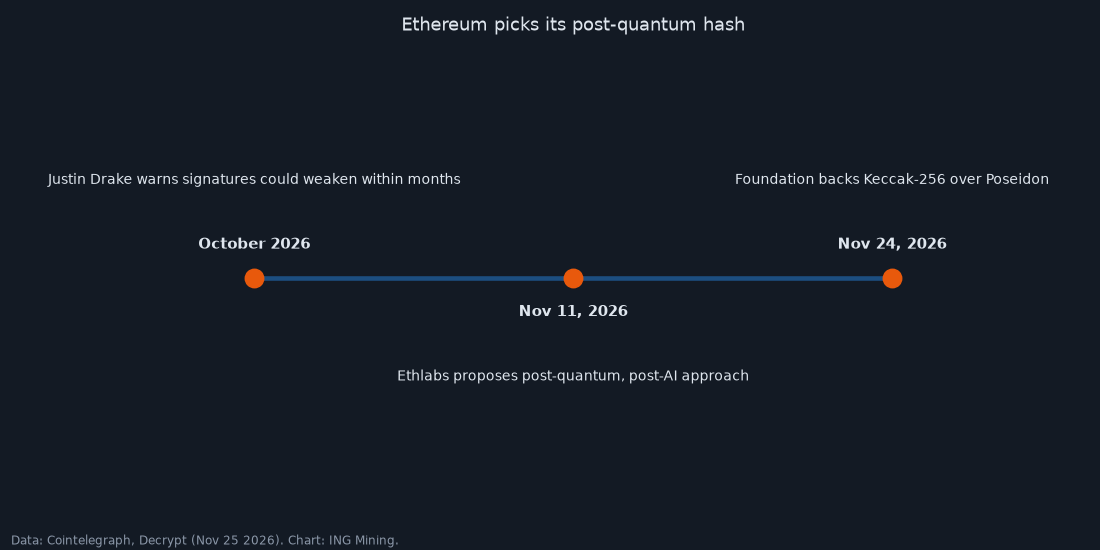
The Ethereum Foundation Keccak-256 pick is a security decision, and it is not a Bitcoin story. The Foundation recommended the Keccak-256 hash function as the base of Ethereum’s defenses against quantum computers and AI-assisted attacks, in a blog post dated November 24, per Cointelegraph. It chose a nearly 20-year-old function over Poseidon, a newer one the team had spent years trying to harden. Decrypt reports the Foundation now sees AI as the more urgent risk.
What the Ethereum Foundation Keccak-256 decision says
Keccak-256 is a hash function. It turns data into a fixed 256-bit fingerprint. The Foundation says it will form the backbone of Ethereum’s post-quantum security, and that “if it is broken, everything else is broken.” Its main argument is age: almost two decades of attacks have not broken it.
The Foundation looked at five candidates. It passed on SHA-256, the function Bitcoin uses, citing collision attacks that Cointelegraph says affect more than half of its protection. It dropped BLAKE2 and BLAKE3 because they have had less research. Poseidon lost because reduced-round versions were still open to attacks. Faster zero-knowledge proofs also erased much of its speed edge, so security was, in the Foundation’s words, the deciding factor.
Why AI comes first
Ethlabs co-founder Julian Ma told Cointelegraph that “AI is here today and it’s breaking everything around us.” U.Today reports the Foundation has doubled its protocol security team, because AI tools are finding bugs in live software faster than human reviewers can keep up. Decrypt adds that researchers want the overhaul done as early as December 2028, and that it may be harder than the 2022 Merge.
It is not clear whether AI could break Ethereum’s current signatures. U.Today says so plainly. The plan is to move from elliptic-curve signatures to hash-based ones, which would change validators, wallets and rollups. Hash-based signatures are larger, which may raise hardware needs for home nodes.
What the Ethereum Foundation Keccak-256 plan means for Bitcoin miners
Does it touch Bitcoin mining? We do not see that in any of the reports. The SHA-256 remark is about which hash suits Ethereum’s new proof system, not about Bitcoin’s proof of work. Bitcoin trades near $59,896 in our live data, and the network runs near 1,040 EH/s. Still, Bitcoin shares the elliptic-curve exposure, so expect this debate to reach it. See our bitcoin price prediction for the price side.
Miner math: what this news does to your machine
Here is the live maths on November 25. Bitcoin is $59,896 and the network is 1040 EH/s, so hashprice is about $26.06 per petahash per day. That is what one PH/s of hashing earns before power.
| Machine | 5c/kWh | 8c/kWh | 12c/kWh | Break-even |
|---|---|---|---|---|
| Antminer S19 (95 TH/s, 3250 W) | -$1.42 | -$3.76 | -$6.88 | 3.2c |
| Antminer S19k Pro (115 TH/s, 2645 W) | -$0.18 | -$2.08 | -$4.62 | 4.7c |
| Antminer S19 XP (141 TH/s, 3010 W) | $0.06 | -$2.10 | -$4.99 | 5.1c |
| Antminer S21 Pro (234 TH/s, 3510 W) | $1.89 | -$0.64 | -$4.01 | 7.2c |
Numbers are profit per day after electricity, at the three power prices shown. Break-even is the most you can pay per kilowatt-hour before the machine loses money. Specs are the manufacturer ratings; network data comes from mempool.space. Try your own power price in our free bitcoin mining profit calculator. See what these machines really sold for in our used ASIC miner price index. Want to run the same numbers on a machine you can buy today? See our used ASIC miners, or buy several at once through bulk lots.
If this story moves bitcoin by nothing, which is our base case for a technical Ethereum decision: the break-even power price on an S19k Pro rises from 4.7 to 4.7 cents per kilowatt-hour. At 8 cents, daily profit goes from -$2.08 to -$2.08.
What it means for your machines
Nothing changes in the table today. At 8 cents most of these machines lose money, and a hash-function choice on another chain does not alter your hashprice. Your SHA-256 ASIC keeps doing the same job.
So what do we do? First, price your delivered power. If a machine loses money, selling beats waiting. We buy used miners, and you can browse bulk used lots or our mining economics guides.
-Nick
ING Mining
This is general information, not financial advice. Crypto is volatile, and exchanges can fail. Please do your own research.
How this story was made: drafted with the help of AI tools from public sources, then edited by Nick Squires. See our editorial policy. Spot an error? Email ns@ingmining.com.