
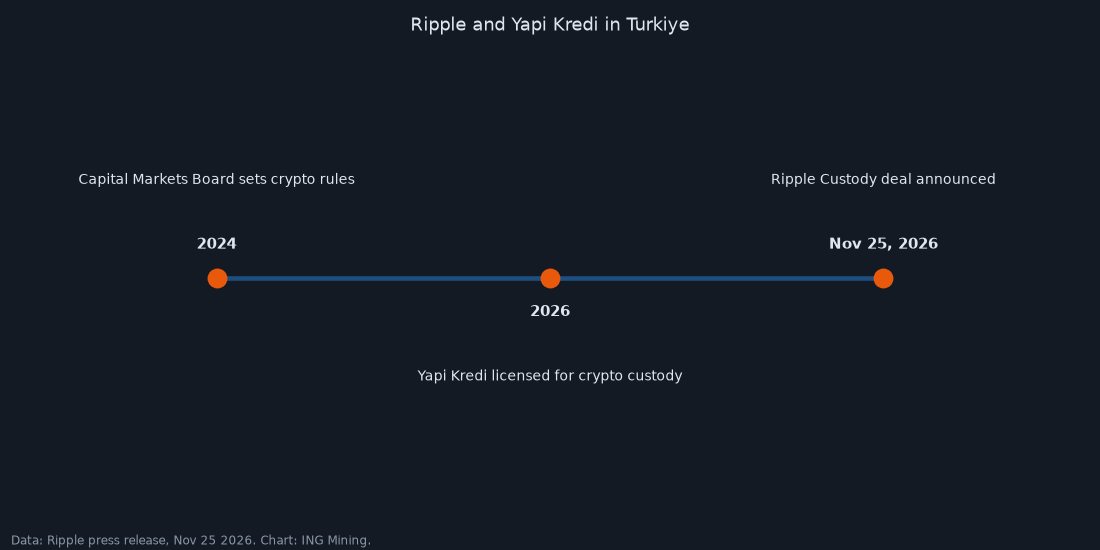
Ripple Yapı Kredi is a custody deal, not an XRP deal. Ripple announced on November 25 that Türkiye’s Yapı Kredi, one of the country’s largest private banks, will use Ripple Custody for its crypto platform, Yapı Kredi Kripto, per Ripple’s press release. The software runs on the bank’s own premises. Nothing in the release says the bank will buy XRP.
What the Ripple Yapı Kredi deal says
Yapı Kredi uses Ripple’s custody technology to hold digital assets for its clients. U.Today and Benzinga report the same terms. The bank received approval from Türkiye’s Capital Markets Board to offer crypto custody in 2026. The board’s 2024 framework requires trading platforms to keep at least 95% of customer crypto with an authorized custodian.
Also, Ripple says its custody technology is the only one behind the leading Turkish banks licensed as crypto custodians. That is Ripple’s own claim, and we could not verify it elsewhere. Ripple also notes that Türkiye is among the top 10 retail crypto markets in the world, with XRP one of its most widely held assets.
Does the Ripple Yapı Kredi deal move XRP?
Probably not by itself. In fact, custody software earns fees for Ripple, but it does not force anyone to buy a token. Benzinga notes XRP was testing $0.90 as the news broke. Bitcoin trades near $59,792 in our live data, so the whole market is under pressure. For context, see our bitcoin price prediction.
However, there is a real signal here. Banks in a large retail market are building regulated custody. That is slow, steady infrastructure, and it favors big names. Meanwhile it does little for bitcoin miners directly.
Miner math: what this news does to your machine
Here is the live maths on November 25. Bitcoin is $59,792 and the network is 1040 EH/s, so hashprice is about $26.02 per petahash per day. That is what one PH/s of hashing earns before power.
| Machine | 5c/kWh | 8c/kWh | 12c/kWh | Break-even |
|---|---|---|---|---|
| Antminer S19 (95 TH/s, 3250 W) | -$1.43 | -$3.77 | -$6.89 | 3.2c |
| Antminer S19k Pro (115 TH/s, 2645 W) | -$0.18 | -$2.09 | -$4.63 | 4.7c |
| Antminer S19 XP (141 TH/s, 3010 W) | $0.06 | -$2.11 | -$5.00 | 5.1c |
| Antminer S21 Pro (234 TH/s, 3510 W) | $1.88 | -$0.65 | -$4.02 | 7.2c |
Numbers are profit per day after electricity, at the three power prices shown. Break-even is the most you can pay per kilowatt-hour before the machine loses money. Specs are the manufacturer ratings; network data comes from mempool.space. Try your own power price in our free bitcoin mining profit calculator. See what these machines really sold for in our used ASIC miner price index. Want to run the same numbers on a machine you can buy today? See our used ASIC miners, or buy several at once through bulk lots.
If this story moves bitcoin by nothing, which is our base case for a custody deal: the break-even power price on an S19k Pro rises from 4.7 to 4.7 cents per kilowatt-hour. At 8 cents, daily profit goes from -$2.09 to -$2.09.
What it means for your machines
Nothing changes in the table. The network runs near 1,040 EH/s, and at 8 cents most of these machines lose money today. A Turkish bank picking custody software does not touch your hashprice or your power bill.
So what do we do? Price your delivered power and run it against the table. If a machine loses money, selling beats waiting for altcoin headlines. We buy used miners, and you can browse bulk used lots or our mining economics guides.
-Nick
ING Mining
This is general information, not financial advice. Crypto is volatile, and exchanges can fail. Please do your own research.
How this story was made: drafted with the help of AI tools from public sources, then edited by Nick Squires. See our editorial policy. Spot an error? Email ns@ingmining.com.