
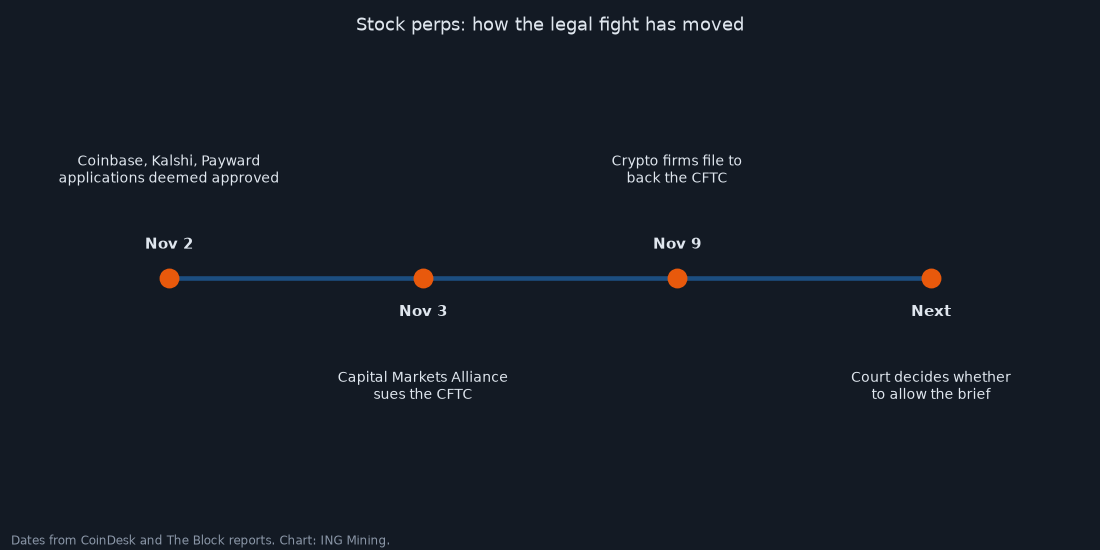
Coinbase, Kalshi and Kraken’s parent Payward are backing the CFTC in a fight over stock perpetual futures. The firms, plus DRW Holdings, Jump Trading and Paradigm, asked a federal court on Monday for permission to file a supporting brief, according to The Block and CoinDesk.
What stock perpetual futures are
Perpetual futures, or perps, let traders bet on a price without owning the asset. Unlike normal futures, they have no expiry date. Crypto traders have used them for years. However, the new twist is applying them to individual US stocks.
The lawsuit and who is on each side
The Capital Markets Alliance sued the CFTC in the Southern District of New York earlier this month. CoinDesk dates the filing to November 3. The group says it is backed by firms including Cboe and Citadel Securities. Its argument is simple: perps with no expiry are really “security-based swaps”, so they fall under the SEC and cannot list on CFTC-regulated exchanges.
The crypto firms disagree. Specifically, they say the SEC was “at the table from the very start”, and that the agencies jointly sought public comment on whether perpetual contracts should be treated as security futures. Coinbase, Kalshi and Payward had applied to list equity perps. As a result, the CFTC treated those applications as approved on November 2.
The CFTC called the lawsuit “troubling” and said markets should be governed by law, “not litigation campaigns”. That is the agency’s own statement.
What stock perpetual futures mean for miners
Honestly, not much directly. A ruling will not change a block reward or a power bill. Still, we cover it because it shows where the money in crypto is heading: more derivatives, more leverage, and more fights between old Wall Street firms and crypto exchanges over who may run the venues.
The indirect link is leverage. For example, heavy derivatives trading can amplify price swings, and we saw about $178 million of long positions liquidated after Tuesday’s inflation report. Because price swings move miner margins, here is today’s hashprice.
Miner math: bitcoin hashprice today
Here is the live maths on November 10. Bitcoin is $73,325 and the network is 962 EH/s, so hashprice is about $34.57 per petahash per day. That is what one PH/s of hashing earns before power.
| Machine | 5c/kWh | 8c/kWh | 12c/kWh | Break-even |
|---|---|---|---|---|
| Antminer S19 (95 TH/s, 3250 W) | -$0.62 | -$2.96 | -$6.08 | 4.2c |
| Antminer S19k Pro (115 TH/s, 2645 W) | $0.80 | -$1.10 | -$3.64 | 6.3c |
| Antminer S19 XP (141 TH/s, 3010 W) | $1.26 | -$0.90 | -$3.79 | 6.7c |
| Antminer S21 Pro (234 TH/s, 3510 W) | $3.88 | $1.35 | -$2.02 | 9.6c |
Numbers are profit per day after electricity, at the three power prices shown. Break-even is the most you can pay per kilowatt-hour before the machine loses money. Specs are the manufacturer ratings; network data comes from mempool.space. Try your own power price in our free bitcoin mining profit calculator. See what these machines really sold for in our used ASIC miner price index. Want to run the same numbers on a machine you can buy today? See our used ASIC miners, or buy several at once through bulk lots.
If a leverage-driven selloff takes bitcoin down 5%: the break-even power price on an S19k Pro falls from 6.3 to 5.9 cents per kilowatt-hour. At 8 cents, daily profit goes from -$1.10 to -$1.30.
We think the safest plan is to size your operation for a lower price, not a hoped-for one. Our mining economics guides explain how. You can sell us your used miners if the margins no longer work, or compare all miners and bulk used ASIC lots if you are buying.
-Nick
ING Mining
This is general information, not financial advice. Crypto is volatile, and exchanges can fail. Please do your own research.
How this story was made: drafted with the help of AI tools from public sources, then edited by Nick Squires. See our editorial policy. Spot an error? Email ns@ingmining.com.