
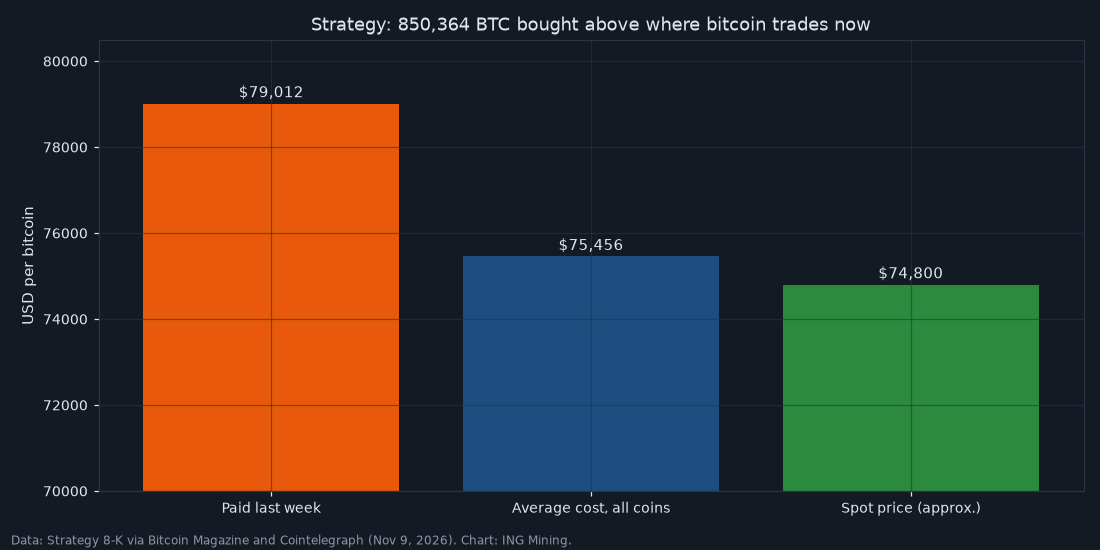
The latest Strategy bitcoin purchase is 1,036 BTC for $81.9 million, Cointelegraph and Bitcoin Magazine report from the firm’s Monday SEC filing. Holdings now stand at 850,364 BTC. The plain read for miners: it is steady buying, but it does not lift your hashprice.
What the filing shows
Strategy paid an average of $79,012 per coin between November 2 and November 8. In total it has paid $64.16 billion at an average of $75,456 per bitcoin. Cointelegraph puts the stack at roughly 4.05% of the 21 million maximum supply.
The money came from selling about 2.05 million MSTR shares for $283.8 million. Of that, $81.9 million went into bitcoin, $188.3 million bought back about 1.89 million STRC preferred shares, and $13.6 million went to cash. Bitcoin Magazine says no preferred stock was sold under the program that week.
Why this Strategy bitcoin purchase is smaller than it looks
Bitcoin trades near $74,800 at the time of Bitcoin Magazine’s report. That is below Strategy’s $75,456 average cost, so the whole position is slightly under water. Cointelegraph adds that since the start of October the firm has spent about $1.06 billion buying back STRC, nearly five times the $219.7 million it put into bitcoin in the same period. Last week’s buy followed 811 BTC the week before, which we covered in our 811 BTC and STRC buyback report.
So the buyer is still there, but most of its cash is going to its own preferred shares. That is a company managing its funding, not a fresh wave of demand.
What this Strategy bitcoin purchase means for miners
We think 1,036 coins is small against the market. Roughly 450 new coins are mined each day, so Strategy took about two days of issuance. That supports the price a little. It does not change hashrate, and your margin depends on those two numbers. See our bitcoin price prediction for the daily view.
Miner math: bitcoin hashprice today
Here is the live maths on November 9. Bitcoin is $74,526 and the network is 962 EH/s, so hashprice is about $35.15 per petahash per day. That is what one PH/s of hashing earns before power.
| Machine | 5c/kWh | 8c/kWh | 12c/kWh | Break-even |
|---|---|---|---|---|
| Antminer S19 (95 TH/s, 3250 W) | -$0.56 | -$2.90 | -$6.02 | 4.3c |
| Antminer S19k Pro (115 TH/s, 2645 W) | $0.87 | -$1.04 | -$3.58 | 6.4c |
| Antminer S19 XP (141 TH/s, 3010 W) | $1.34 | -$0.82 | -$3.71 | 6.9c |
| Antminer S21 Pro (234 TH/s, 3510 W) | $4.01 | $1.49 | -$1.88 | 9.8c |
Numbers are profit per day after electricity, at the three power prices shown. Break-even is the most you can pay per kilowatt-hour before the machine loses money. Specs are the manufacturer ratings; network data comes from mempool.space. Try your own power price in our free bitcoin mining profit calculator. See what these machines really sold for in our used ASIC miner price index. Want to run the same numbers on a machine you can buy today? See our used ASIC miners, or buy several at once through bulk lots.
If bitcoin slips another 5% from here: the break-even power price on an S19k Pro falls from 6.4 to 6.0 cents per kilowatt-hour. At 8 cents, daily profit goes from -$1.04 to -$1.24.
Be honest about the second table: a company that sits below its cost basis is a reason for caution, not a floor. If a machine already loses money at your power price, a treasury purchase will not fix it. Read our mining economics guides.
If your machines no longer pay, you can sell us your used miners. To buy, see all miners.
-Nick
ING Mining
This is general information, not financial advice. Crypto is volatile, and exchanges can fail. Please do your own research.
How this story was made: drafted with the help of AI tools from public sources, then edited by Nick Squires. See our editorial policy. Spot an error? Email ns@ingmining.com.