
Ethereum whales are buying while ETH slides. ETH traded just above $2,100 on Monday morning, after a multi-month low of $2,070 hours earlier, CryptoPotato reports. Bitcoinist had it near $2,230 a day earlier. The short answer for miners: ETH has no ASIC hashrate, but a weak ETH usually drags bitcoin sentiment with it.
What Ethereum whales bought
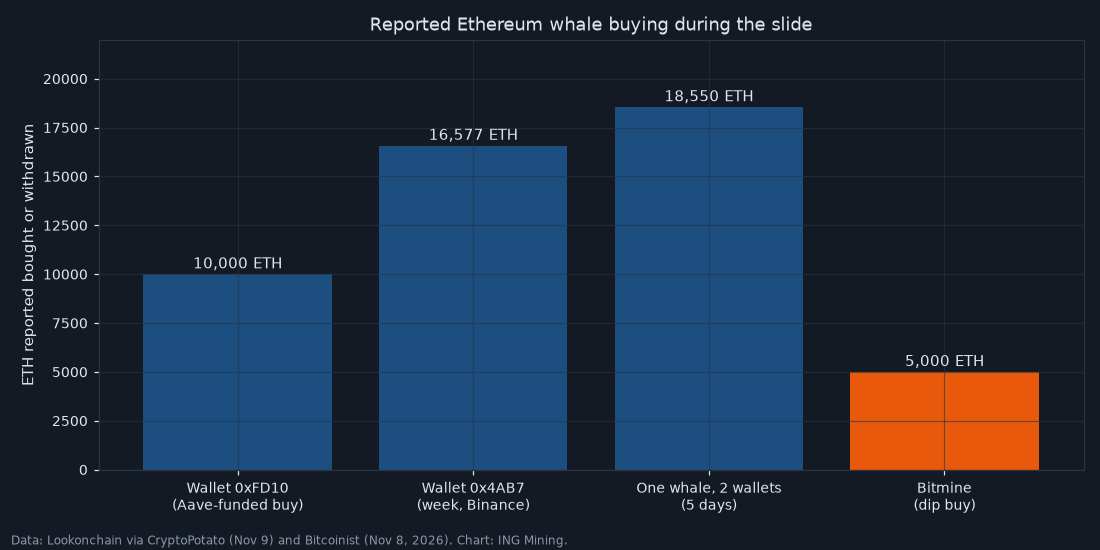
CryptoPotato cites Lookonchain. One wallet (0xFD10) borrowed 22 million USDT on Aave and spent 21.55 million USDT on 10,000 ETH, at an average of $2,155. That is a leveraged buy, and ETH now trades below that price.
Another wallet (0x4AB7) pulled 3,500 ETH, about $7.53 million, off Binance. Its Binance withdrawals this week total 16,577 ETH, about $37.5 million, per the same post.
Bitcoinist adds more, without naming a data source. It says one whale using two wallets withdrew 18,550 ETH in five days, and Bitmine added 5,000 ETH. We treat these as on-chain tracker claims, not settled fact.
How far did Ethereum fall while whales bought?
CryptoPotato’s headline says 15% in five days. Its text shows ETH down more than 5% in 24 hours. We could not rebuild the full 15% from the articles, so we do not state it as fact. Last week ETH rose to about $2,450 after the US midterms, was rejected, and held $2,200 until it broke below $2,100 on Monday.
The pain is real on the leverage side. Onchain Lens says one Hyperliquid trader lost $19.86 million on ETH longs across two accounts. CoinGlass shows a single ETH liquidation of $48.16 million on Binance. Whale buying is not a bottom signal. Buyers can be wrong, and $2,000 is the next level traders watch.
What it means for bitcoin miners
Blunt version: nothing direct. Ethereum is proof of stake, so your S19 earns bitcoin, not ETH. The link is risk appetite. We covered the $1 billion liquidation day that took bitcoin to a 77-day low. If ETH breaks $2,000, more bitcoin selling is a fair risk.
Miner math: bitcoin hashprice today
Here is the live maths on November 9. Bitcoin is $73,871 and the network is 968 EH/s, so hashprice is about $34.65 per petahash per day. That is what one PH/s of hashing earns before power.
| Machine | 5c/kWh | 8c/kWh | 12c/kWh | Break-even |
|---|---|---|---|---|
| Antminer S19 (95 TH/s, 3250 W) | -$0.61 | -$2.95 | -$6.07 | 4.2c |
| Antminer S19k Pro (115 TH/s, 2645 W) | $0.81 | -$1.09 | -$3.63 | 6.3c |
| Antminer S19 XP (141 TH/s, 3010 W) | $1.27 | -$0.89 | -$3.78 | 6.8c |
| Antminer S21 Pro (234 TH/s, 3510 W) | $3.90 | $1.37 | -$2.00 | 9.6c |
Numbers are profit per day after electricity, at the three power prices shown. Break-even is the most you can pay per kilowatt-hour before the machine loses money. Specs are the manufacturer ratings; network data comes from mempool.space. Try your own power price in our free bitcoin mining profit calculator. See what these machines really sold for in our used ASIC miner price index. Want to run the same numbers on a machine you can buy today? See our used ASIC miners, or buy several at once through bulk lots.
If the ETH slide drags bitcoin down 5%: the break-even power price on an S19k Pro falls from 6.3 to 6.0 cents per kilowatt-hour. At 8 cents, daily profit goes from -$1.09 to -$1.29.
Check the table before you trust any price call. If a machine already sits below break-even at your power price, a further drop only deepens the loss. See our bitcoin price prediction and the mining economics guides.
If your machines no longer pay, you can sell us your used miners. To buy, see all miners.
-Nick
ING Mining
This is general information, not financial advice. Crypto is volatile, and exchanges can fail. Please do your own research.
How this story was made: drafted with the help of AI tools from public sources, then edited by Nick Squires. See our editorial policy. Spot an error? Email ns@ingmining.com.