
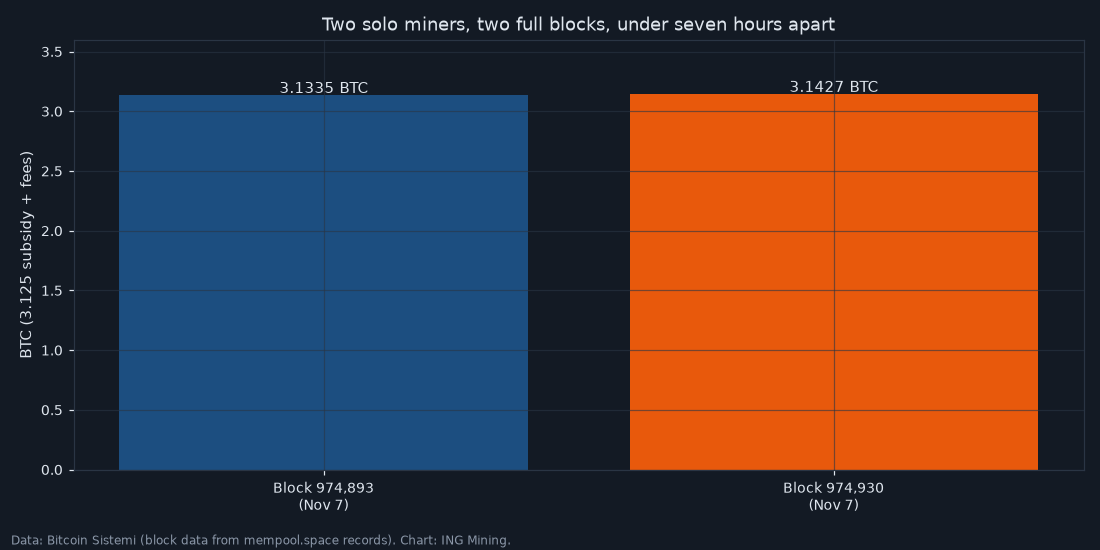
Two solo bitcoin miners each found a full block on November 7, and each block paid a little over 3.13 BTC. BeInCrypto puts each win above $230,000. Bitcoin Sistemi reports both came through the Solo CKPool service, less than seven hours apart. Here is what happened, how long the odds really are, and what it tells a small miner.
What the two solo bitcoin miners won
Bitcoin Sistemi lists block 974,893 with about 0.0085 BTC in fees, for a total near 3.1335 BTC. Block 974,930 came about six hours and fifty minutes later, with about 0.0177 BTC in fees and a total near 3.1427 BTC. The base reward is 3.125 BTC in both cases. Bitcoin Sistemi values the blocks at roughly $237,000 and $239,000, or about $476,000 together. It says the first report came from Bitcoin developer Mononaut.
The site says Solo CKPool charges a 2% fee. It gives no source for that figure, so treat it as unconfirmed. We also do not know who the miners are, what hardware they ran, or what they paid for power. Nobody has published that.
How long are the odds?
BeInCrypto calls it a beat of million-to-one odds. We can check the shape of that. The network runs near 983 EH/s, per mempool.space. A machine with a share of that hashrate wins a share of the roughly 144 blocks per day. A 200 TH/s miner holds 2.0e-07 of the network. Across 144 blocks a day, that is about one block every 94 years on average. That is our own arithmetic, not a figure from the reports. A smaller machine waits far longer.
So the wins are rare. They are also real, and solo mining is a lottery ticket that costs electricity. It pays nothing on most days. A pool pays a small amount every day instead.
Miner math: pool mining versus a solo lottery ticket
Here is the live maths on November 8. Bitcoin is $75,830 and the network is 983 EH/s, so hashprice is about $34.94 per petahash per day. That is what one PH/s of hashing earns before power.
| Machine | 5c/kWh | 8c/kWh | 12c/kWh | Break-even |
|---|---|---|---|---|
| Antminer S19 (95 TH/s, 3250 W) | -$0.58 | -$2.92 | -$6.04 | 4.3c |
| Antminer S19k Pro (115 TH/s, 2645 W) | $0.84 | -$1.06 | -$3.60 | 6.3c |
| Antminer S19 XP (141 TH/s, 3010 W) | $1.31 | -$0.85 | -$3.74 | 6.8c |
| Antminer S21 Pro (234 TH/s, 3510 W) | $3.96 | $1.44 | -$1.93 | 9.7c |
Numbers are profit per day after electricity, at the three power prices shown. Break-even is the most you can pay per kilowatt-hour before the machine loses money. Specs are the manufacturer ratings; network data comes from mempool.space. Try your own power price in our free bitcoin mining profit calculator. See what these machines really sold for in our used ASIC miner price index. Want to run the same numbers on a machine you can buy today? See our used ASIC miners, or buy several at once through bulk lots.
What we would do
We would not buy a miner for a lottery. If the goal is steady income, the table above is the honest answer, and it depends on your power price. If you want a lottery ticket and already own a small machine, solo mining costs you only the electricity you already pay. Keep the cost low and the expectations lower.
To see real numbers, read our mining economics guides. Then compare machines on all miners, or check bulk used ASIC miners for larger lots.
-Nick
ING Mining
This is general information, not financial advice. Crypto is volatile, and exchanges can fail. Please do your own research.
How this story was made: drafted with the help of AI tools from public sources, then edited by Nick Squires. See our editorial policy. Spot an error? Email ns@ingmining.com.