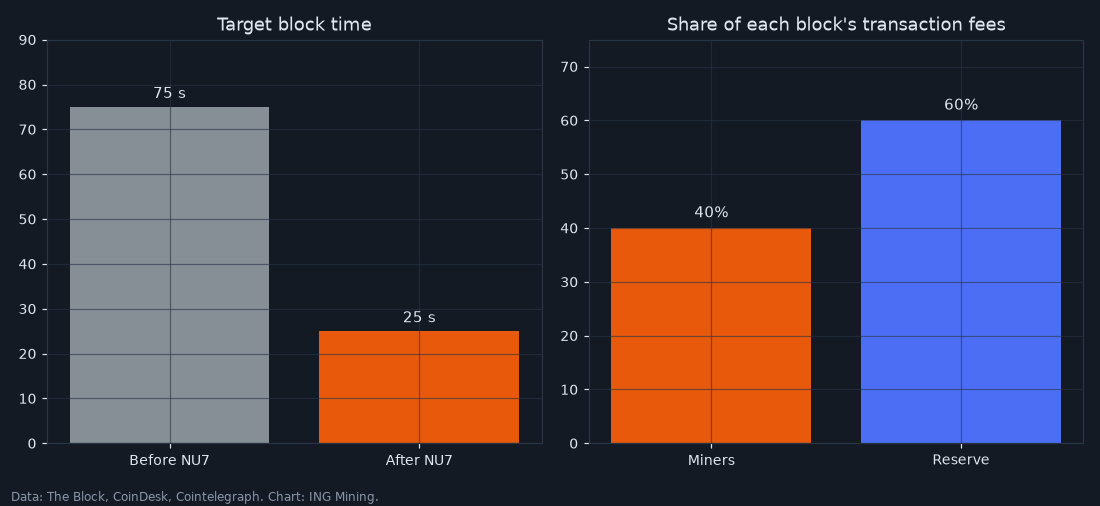
The Zcash NU7 upgrade went live on mainnet at block 3,543,405, cutting the target block time from 75 seconds to 25. The Block, CoinDesk and Cointelegraph agree on the block and the change. It also sends 60% of fees to a reserve. Here is what that means for people who mine.
What the Zcash NU7 upgrade changes
Per CoinDesk and Cointelegraph, the upgrade took effect at 02:34 UTC on Friday, November 6. The Block dates it November 5, which is the same moment in U.S. Eastern time. So blocks now arrive on a 25-second target instead of 75. However, Cointelegraph notes that real intervals drift toward the target as difficulty adjusts. In practice, CoinDesk measured about 39 seconds over the first 225 blocks.
The Block reports that the same factor shrinks each block subsidy, so new ZEC issuance stays essentially unchanged. The upgrade also triples the blocks between halvings. As a result, the halving schedule and the 21 million ZEC cap stay as they were.
Zcash NU7 upgrade: where the fee money goes
This is the part miners should read twice. The Block and CoinDesk both say miners now get 40% of each block’s transaction fees. The other 60% leaves circulation and goes into a public reserve. Cointelegraph and CoinDesk say that reserve starts feeding future block rewards around February 2031. The Block puts it at block 8,939,664. Decrypt, which also covered it, says only “2031.” Cointelegraph and Decrypt state the 60% but not the 40%.
So the plain read is that fee income per block falls for miners today. Still, no source puts a dollar figure on it, so we will not either.
The other numbers
Meanwhile, about 12,224 ZEC sits in the old Sprout pool and nobody can spend it. Cointelegraph prices that at about $15 million and Decrypt at about $16 million, because each used a different ZEC price. CoinDesk says no recovery plan is approved yet. Developers also tested a higher orphan rate at 25 seconds (3.43% against 1.57% at 75 seconds), per CoinDesk, and expect the live rate to stay under 1%, per Decrypt. Finally, The Block had ZEC down 5.17% on the day at $1,254.7 at 2:05 a.m. Friday.
Miner math: Bitcoin margins on the day Zcash changes its rules
Here is the live maths on November 6. Bitcoin is $75,923 and the network is 1043 EH/s, so hashprice is about $33.04 per petahash per day. That is what one PH/s of hashing earns before power.
| Machine | 5c/kWh | 8c/kWh | 12c/kWh | Break-even |
|---|---|---|---|---|
| Antminer S19 (95 TH/s, 3250 W) | -$0.76 | -$3.10 | -$6.22 | 4.0c |
| Antminer S19k Pro (115 TH/s, 2645 W) | $0.63 | -$1.28 | -$3.82 | 6.0c |
| Antminer S19 XP (141 TH/s, 3010 W) | $1.05 | -$1.12 | -$4.01 | 6.4c |
| Antminer S21 Pro (234 TH/s, 3510 W) | $3.52 | $0.99 | -$2.38 | 9.2c |
Numbers are profit per day after electricity, at the three power prices shown. Break-even is the most you can pay per kilowatt-hour before the machine loses money. Specs are the manufacturer ratings; network data comes from mempool.space. Try your own power price in our free bitcoin mining profit calculator. See what these machines really sold for in our used ASIC miner price index. Want to run the same numbers on a machine you can buy today? See our used ASIC miners, or buy several at once through bulk lots.
If the risk-off mood knocks bitcoin down another 10%: the break-even power price on an S19k Pro falls from 6.0 to 5.4 cents per kilowatt-hour. At 8 cents, daily profit goes from -$1.28 to -$1.66.
The blunt answer for miners
The table above covers bitcoin machines. Zcash uses a different algorithm and different hardware, so the Zcash NU7 upgrade does not touch an S19 or S21. However, it matters if you mine ZEC, or if you are weighing which coin to point hashrate at. Bitcoin hashrate sits near 1043 EH/s per mempool.space. At 8 cents most older bitcoin machines lose money today. If yours do, then see our we buy used miners page, or read the mining economics guides.
-Nick
ING Mining
This is general information, not financial advice. Crypto is volatile, and exchanges can fail. Please do your own research.
How this story was made: drafted with the help of AI tools from public sources, then edited by Nick Squires. See our editorial policy. Spot an error? Email ns@ingmining.com.