
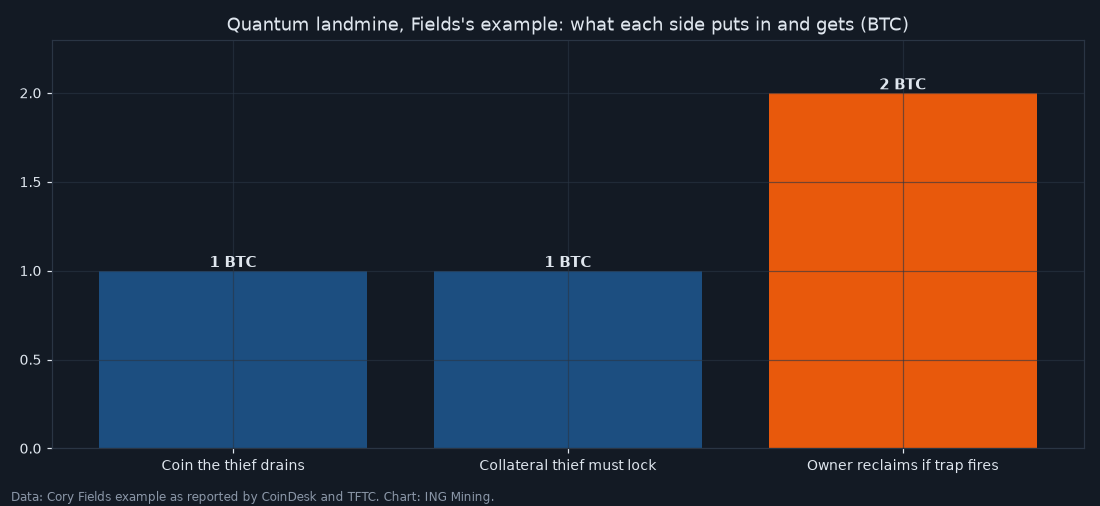
Quantum landmines for Bitcoin are a new idea from Bitcoin Core developer Cory Fields. Under his sketch, a thief who cracks an old wallet would have to put up as much BTC as he steals. If the owner had planted a hidden trap, the thief loses both. CoinDesk reported it on November 5.
How the quantum landmines work
Fields posted the idea to the bitcoin-dev mailing list on November 4. First, an owner creates a small quantum-safe output now, before quantum attacks are possible. That output secretly proves they own the coin. Later, a thief with a quantum computer drains the vulnerable coin. To do it, the thief must attach collateral from a quantum-safe wallet. In Fields’ example, stealing 1 BTC takes another 1 BTC.
Both coins then sit locked for a waiting period, such as 30 days. During that window the owner can reveal the hidden proof, take back the coin, and claim the thief’s collateral. As TFTC explains, the thief cannot tell which holdings are trapped before committing his own money.
What the quantum landmines proposal does not solve
Fields calls these ideas thought experiments. They assume quantum-safe wallets exist first, and the enforcement rules are not written. There is no BIP number. Moreover, the design only protects owners who still hold their keys, so coins believed lost, including those tied to Satoshi, get no cover. For those, Fields sketched a separate auction idea, but the details are thin.
There is a bigger catch. The chain cannot tell a thief from the true owner. An honest holder moving his own 1 BTC would also have to post 1 BTC of collateral. TFTC argues that, unless the rules fix this, the proposal is dead before deployment. That is TFTC’s verdict, not Fields’. Cryptobriefing, among others, also covered the proposal.
Nothing changes on the network today. Bitcoin trades near $75,640, and the quantum debate is still a mailing-list argument. Our bitcoin price prediction page tracks the price side.
Miner math: what this story does to your margin
Here is the live maths on November 6. Bitcoin is $75,640 and the network is 1037 EH/s, so hashprice is about $33.13 per petahash per day. That is what one PH/s of hashing earns before power.
| Machine | 5c/kWh | 8c/kWh | 12c/kWh | Break-even |
|---|---|---|---|---|
| Antminer S19 (95 TH/s, 3250 W) | -$0.75 | -$3.09 | -$6.21 | 4.0c |
| Antminer S19k Pro (115 TH/s, 2645 W) | $0.64 | -$1.27 | -$3.81 | 6.0c |
| Antminer S19 XP (141 TH/s, 3010 W) | $1.06 | -$1.11 | -$4.00 | 6.5c |
| Antminer S21 Pro (234 TH/s, 3510 W) | $3.54 | $1.01 | -$2.36 | 9.2c |
Numbers are profit per day after electricity, at the three power prices shown. Break-even is the most you can pay per kilowatt-hour before the machine loses money. Specs are the manufacturer ratings; network data comes from mempool.space. Try your own power price in our free bitcoin mining profit calculator. See what these machines really sold for in our used ASIC miner price index. Want to run the same numbers on a machine you can buy today? See our used ASIC miners, or buy several at once through bulk lots.
If quantum fear knocked 5% off the bitcoin price: the break-even power price on an S19k Pro falls from 6.0 to 5.7 cents per kilowatt-hour. At 8 cents, daily profit goes from -$1.27 to -$1.46.
The blunt answer for miners
This story does not touch your hashprice today. No code ships and no fork is scheduled. Therefore, the table above is the real news for your rigs. However, the direction matters. Quantum risk is a price risk, because a scare can move BTC faster than any soft fork can land. A 5% drop hurts more than any landmine helps. In short, we would not buy or sell machines on a mailing-list thought experiment. Read the margin against your own power price instead.
If the maths says a machine loses money for you, see our we buy used miners page. If you want to buy at today’s used prices, browse the miners in stock.
-Nick
ING Mining
This is general information, not financial advice. Crypto is volatile, and exchanges can fail. Please do your own research.
How this story was made: drafted with the help of AI tools from public sources, then edited by Nick Squires. See our editorial policy. Spot an error? Email ns@ingmining.com.