
BitGo now offers Stacks Bitcoin staking to eligible institutions, and the coins stay in qualified custody. The Defiant reported it on November 3. Clients earn bitcoin, not a new token, and the yield is paid by Stacks miners.
How Stacks Bitcoin staking works at BitGo
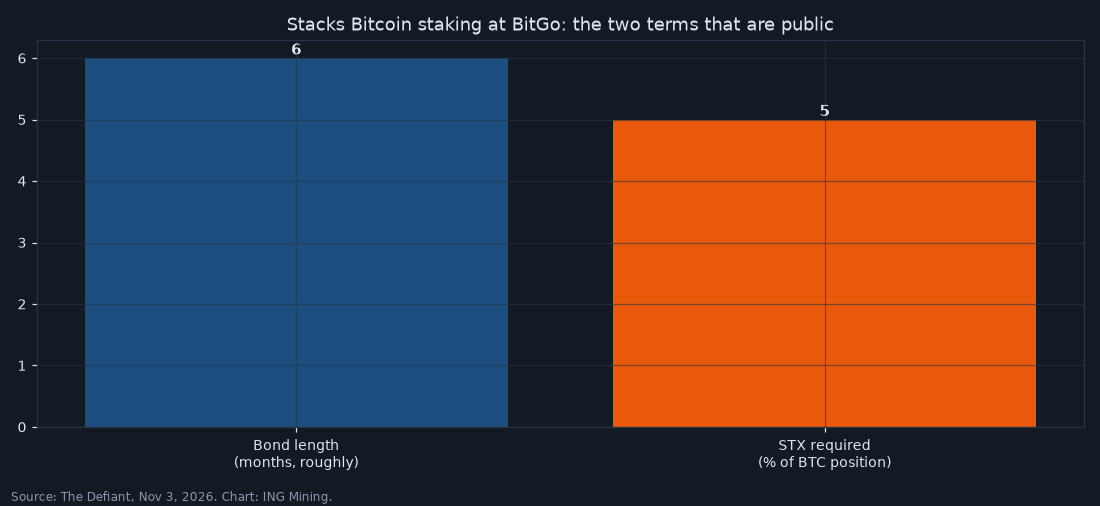
The Defiant says eligible institutions must pair their BTC with STX worth 5% of their Bitcoin position. It describes roughly six-month bonds funded by Stacks miners. A KuCoin news flash adds that rewards are paid weekly and that the BTC stays on the Bitcoin base layer. We could only confirm the first two points in The Defiant, so treat the weekly payout as a single-source claim.
Stacks miners spend bitcoin to compete for the right to write blocks. That spending is where the reward comes from. It is a different job from the bitcoin miners who run ASICs.
What we do not know about BitGo Stacks staking
The announcement lists no yield rate, no fees and no minimum, according to the KuCoin summary. The Defiant’s summary gave no figures either. So nobody can say yet what the return is. The STX pairing also matters. That token can move in price, so the position carries risk beyond bitcoin itself.
Why this matters to ASIC miners
It shows a new way for big holders to earn on bitcoin without selling it. For ASIC owners it is background. Your income is still the block subsidy and fees, and the yield here comes from a separate network. The bitcoin network runs near 1027 EH/s per mempool.space, and nothing in this news changes that.
Miner math: what your ASIC earns versus staking talk
Here is the live maths on November 3. Bitcoin is $77,539 and the network is 1027 EH/s, so hashprice is about $34.18 per petahash per day. That is what one PH/s of hashing earns before power.
| Machine | 5c/kWh | 8c/kWh | 12c/kWh | Break-even |
|---|---|---|---|---|
| Antminer S19 (95 TH/s, 3250 W) | -$0.65 | -$2.99 | -$6.11 | 4.2c |
| Antminer S19k Pro (115 TH/s, 2645 W) | $0.76 | -$1.15 | -$3.69 | 6.2c |
| Antminer S19 XP (141 TH/s, 3010 W) | $1.21 | -$0.96 | -$3.85 | 6.7c |
| Antminer S21 Pro (234 TH/s, 3510 W) | $3.79 | $1.26 | -$2.11 | 9.5c |
Numbers are profit per day after electricity, at the three power prices shown. Break-even is the most you can pay per kilowatt-hour before the machine loses money. Specs are the manufacturer ratings; network data comes from mempool.space. Try your own power price in our free bitcoin mining profit calculator. See what these machines really sold for in our used ASIC miner price index. Want to run the same numbers on a machine you can buy today? See our used ASIC miners, or buy several at once through bulk lots.
If institutional demand lifts bitcoin 5%: the break-even power price on an S19k Pro rises from 6.2 to 6.5 cents per kilowatt-hour. At 8 cents, daily profit goes from -$1.15 to -$0.95.
Compare any yield pitch with the table above. A used machine earns or loses money every day at your power rate. You can see the real resale numbers in our used ASIC miner price index, or browse every miner in stock.
-Nick
ING Mining
This is general information, not financial advice. Crypto is volatile, and exchanges can fail. Please do your own research.
How this story was made: drafted with the help of AI tools from public sources, then edited by Nick Squires. See our editorial policy. Spot an error? Email ns@ingmining.com.