
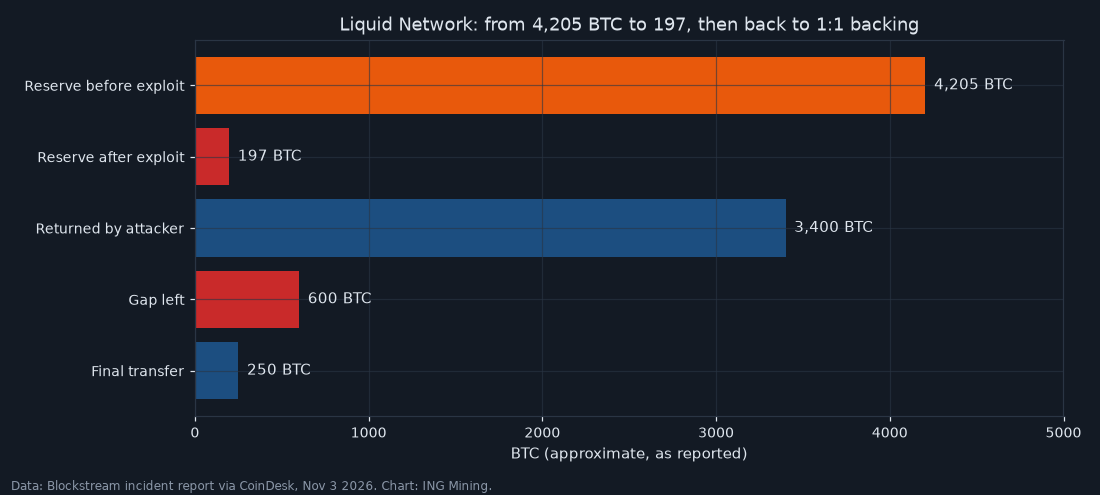
Liquid Network backing is whole again: the federation says its bitcoin reserves are fully restored, about two months after a $320 million exploit. The Liquid Federation announced on November 3 that every LBTC is again backed 1:1 by real bitcoin, per CoinDesk.
How the Liquid Network backing broke and came back
On September 6, a software bug in Elements, the code Liquid runs on, let an attacker create about 4,000 LBTC with no bitcoin behind it. Then the attacker cashed those out for real bitcoin through peg-outs. According to Blockstream’s incident report, the reserve fell from about 4,205 BTC to 197 BTC.
The attacker, who claimed to be a white hat, sent back 3,400 BTC the next day. That left roughly 600 BTC missing. A final 250 BTC transfer closed the books, and Decrypt reports the same timeline. Neither outlet says where the rest of the shortfall came from. The federation has not disclosed it, so we will not guess.
Liquid Network backing: what is still restricted
Users have been able to swap BTC and LBTC 1:1 through providers such as SideSwap since late October. Direct withdrawals from the federation still run under what it calls “enhanced operational controls.” However, it promised governance changes “in the coming weeks.” Until those arrive, treat the restoration as the federation’s statement, not an audit you can check yourself.
Related: why bitcoin fell below $77,000. Our daily view is on the bitcoin price prediction page.
Miner math: what the Liquid exploit means for your margin
Here is the live maths on November 3. Bitcoin is $76,999 and the network is 1026 EH/s, so hashprice is about $33.98 per petahash per day. That is what one PH/s of hashing earns before power.
| Machine | 5c/kWh | 8c/kWh | 12c/kWh | Break-even |
|---|---|---|---|---|
| Antminer S19 (95 TH/s, 3250 W) | -$0.67 | -$3.01 | -$6.13 | 4.1c |
| Antminer S19k Pro (115 TH/s, 2645 W) | $0.73 | -$1.17 | -$3.71 | 6.2c |
| Antminer S19 XP (141 TH/s, 3010 W) | $1.18 | -$0.99 | -$3.88 | 6.6c |
| Antminer S21 Pro (234 TH/s, 3510 W) | $3.74 | $1.21 | -$2.16 | 9.4c |
Numbers are profit per day after electricity, at the three power prices shown. Break-even is the most you can pay per kilowatt-hour before the machine loses money. Specs are the manufacturer ratings; network data comes from mempool.space. Try your own power price in our free bitcoin mining profit calculator. See what these machines really sold for in our used ASIC miner price index. Want to run the same numbers on a machine you can buy today? See our used ASIC miners, or buy several at once through bulk lots.
If the Liquid news nudges bitcoin down 1%: the break-even power price on an S19k Pro falls from 6.2 to 6.1 cents per kilowatt-hour. At 8 cents, daily profit goes from -$1.17 to -$1.21.
The blunt answer for miners
This does not change your margin. About 4,000 BTC moved inside a sidechain, and the network’s hashrate, difficulty and block rewards were untouched. Hashrate sits near 1026 EH/s per mempool.space. Also, the scenario above is a small price wobble, not a prediction. Your numbers are bitcoin price, hashrate and your power price.
The lesson is about custody. Bitcoin held on a federated sidechain depends on a group of signers and on the code, and in September the code failed. If you keep mining proceeds there, ask whether you need to. Check the table against your own power price. If you are under water, see our we buy used miners page or the mining economics guides.
-Nick
ING Mining
This is general information, not financial advice. Crypto is volatile, and exchanges can fail. Please do your own research.