
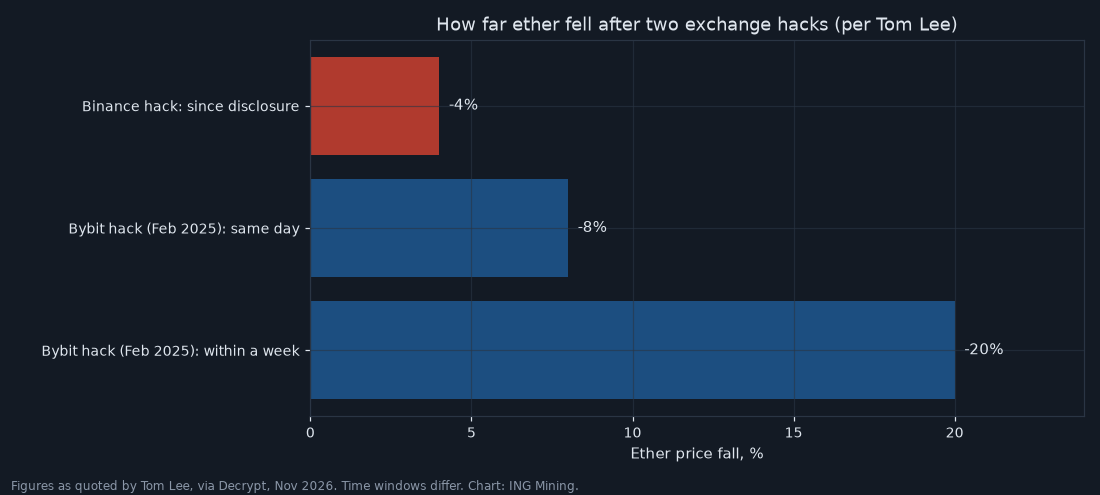
Tom Lee says the Binance hack is bullish for Ethereum. The Bitmine chairman called the theft “a terrible development”, but said the market’s reaction was “very constructive”, according to Decrypt. Ether is down about 4% since the theft was disclosed.
What Tom Lee said about Ethereum and the Binance hack
Lee compared the move with the Bybit hack of February 2025. After that $1.5 billion theft, ether fell 8% on the day and about 20% within a week. This time it fell 4%. In his view, Tom Lee Ethereum optimism is justified. He gave six reasons the damage stayed small:
- Binance can cover customer losses.
- No cascade of DeFi failures followed.
- The industry acted fast and roughly halved the potential loss.
- The FBI named North Korea within two days.
- It was a breach of corporate infrastructure, not a flaw in a blockchain.
- The small drop itself, which he reads as a sign of a bull market.
The Binance theft is put at about $6.3 billion by most outlets. Decrypt says $6.4 billion. The numbers differ, so treat both as approximate.
Is the Bybit comparison fair?
Not quite. CryptoSlate points out that the 20% Bybit figure covers a full week, while the 4% Binance figure covers a shorter window. So the two are not like for like. In addition, Lee runs the biggest Ethereum treasury, so he has every reason to sound upbeat. However, we would read his six points as an argument, not as proof.
Why the Tom Lee Ethereum view matters: Bitmine keeps buying
Meanwhile, Bitmine bought another 8,573 ETH, worth about $19 million, as of November 1. Its total is 6,060,506 ETH, about 4.9% of the 122.2 million supply. The company says it is 99% of the way to its 5% target. It has bought every week since June 30, 2025. Unchained notes the buy is slower than recent weeks. We covered the fund-flow side in Ether ETF outflows and the Bitmine 5% cap.
Miner math: what the Ethereum hack story does to your margin
Here is the live maths on November 3. Bitcoin is $76,720 and the network is 1037 EH/s, so hashprice is about $33.50 per petahash per day. That is what one PH/s of hashing earns before power.
| Machine | 5c/kWh | 8c/kWh | 12c/kWh | Break-even |
|---|---|---|---|---|
| Antminer S19 (95 TH/s, 3250 W) | -$0.72 | -$3.06 | -$6.18 | 4.1c |
| Antminer S19k Pro (115 TH/s, 2645 W) | $0.68 | -$1.23 | -$3.77 | 6.1c |
| Antminer S19 XP (141 TH/s, 3010 W) | $1.11 | -$1.06 | -$3.95 | 6.5c |
| Antminer S21 Pro (234 TH/s, 3510 W) | $3.63 | $1.10 | -$2.27 | 9.3c |
Numbers are profit per day after electricity, at the three power prices shown. Break-even is the most you can pay per kilowatt-hour before the machine loses money. Specs are the manufacturer ratings; network data comes from mempool.space. Try your own power price in our free bitcoin mining profit calculator. See what these machines really sold for in our used ASIC miner price index. Want to run the same numbers on a machine you can buy today? See our used ASIC miners, or buy several at once through bulk lots.
If bitcoin also slipped 4% on hack fear: the break-even power price on an S19k Pro falls from 6.1 to 5.8 cents per kilowatt-hour. At 8 cents, daily profit goes from -$1.23 to -$1.38.
The blunt answer for miners
Directly, nothing changes. Bitmine buys ether, and ether is not mined with an ASIC. Your hashprice depends on bitcoin’s price and network hashrate, which sits near 1037 EH/s per mempool.space. The only link is mood. A hack that rattles one exchange can push all coins down for a day or two.
So check the table against your own power price. If your machine loses money at 8 cents today, a calm hack story will not save it. See our we buy used miners page or the mining economics guides.
-Nick
ING Mining
This is general information, not financial advice. Crypto is volatile, and exchanges can fail. Please do your own research.