
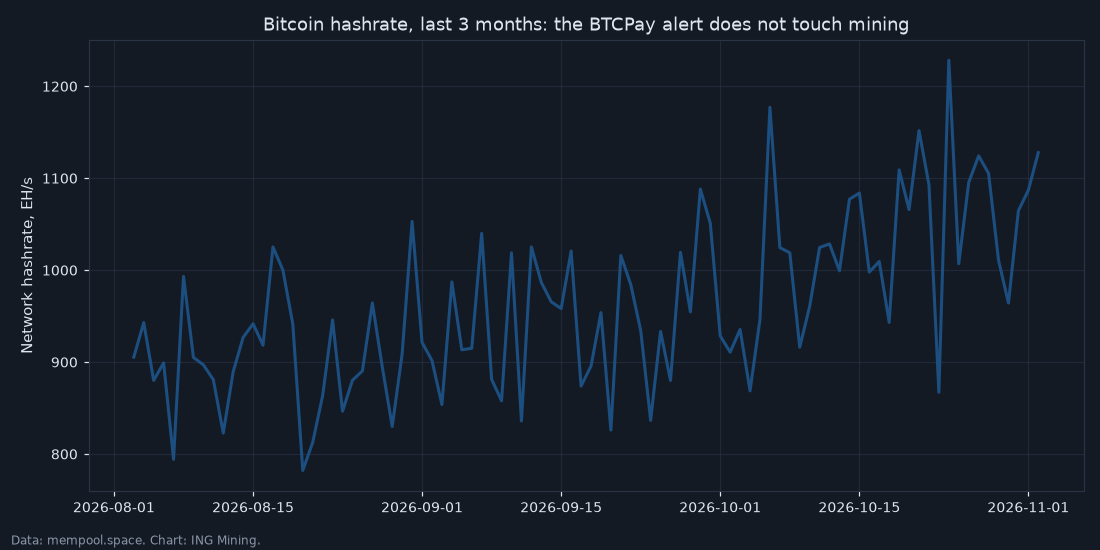
BTCPay Server has told its users to switch their servers off. The free tool, which merchants use to take bitcoin payments, received reports that attackers were draining hot wallets. The warning went out on Sunday, November 1. Here is what is known, what is not, and what it means for miners at $78,198 bitcoin.
What the BTCPay Server alert says
According to CoinDesk, the project asked operators to shut down their instances until the investigation is finished. The stop command is ./btcpay-down.sh. BTCPay cannot switch servers off from its side, because every merchant runs their own. Crypto.news and several other outlets report the same core facts.
What is still unknown about the BTCPay Server attacks
Quite a lot. BTCPay has given no loss figure and no count of hit servers. No fix has been announced. The attacker apparently had administrator access on the affected servers, but how they got it is not confirmed.
Reports also disagree on versions. Founder Nicolas Dorier said the cases appear to involve releases older than 2.4.2, per CoinDesk. Another outlet says 2.4.1 and older. BTCPay says its own public servers, running 2.4.7, were not attacked. Do not read that as proof that newer versions are safe, because that is not established yet.
Why a hot wallet is the weak spot
A hot wallet keeps its keys on an internet-connected server so it can sign payments automatically. If someone gets in as administrator, they can send the coins out. This is separate from the August 2026 flaw, which exposed Lightning credentials and was fixed in 2.4.2, per CoinDesk. It is also separate from the Binance hack.
What it means for miners
Most miners do not run a BTCPay Server. If you do, for example to take payment for hosting or hardware, stop the server now and move any balance to cold storage. Wait for BTCPay’s all-clear before you restart.
For everyone else, the lesson is simple: keep only small balances on any server-side wallet. Pay your pool out to a wallet you control. Our Binance Pool guide shows how.
The mining side is untouched. Hashrate is steady, so difficulty is not the problem today. The question is whether another security scare moves the price. We would not bet on it, but a second hack in one week is not good for sentiment.
Miner Math: your margin while the BTCPay alert plays out
Here is the live maths on November 2. Bitcoin is $78,177 and the network is 1045 EH/s, so hashprice is about $33.84 per petahash per day. That is what one PH/s of hashing earns before power.
| Machine | 5c/kWh | 8c/kWh | 12c/kWh | Break-even |
|---|---|---|---|---|
| Antminer S19 (95 TH/s, 3250 W) | -$0.69 | -$3.03 | -$6.15 | 4.1c |
| Antminer S19k Pro (115 TH/s, 2645 W) | $0.72 | -$1.19 | -$3.73 | 6.1c |
| Antminer S19 XP (141 TH/s, 3010 W) | $1.16 | -$1.01 | -$3.90 | 6.6c |
| Antminer S21 Pro (234 TH/s, 3510 W) | $3.71 | $1.18 | -$2.19 | 9.4c |
Numbers are profit per day after electricity, at the three power prices shown. Break-even is the most you can pay per kilowatt-hour before the machine loses money. Specs are the manufacturer ratings; network data comes from mempool.space. Try your own power price in our free bitcoin mining profit calculator. See what these machines really sold for in our used ASIC miner price index. Want to run the same numbers on a machine you can buy today? See our used ASIC miners, or buy several at once through bulk lots.
If the security scares knock bitcoin down 5%: the break-even power price on an S19k Pro falls from 6.1 to 5.8 cents per kilowatt-hour. At 8 cents, daily profit goes from -$1.19 to -$1.38.
What we think
This is a payment-tool problem, not a mining problem. Check your own break-even before you buy any machine. See our miners in stock and the daily Bitcoin price prediction.
-Nick
ING Mining
This is general information, not financial advice. Crypto is volatile, and you can lose money. Please do your own research.